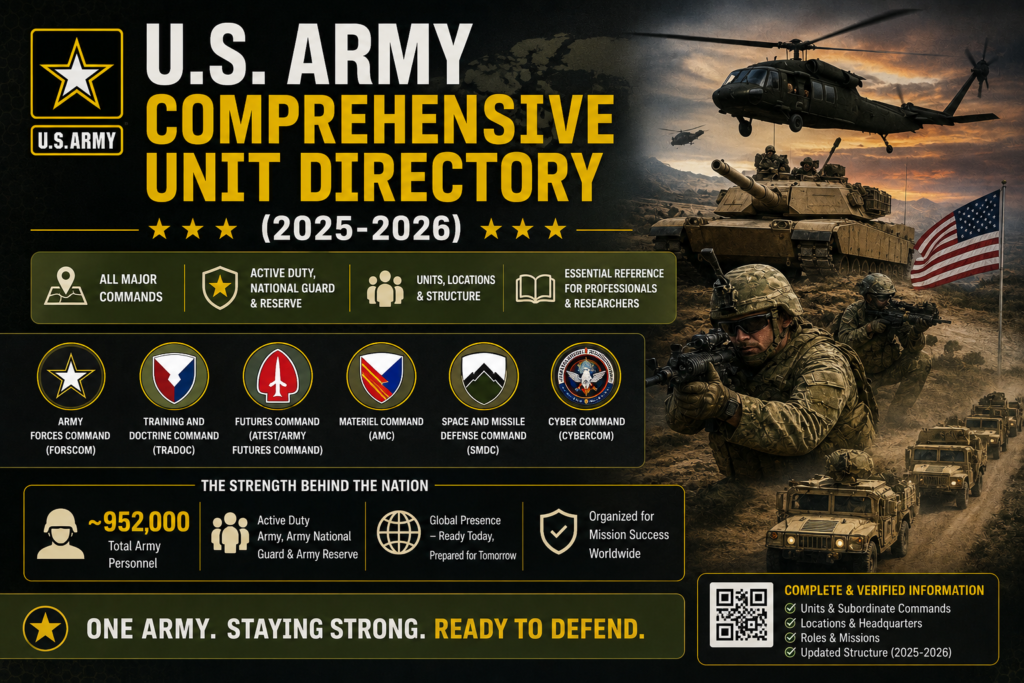
U.S. ARMY COMPREHENSIVE UNIT DIRECTORY (2025-2026)
Global U.S. Army Personnel Summary (
Estimated 2025/2026)
Active Duty: ~452,000
Army National Guard: ~325,000
Army Reserve: ~175,000
Total Force: ~952,000
Comprehensive directory of U.S. Army commands, corps, divisions, brigades, and supporting military organizations.
1. PERSONNEL BREAKDOWN
Component
Estimated Personnel
Percentage of Total Force
Active Duty
~452,000
47.5%
Army National Guard
~325,000
34.1%
Army Reserve
~175,000
18.4%
TOTAL FORCE
~952,000
100%
2. INTELLIGENCE ASSESSMENT
Factor
Assessment
Implication
Active Duty Force
Provides immediate global response capability within 18-96 hours
Enables rapid crisis response and forward deterrence
National Guard
Dual state-federal mission; supports homeland security and state emergency operations
Critical for domestic disasters and overseas deployments
Army Reserve
Provides combat support and sustainment during major conflicts
Force multiplier for extended operations
Force Structure
Indicates continued emphasis on Indo-Pacific and European deterrence
Reflects National Defense Strategy priorities
Recruitment
Challenges have influenced recent end-strength planning while modernization remains a priority
Driving innovation in talent management and retention
3. MAJOR ARMY COMMANDS (MACOMs)
Unit Name
Location
MAO (Major Area of Operations)
Size
Under
Mission/Focus
FORSCOM
Fort Liberty, NC
Global
Commands ~250,000+
HQDA
Training & mobilization of all combat forces
TRADOC
Fort Eustis, VA
CONUS
~30,000
HQDA
Recruiting, training, doctrine development
AMC
Redstone Arsenal, AL
Global
~60,000
HQDA
Logistics, equipment acquisition & sustainment
AFC
Austin, TX
Global
~18,000
HQDA
Modernization, future tech, R&D
MEDCOM
JBSA Fort Sam Houston, TX
Global
~45,000
HQDA
Army-wide healthcare & medical training
INSCOM
Fort Belvoir, VA
Global
~10,500
HQDA
Military intelligence & counterintelligence
USASOC
Fort Liberty, NC
Global
~35,000
USSOCOM
Army special operations forces
4. ARMY CORPS
Unit Name
Location
MAO
Size
Under
Mission/Focus
I Corps
Joint Base Lewis-McChord, WA
Indo-Pacific
20,000-45,000
FORSCOM/USARPAC
Pacific theater operations
III Armored Corps
Fort Cavazos, TX
Global
20,000-45,000
FORSCOM
Heavy armor & mechanized operations
V Corps
Fort Knox, KY (Fwd: Poznań, Poland)
Europe
20,000-45,000
FORSCOM/USAREUR-AF
European deterrence & NATO operations
XVIII Airborne Corps
Fort Liberty, NC
Global
20,000-45,000
FORSCOM
Rapid deployment contingency force
5. ACTIVE DUTY DIVISIONS
Unit Name
Location
Current Deployment
Size
Under
Type
1st Armored Division
Fort Bliss, TX
Rotational: Europe
~14,000
III Corps
Armored (ABCT)
1st Cavalry Division
Fort Cavazos, TX
CONUS-based
~16,000
III Corps
Armored (ABCT)
1st Infantry Division
Fort Riley, KS
Rotational: Europe
~12,000
III Corps
Armored (ABCT)
2nd Infantry Division
Camp Humphreys, South Korea
South Korea (Permanent)
~10,000
USARPAC/Eighth Army
Stryker/Armor
3rd Infantry Division
Fort Stewart, GA
Rotational: Middle East
~14,000
XVIII Airborne Corps
Armored (ABCT)
4th Infantry Division
Fort Carson, CO
CONUS-based
~15,000
III Corps
Stryker (SBCT)
10th Mountain Division
Fort Drum, NY
Rotational: Europe, Africa
~12,000
XVIII Airborne Corps
Light Infantry (IBCT)
25th Infantry Division
Schofield Barracks, HI / JBER, AK
Indo-Pacific
~12,000
USARPAC/I Corps
Light/Stryker
82nd Airborne Division
Fort Liberty, NC
Global Response Force
~14,000
XVIII Airborne Corps
Airborne (IBCT)
101st Airborne Division
Fort Campbell, KY
Rotational: Europe, Middle East
~15,000
XVIII Airborne Corps
Air Assault
11th Airborne Division
JBER, Alaska
Arctic/Indo-Pacific
~11,000
USARPAC/I Corps
Airborne/Arctic
6. SEPARATE BRIGADES & REGIMENTS
Unit Name
Location
MAO
Size
Under
Type
173rd Airborne Brigade
Vicenza, Italy
Europe/Africa
~3,300
USAREUR-AF
Airborne IBCT
2nd Cavalry Regiment
Vilseck, Germany
Eastern Europe
~4,500
USAREUR-AF
Stryker Brigade
3rd Armored Cavalry Regiment
Fort Cavazos, TX
CONUS
~4,500
III Corps
Heavy Recon
11th Armored Cavalry Regiment
Fort Irwin, CA
CONUS (NTC OPFOR)
~3,500
FORSCOM
OPFOR Training
75th Ranger Regiment
Fort Moore, GA
Global
~3,500
USASOC
Special Operations
Security Force Assistance Command
Fort Liberty, NC
Global
~10,000+
FORSCOM
Foreign Training
7. ARMY NATIONAL GUARD DIVISIONS
Unit Name
Primary Location
Size
Under
Type
28th Infantry Division
Pennsylvania
~14,000
PA ARNG/FORSCOM
Mechanized
29th Infantry Division
Virginia
~12,000
VA ARNG/FORSCOM
Light/Mechanized
34th Infantry Division
Minnesota
~13,000
MN ARNG/FORSCOM
Light Infantry
35th Infantry Division
Kansas
~11,000
KS ARNG/FORSCOM
Mechanized
36th Infantry Division
Texas
~18,000
TX ARNG/FORSCOM
Mechanized/Armor
38th Infantry Division
Indiana
~13,000
IN ARNG/FORSCOM
Mechanized
40th Infantry Division
California
~13,000
CA ARNG/USARPAC
Mechanized/Aviation
42nd Infantry Division
New York
~15,000
NY ARNG/FORSCOM
Mechanized
8. SPECIAL OPERATIONS UNITS
Unit Name
Location
Size
Under
Mission
1st Special Forces Command
Fort Liberty, NC
~12,000
USASOC
Unconventional Warfare
1st Special Forces Group
JBLM, WA
~1,500
1st SFC
Indo-Pacific
3rd Special Forces Group
Fort Liberty, NC
~1,500
1st SFC
Africa
5th Special Forces Group
Fort Campbell, KY
~1,500
1st SFC
Middle East/CENTCOM
7th Special Forces Group
Eglin AFB, FL
~1,500
1st SFC
Latin America
10th Special Forces Group
Fort Carson, CO
~1,500
1st SFC
Europe
75th Ranger Regiment
Fort Moore, GA
~3,500
USASOC
Direct Action
160th SOAR
Fort Campbell, KY
~2,800
USASOC
Special Operations Aviation
4th Psychological Operations Group
Fort Liberty, NC
~1,200
1st SFC
Information Operations
9. OPERATIONAL CAPABILITIES MATRIX
Capability
Primary Units
Readiness Level
Strategic Importance
Rapid Deployment
82nd Airborne, XVIII Airborne Corps
18-96 hours
Critical
Combined Arms Operations
All ABCTs, SBCTs, IBCTs
High
Core Competency
Airborne Forces
82nd ABN, 173rd ABN, 11th ABN
High
Strategic Entry
Armored Warfare
1st AD, 1st CAV, 1st ID, 3rd ID
High
European Deterrence
Special Operations
75th Rangers, SF Groups, MARSOC
Very High
Global Reach
Long-Range Precision Fires
Field Artillery Brigades
High
Multi-Domain Ops
Air & Missile Defense
ADA Brigades
High
Homeland/Forward Defense
Logistics & Sustainment
Sustainment Commands, Army Reserve
High
Force Projection
Cyber Operations
Army Cyber Command, INSCOM
Very High
Emerging Domain
Space-enabled Operations
Space Support Elements
High
Multi-Domain Integration
10. GLOBAL DEPLOYMENT SUMMARY
Region
Major Units Deployed
Primary Bases
Mission Focus
Europe
V Corps (Fwd), 2nd Cav Regt, 173rd ABN
Poland, Germany, Italy, Romania
NATO Deterrence vs Russia
Indo-Pacific
2nd ID, 11th ABN Div, 25th ID
South Korea, Japan, Alaska, Hawaii
Deterrence vs China/North Korea
Middle East
ARCENT, Rotational BCTs
Kuwait, Qatar, Iraq, Syria
Counter-ISIS, Iran Deterrence
Africa
Rotational IBCTs, SF Teams
Djibouti, Niger, Cameroon
Counter-terrorism, Partner Training
CONUS
All Major Commands
100+ installations
Training, Readiness, Homeland Defense
11. STRATEGIC PRIORITIES (2025-2026)
Priority
Focus Area
Investment Level
Timeline
Indo-Pacific Deterrence
Forward presence, MLR development
Very High
2025-2030
NATO Readiness
V Corps Forward, rotational forces
Very High
Ongoing
Multi-Domain Operations
Integration of land, air, sea, space, cyber
High
2025-2028
AI Integration
Autonomous systems, decision support
High
2025-2035
Long-Range Precision Fires
LRPF, hypersonics, extended range artillery
Very High
2025-2030
Drone & Counter-UAS
Unmanned systems, air defense
High
2025-2027
Cyber Warfare
Defensive/offensive cyber capabilities
Very High
Ongoing
Electronic Warfare
Spectrum dominance, jamming
High
2025-2028
Force Modernization
Next-gen vehicles, networks, soldiers
Very High
2025-2035
12. ORGANIZATIONAL STRUCTURE
UNITED STATES ARMY │ ├── HEADQUARTERS, DEPARTMENT OF THE ARMY (HQDA) │ │ │ ├── MAJOR COMMANDS (MACOMs) │ │ ├── FORSCOM (Forces Command) │ │ ├── TRADOC (Training & Doctrine Command) │ │ ├── AMC (Materiel Command) │ │ ├── AFC (Futures Command) │ │ ├── MEDCOM (Medical Command) │ │ ├── INSCOM (Intelligence & Security Command) │ │ └── USASOC (Special Operations Command) │ │ │ ├── CORPS │ │ ├── I Corps (Pacific) │ │ ├── III Armored Corps │ │ ├── V Corps (Europe) │ │ └── XVIII Airborne Corps │ │ │ ├── ACTIVE COMPONENT │ │ ├── 11 Combat Divisions │ │ ├── Separate Brigades & Regiments │ │ └── Functional Brigades (ADA, Engineer, Aviation, etc.) │ │ │ ├── ARMY NATIONAL GUARD │ │ ├── 8 Combat Divisions │ │ ├── Separate Brigades │ │ └── State-Based Units (54 total) │ │ │ └── ARMY RESERVE │ ├── Sustainment Commands │ ├── Training Commands │ └── Functional Support Units
13. KEY EQUIPMENT INVENTORY
Platform
Quantity (Approx.)
Primary Users
Status
M1A2 Abrams SEPv3
~2,500
Armored BCTs
Active/Modernizing
Bradley Fighting Vehicle
~6,000
Armored/Stryker BCTs
Active/Replacing
Stryker
~4,500
Stryker BCTs
Active
AH-64 Apache
~800
Combat Aviation Brigades
Active/Modernizing
UH-60 Black Hawk
~2,100
All Aviation Units
Active
CH-47 Chinook
~500
Heavy Lift Aviation
Active
HIMARS
~500
Field Artillery Brigades
Active/Expanding
Patriot Air Defense
~80 Batteries
ADA Brigades
Active
M777 Howitzer
~1,000
Field Artillery
Active
Javelin ATGM
~40,000 missiles
Infantry Units
Active
MQ-1C Gray Eagle
~300
Aviation Brigades
Active
14. RISK ASSESSMENT
Factor
Assessment
Trend
Mitigation Strategy
Readiness
HIGH
Stable
Continued training investments, rotational deployments
Personnel Growth
MODERATE
Improving
Enhanced recruiting incentives, retention bonuses
Modernization
HIGH
Accelerating
AFC priorities, LRFP, NGCV programs
Global Presence
EXTENSIVE
Stable
Forward deployments in Europe, Indo-Pacific, Middle East
Recruitment Risk
MEDIUM
Improving
Digital outreach, education benefits, targeted marketing
Strategic Flexibility
VERY HIGH
Strong
Multi-domain capabilities, reserve integration
Equipment Aging
MEDIUM-HIGH
Concern
Modernization programs, service life extensions
Budget Sustainability
MEDIUM
Uncertain
Competing priorities, modernization vs readiness
Great Power Competition
HIGH THREAT
Escalating
Focus on China (Indo-Pacific), Russia (Europe)
15. INTELLIGENCE SUMMARY
Overall Force Assessment: The U.S. Army maintains a high state of readiness with approximately 952,000 total personnel distributed across active, guard, and reserve components. The force is optimized for multi-domain operations with strategic emphasis on:
Indo-Pacific Deterrence (Primary Focus)
European NATO Defense (Secondary Focus)
Middle East Stability Operations (Tertiary Focus)
Key Strengths:
Global rapid deployment capability (18-96 hours)
Integrated active-reserve component structure
Advanced technological modernization programs
Extensive global basing and prepositioned equipment
Key Challenges:
Recruitment and retention in a competitive labour market
Balancing modernisation with current readiness
Equipment ageing and replacement timelines
Sustaining global presence with finite resources
Strategic Outlook (2025-2026): The Army is successfully transitioning to a Multi-Domain Operations force structure while maintaining global readiness. Recruitment improvements in FY2025 indicate renewed appeal of military service. Modernisation priorities (long-range fires, air defense, aviation, networks, and soldier lethality) remain on track despite budget constraints.