
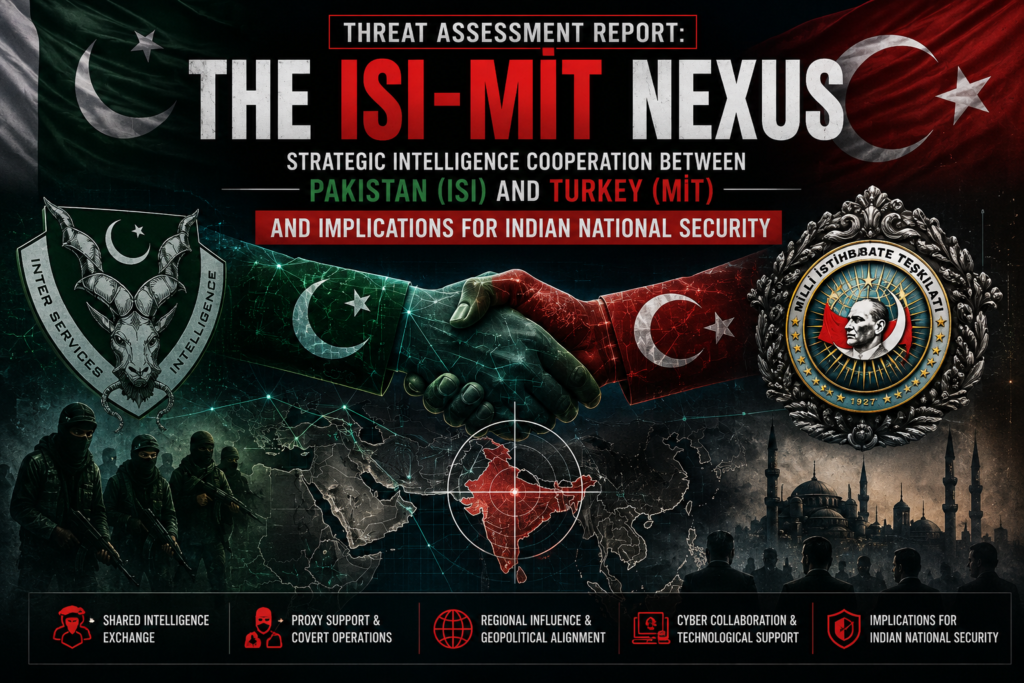
THREAT ASSESSMENT REPORT: THE ISI-MİT NEXUS
Strategic Intelligence Cooperation Between Pakistan (ISI) and Turkey (MİT) and Implications for Indian National Security
1. EXECUTIVE SUMMARY
This report assesses the deepening strategic, operational, and technological integration between Pakistan’s Inter-Services Intelligence (ISI) and Turkey’s National Intelligence Organization (MİT). This alliance, often termed the ISI-MİT Nexus, represents a compound and evolving national security threat to the Republic of India. By combining the ISI’s extensive human intelligence (HUMINT) and proxy warfare networks with MİT’s advanced technical intelligence (TECHINT), cyber capabilities, and drone warfare expertise, the axis seeks to challenge Indian military dominance in South Asia, internationalize the Kashmir dispute, and conduct direct espionage on Indian soil.
2. ORGANIZATIONAL PROFILES & COMPLEMENTARY CAPABILITIES
Inter-Services Intelligence (ISI) – Pakistan
- Core Strength: Human Intelligence (HUMINT), proxy warfare, and asymmetric operations.
- Key Directorate: Joint Intelligence North (JIN), which is exclusively dedicated to managing the insurgency and intelligence operations in Jammu & Kashmir.
- Operational Style: Relies on deep-cover agents, militant proxies, and diaspora networks to maintain plausible deniability.
Milli İstihbarat Teşkilatı (MİT) – Turkey
- Core Strength: Technical Intelligence (TECHINT), Signals Intelligence (SIGINT), Cyber Operations, and Unmanned Aerial Vehicle (UAV) warfare.
- Key Directorate: Cyber Intelligence Directorate and Technical Intelligence Division.
- Operational Style: Highly aggressive, utilizing diplomatic cover, advanced surveillance tech, and global clandestine outposts. Under the current leadership, MİT has shifted from a passive defensive posture to an active, expeditionary intelligence force.
3. MODUS OPERANDI: HOW THE NEXUS OPERATES
The ISI and MİT do not merely share information; they have integrated their operational workflows to create a multi-domain threat matrix against India:
- Intelligence Fusion: ISI provides granular, ground-level HUMINT from the Line of Control (LoC) and within Kashmir. MİT processes this data using advanced SIGINT and satellite imagery, providing the Pakistani military with a real-time, fused intelligence picture of Indian troop movements.
- Diplomatic & Consular Cover: The establishment of the Turkish Consulate in Srinagar is viewed by Indian security establishments as a joint intelligence outpost. It allows MİT officers operating under diplomatic immunity to coordinate directly with ISI assets in a highly sensitive, militarized zone.
- Third-Country Operations: ISI utilizes Turkey as a safe haven and logistical hub for its “Third Country Technique,” moving assets, funds, and operatives through Turkish networks to bypass direct border security.
- Information & Cyber Warfare: MİT’s cyber directorate collaborates with Pakistani cyber units to launch coordinated disinformation campaigns, aiming to radicalize populations, incite unrest in Kashmir, and damage India’s global diplomatic standing.
4. FINANCIAL AND LOGISTICAL CONDUITS
While direct cash transfers between intelligence agencies are highly classified, the financial and logistical support flows through state-level defense and intelligence budgets:
- State Budget Allocations: MİT’s budget has surged exponentially (reportedly a 125% increase recently), funded directly by the Turkish Presidency. ISI is funded through Pakistan’s massive defense budget, which operates with minimal civilian oversight.
- Defense Offsets and Tech Transfers: The primary financial conduit is the defense industry. Pakistan’s procurement of Turkish military hardware (e.g., Bayraktar TB2 drones, MILGEM corvettes, ATAK helicopters) involves billions of dollars. These contracts include “offset clauses” that fund joint intelligence infrastructure, SIGINT sharing platforms, and training facilities.
- The “Quid Pro Quo” Economy: Pakistan provides MİT with intelligence and operational help to track and eliminate the Gülen movement (FETÖ) and the PKK in South Asia/Central Asia. In exchange, Turkey provides Pakistan with advanced military technology and diplomatic shielding, bypassing the need for direct financial bribes.
5. WHY THIS CONSTITUTES A SEVERE INDIAN NATIONAL SECURITY THREAT
The ISI-MİT nexus elevates the threat to India from a traditional border dispute to a multi-domain, technologically advanced strategic challenge. The specific threat vectors include:
A. Technological Asymmetry and Border Surveillance
Turkey is a global leader in drone warfare and electronic surveillance. By integrating Turkish UAVs and SIGINT equipment into Pakistan’s border defence architecture, the ISI can monitor Indian military mobilizations in real-time. This degrades India’s element of surprise and complicates military planning along the Western border.
B. Direct Espionage on Indian Soil
Recent OSINT disclosures (e.g., Nordic Monitor) confirm that MİT is no longer just operating from Pakistan; it is actively running espionage networks inside India.
- MİT agents operating under diplomatic cover at the Turkish Embassy in New Delhi are actively surveilling Indian NGOs, tracking foreign nationals, and mapping civil society networks.
- This represents a severe breach of India’s internal security, as a foreign intelligence agency is conducting unilateral covert operations within Indian territory.
C. The “Srinagar Consulate” Intelligence Foothold
Turkey’s physical diplomatic presence in Srinagar provides a permanent, legally protected intelligence node inside Indian-administered Kashmir. This allows the ISI-MİT axis to conduct signals interception, monitor local leadership, and coordinate proxy activities with a level of access that was previously impossible.
D. Diplomatic Encirclement and Internationalisation of Kashmir
MİT leverages Turkey’s position as a NATO member and a leading voice in the Organization of Islamic Cooperation (OIC). The intelligence axis works to systematically push the Kashmir narrative in global forums (UN, OIC), attempting to diplomatically isolate India and frame its internal counter-terrorism operations as “human rights violations.”
E. Radicalisation and Proxy Sustenance
While MİT may not directly arm proxies, its ideological and financial intelligence networks help sustain the ecosystem that supports Kashmiri militancy. By providing diplomatic cover, facilitating international funding routes, and amplifying extremist narratives through cyber channels, MİT enables the ISI’s proxy war to continue despite India’s stringent internal security measures.
6. STRATEGIC OUTLOOK AND CONCLUSION
Assessment: The ISI-MİT nexus is a permanent and escalating feature of South Asia’s geopolitical landscape. It is driven by Turkey’s ambition to lead the Islamic world and Pakistan’s need to counter India’s conventional military superiority.
Conclusion: For India, this alliance transforms the threat from Pakistan from a primarily kinetic, border-centric challenge into a complex, multi-dimensional threat. India is now facing an adversary (Pakistan) that is being artificially enhanced by a NATO-member state’s (Turkey) advanced intelligence apparatus, cyber capabilities, and drone technology.
Recommended Focus Areas for Indian Security Establishments:
- Counter-Espionage: Aggressive identification and expulsion of MİT operatives operating under diplomatic and NGO covers within India.
- Technological Countermeasures: Developing advanced anti-drone and SIGINT-jamming capabilities to neutralize the Turkish-supplied surveillance grid along the LoC.
- Diplomatic Pushback: Leveraging India’s strategic partnerships to counter Turkey’s narrative in the OIC and UN, while strictly monitoring Turkish consular activities in Srinagar.
- Financial Tracking: Enhancing scrutiny of defense trade and NGO funding routes that may be utilized by the ISI-MİT axis to funnel resources into the Kashmir theater.
ORGANIZATIONAL STRUCTURES
ISI (Pakistan’s Inter-Services Intelligence)
The ISI has a three-wing structure, each headed by a 2-star General reporting to the Director-General
1. Internal Wing
- Domestic intelligence
- Counter-intelligence and counter-espionage
- Counter-terrorism operations
2. External Wing
- Foreign intelligence collection
- External counter-intelligence
- Espionage operations abroad
3. Foreign Relations Wing
- Diplomatic intelligence
- Foreign liaison relationships
Key Departments:
- Joint Intelligence X (JIX): Coordinates all ISI departments and processes intelligence reports
- Covert Action Division: Paramilitary and special operations in hostile environments
- Joint Intelligence Bureau: Anti-state intelligence, counterfeit operations, TTP monitoring
- Joint Counter-Intelligence Bureau: Focused specifically on India’s RAW
- Joint Intelligence North: Exclusively responsible for Jammu & Kashmir and Northern Areas
- Joint Intelligence Miscellaneous: Offensive espionage operations in foreign countries
- Joint Signal Intelligence Bureau (JSIB): ELINT, COMINT, SIGINT along the India-Pakistan border
- Joint Intelligence Technical: Electronic warfare, explosives, chemical/biological warfare sections
- SS Directorate: Special Services Group officers monitoring terrorist activities
MİT (Turkey’s National Intelligence Organisation)
MİT operates directly under the President of Turkey and coordinates with the National Security Council (MGK)
Key Directorates:
- Foreign Operations Directorate (Dış Operasyonlar Başkanlığı): Clandestine operations abroad, surveillance, covert actions
- Cyber Intelligence Directorate (Siber İstihbarat Başkanlığı): Psychological warfare, information operations
- Security Investigations Directorate (Güvenlik Tahkikat Başkanlığı): Ideological vetting and counter-terrorism
- Technical Intelligence Division: Includes the TCG Ufuk intelligence ship and UAV operations
- Specialized divisions: Counter-terrorism, foreign espionage, ELINT, SIGINT
MİT headquarters is in Ankara (“KALE/FORTRESS”) with regional offices and international presence
greydynamics.com.
COOPERATION MECHANISMS
Documented ISI-MİT Collaboration:
- Joint Counter-Terrorism Operations
- In 2025, Turkish MİT and Pakistani ISI jointly captured high-level Daesh operative Ozgur Altun at the Pakistan-Afghanistan border www.turkiyetoday.com
- This demonstrates operational coordination and intelligence sharing
- Intelligence Sharing on Kashmir
- Pakistan and Turkey have agreed on “joint military drills, police cooperation, training and intelligence sharing” since 2008 www.vifindia.org
- Turkey opened a consulate in Srinagar (Indian-administered Kashmir) in 2021, which India views as an intelligence outpost
- Third-Country Operations
- ISI uses the “Third Country Technique,” operating through countries including Turkey
- MİT maintains covert outposts under diplomatic, business, and NGO covers globally
- Strategic Coordination
- High-level Turkish intelligence delegations regularly visit Pakistan
- MİT played a role in Pakistan-Afghanistan ceasefire talks in Doha (2025)
FUNDING MECHANISMS
ISI Funding:
- ISI is described as “very well-funded”, but exact figures are classified
- Pakistan’s overall military spending: $8.63 billion USD (2023)
- Funding flows through Pakistan’s defence budget with minimal public oversight
- Historical evidence shows the use of trusts and front organisations for Kashmir operations
MİT Funding:
- 2024 Budget: Estimated $277.2 million USD (125.7% increase from 2023) greydynamics.com
- 2023 Budget: Approximately $626.4 million Turkish Lira nordicmonitor.com
- Budget approved by Turkish Grand National Assembly but escapes detailed public scrutiny nordicmonitor.com
- MİT has “full immunity from prosecution” and requires presidential approval for any investigation nordicmonitor.com
- Turkey’s overall military budget: $19.58 billion USD (2023) www.macrotrends.net
Financial Cooperation:
While specific ISI-MİT financial flows are not publicly documented, the cooperation includes:
- Defense contracts: Pakistan signed $1.5 billion agreement for Turkish MILGEM corvettes (2018) idsa.in
- Technology transfers: Turkish defence companies (SDT, etc.) have contracts with Pakistan Air Force defenceturkey.com
- Joint ventures: Military training, co-production of defense equipment en.yenisafak.com
OPERATIONAL METHODS
ISI Methods:
- Human Intelligence (HUMINT): Large network of agents building long-term relationships
- Diplomatic Cover: ISI centres located in embassy premises
- NGO/Multinational Cover: Operatives embedded in international organizations
- Media Cover: International media centres provide operational freedom
- Proxy Groups: Cultivation of militant organisations for plausible deniability
MİT Methods:
- Clandestine Outposts: Operations under the guise of journalism, academia, business, and charities
- Proxy Networks: Cultivation of groups within Turkish and Muslim communities
- Criminal Networks: Collaboration with transnational organised crime, mafia, and smuggling rings
- UAV/Technical Intelligence: Instant surveillance and real-time decision-making greydynamics.com
- Cyber Operations: Psychological warfare and disinformation campaigns nordicmonitor.com
HOW THEY WORK TOGETHER AGAINST INDIA
Based on open-source analysis:
- Intelligence Fusion: ISI provides ground-level intelligence from Kashmir; MİT provides strategic intelligence and technical surveillance
- Diplomatic Coordination: Both agencies work to amplify Kashmir narrative at UN and OIC forums
- Technology Sharing: Turkish drone technology and SIGINT capabilities enhance Pakistan’s monitoring of Indian military movements
- Deniability: MİT’s global network provides Pakistan with third-country operational capabilities
- Mutual Support: Pakistan provides MİT with intelligence on FETÖ and PKK; Turkey provides ISI with diplomatic cover and advanced technology
Intelligence partnership between Pakistan’s Inter-Services Intelligence (ISI) and Turkey’s Milli İstihbarat Teşkilatı (MİT). Geopolitical analysts and Indian security establishments frequently refer to this as the ISI-MİT nexus, and their cooperation is heavily directed against Indian interests.
The relationship between the two agencies is built on a foundation of shared geopolitical rivals, mutual strategic interests, and decades of military cooperation. Here is how the ISI and MİT collaborate in the context of India:
1. The Kashmir Nexus and Proxy Warfare
The primary theatre where ISI and MİT align against India is the Kashmir region.
- ISI’s Role: The ISI has historically managed and funded a network of proxy militant groups in Jammu & Kashmir to keep an insurgency alive against Indian rule.
- MİT’s Role: While MİT may not directly run kinetic operations in Kashmir, Indian intelligence assessments suggest that Turkish intelligence provides ideological support, diplomatic cover, and potentially financial channels to sustain the narrative. Furthermore, MİT uses its global intelligence network to monitor Indian military movements and share that strategic intelligence with the ISI.
2. The Srinagar Consulate: An Intelligence Foothold
One of the most significant flashpoints between India and Turkey was Turkey’s decision to open a diplomatic consulate in Srinagar (Indian-administered Kashmir) in 2021.
- Indian Intelligence Perspective: New Delhi viewed this move not merely as diplomacy, but as a joint ISI-MİT intelligence outpost. By having a physical diplomatic presence in the heart of a disputed and highly militarized region, MİT agents operating under diplomatic cover could allegedly coordinate more closely with ISI assets on the ground, monitor Indian security forces, and gather signals intelligence (SIGINT).
3. Military Technology and Surveillance Sharing
Intelligence cooperation between the two agencies goes hand-in-hand with military technology transfers, which directly impact the balance of power with India.
- Drone Warfare & SIGINT: Turkey is a global leader in drone technology (such as the Bayraktar TB2). Pakistan has heavily invested in Turkish drones. Alongside the hardware, MİT and Turkish defense intelligence share the underlying surveillance, cryptographic, and signals intelligence (SIGINT) frameworks with the ISI. This allows Pakistan to better monitor Indian military communications and troop movements along the Line of Control (LoC) and the international border.
4. Coordinated Information and Diplomatic Warfare
MİT and the ISI collaborate closely on “soft” intelligence—specifically information warfare and diplomatic isolation of India.
- International Forums: Both agencies work to amplify narratives regarding human rights violations in Kashmir at international platforms like the United Nations and the Organization of Islamic Cooperation (OIC).
- Cyber and Media Operations: There are frequent reports of coordinated cyber campaigns and media narratives originating from both Turkish and Pakistani state-aligned networks, aimed at damaging India’s global image and inciting internal unrest.
5. The “Quid Pro Quo”: What does Turkey get?
A logical question is why MİT would risk diplomatic fallout with a major economic partner like India to help Pakistan. The answer lies in a strategic exchange:
- Help against FETÖ and PKK: Turkey’s biggest internal security threat is the Gülen movement (designated as FETÖ by Ankara) and the PKK (Kurdistan Workers’ Party). The ISI has deep intelligence reach in South Asia, Central Asia, and Afghanistan. Pakistan provides MİT with intelligence, tracking data, and sometimes extradition of FETÖ and PKK operatives hiding in the region.
- Access to the Islamic World: Turkey uses its alliance with Pakistan (a nuclear-armed Islamic state) to project itself as a leader of the Muslim world, which is a core foreign policy goal of President Erdoğan.
Summary
From the perspective of New Delhi, the ISI-MİT axis is a recognized security threat. While the ISI handles the “kinetic” and ground-level covert operations in South Asia, MİT provides the high-level strategic intelligence, advanced surveillance technology, diplomatic leverage, and global intelligence reach that Pakistan lacks on its own. Together, they form a comprehensive intelligence front aimed at keeping India strategically pressured on its western borders.
2026 First-Half Global Sanctions & SDN List Master Intelligence Report
Pingback: Country-Wise List of Famous Hackers -