
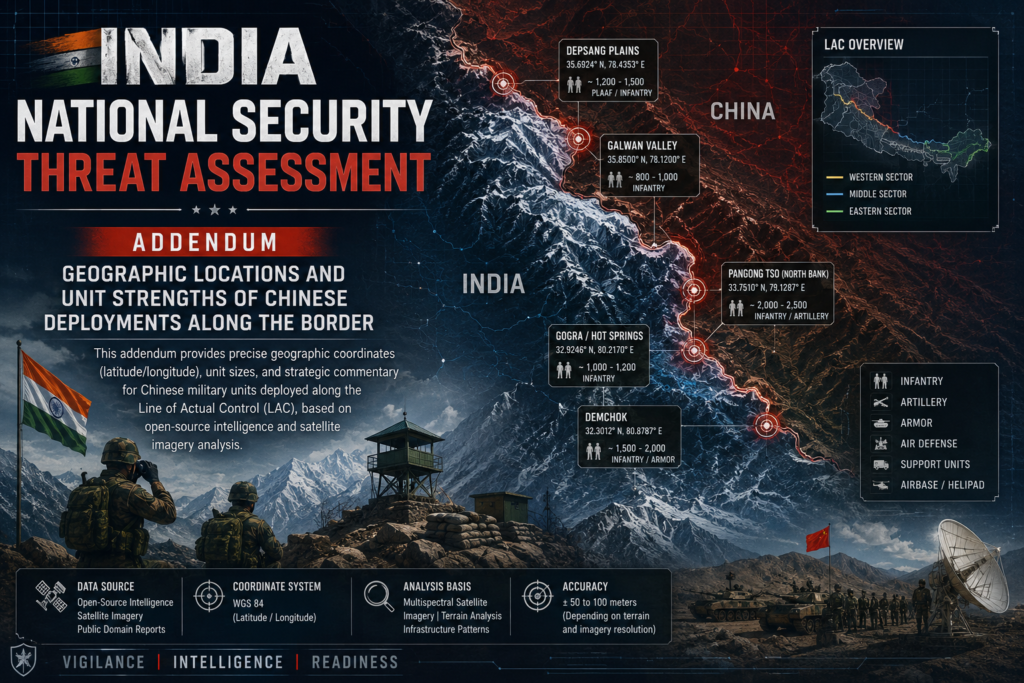
INDIA NATIONAL SECURITY THREAT ASSESSMENT — ADDENDUM
GEOGRAPHIC LOCATIONS AND UNIT STRENGTHS OF CHINESE DEPLOYMENTS ALONG THE BORDER
This addendum provides precise geographic coordinates (latitude/longitude), unit sizes, and strategic commentary for Chinese military units deployed along the Line of Actual Control (LAC), based on open-source intelligence and satellite imagery analysis.
PLA Deployment Along the Line of Actual Control
A comprehensive assessment of the People’s Liberation Army’s layered, defense-in-depth posture across the Western Theater — from theater-level command to frontline border outposts.
ITheater & Command-Level Units
The apex of PLA command architecture in the western sector, centered on the Western Theater Command headquartered in Chengdu.
| Unit | Headquarters | Coordinates | Size / Remarks |
|---|---|---|---|
| Western Theater Command (WTC) | Chengdu, Sichuan | 30.57°N, 104.06°E | Covers Tibet, Xinjiang, Qinghai, Gansu, Ningxia, Sichuan, Chongqing; commands 200,000+ troops |
| WTC Ground Force Headquarters | Lanzhou, Gansu | 36.06°N, 103.83°E | Supreme ground force command for the Western Theater |
IIGroup Army-Level Units
The operational maneuver core — two elite group armies (76th & 77th) with specialized combined-arms, mountain, and aviation brigades.
| Unit | Headquarters | Coordinates | Size / Remarks |
|---|---|---|---|
| 76th Group Army | Xining, Qinghai | 36.62°N, 101.78°E | Group Army 6 combined arms brigades (heavy, medium, light) + artillery + air defense + army aviation |
| 61st Motorized Infantry Division | Tianshui, Gansu | 34.58°N, 105.72°E | Division-level; motorized infantry |
| 62nd Combined Arms Brigade | Jiayuguan, Gansu | 39.77°N, 98.29°E | Brigade-level; heavy combined arms |
| 12th Combined Arms Brigade | Zhangye, Gansu | 38.93°N, 100.45°E | Equipped with Type 99A main battle tanks |
| 13th Army Aviation Brigade | Zhangye, Gansu | 38.93°N, 100.45°E | Brigade-level; army aviation |
| Air Defense Brigade | Linxia, Gansu | 35.60°N, 103.21°E | HQ-9 / HQ-9B air defense systems |
| 77th Group Army | Chongzhou, Sichuan | 30.59°N, 103.61°E | Elite PLA elite mountain force; permanently stationed in Tibet; high-altitude warfare specialization |
| 139th Heavy Combined Arms Brigade | — | — | Heavy combined arms |
| 40th Mountain Combined Arms Brigade | — | — | Mountain warfare specialization |
| Army Aviation Brigade | — | — | Brigade-level; army aviation |
| Air Defense Brigade | — | — | HQ-9 / HQ-9B systems |
IIIMilitary District-Level Units
Deputy theater-grade commands responsible for territorial defense, border security, and garrison operations across Tibet and Xinjiang.
| Unit | Headquarters | Coordinates | Size / Remarks |
|---|---|---|---|
| Tibet Military District | Lhasa, Tibet | 29.65°N, 91.13°E | Deputy Theater Est. 1952; commands 3 border defense regiments + multiple sub-districts |
| 52nd Mountain Infantry Brigade | Tibet (frontline) | — | Core mountain warfare unit |
| 53rd Mountain Infantry Brigade | Tibet (frontline) | — | Core mountain warfare unit |
| 54th Heavy Combined Arms Brigade | Tibet (frontline) | — | Equipped with Type 15 light tanks (high-altitude optimized) |
| Artillery Brigade | Tibet | — | Long-range artillery support |
| Army Aviation Unit | Tibet | — | Z-20 high-altitude assault helicopters |
| Electronic Warfare Unit | Lhasa area | 29.65°N, 91.12°E | Regiment-level; ECM & SIGINT |
| 351st Border Defense Regiment | Zayü County, Tibet | 28.66°N, 97.47°E | Border patrol & defense |
| 352nd Border Defense Regiment | Mêdog County, Tibet | 29.33°N, 95.33°E | Border patrol & defense |
| Xinjiang Military District | Urumqi, Xinjiang | 43.84°N, 87.57°E | Deputy Theater Commands 4 legacy combined arms divisions |
| 6th Mechanized Infantry Division | Kashgar, Xinjiang | 39.47°N, 75.99°E | Pioneering high-altitude mechanized unit |
| 362nd Border Defense Regiment | North Bank of Pangong Lake | 33.76°N, 78.99°E | Garrisoned at Khurnak Fort |
| Hetian (Hotan) Military Sub-district | Hotan, Xinjiang | 37.11°N, 79.93°E | Stationed at 5,380 m altitude; adjacent to Galwan Valley |
IVAir Force & Air Defense Units
Fifth-generation airpower and integrated air defense networks forming the overwatch and shield layers of the LAC posture.
| Unit | Location | Coordinates | Size / Remarks |
|---|---|---|---|
| Shigatse Air Base | Shigatse, Tibet | 29.35°N, 89.31°E | 5th Gen Altitude 3,782 m; 5,000-m runway; permanently deploys J-20 stealth fighters & GJ-11 stealth UAVs |
| Western Theater Command Air Force | — | — | Commands 3 air bases across the theater |
| Air Defense Brigades (×4) | Xinjiang / Tibet MDs, 76th / 77th GAs | — | HQ-9 / HQ-9B; at least 10 PLA units integrated into joint air defense network |
VFrontline Border Facilities & Air Defense Positions
Hardened, forward-deployed infrastructure forming the physical anchor of China’s LAC posture — many within direct line-of-sight of Indian positions.
| Facility | Location | Coordinates | Size / Remarks |
|---|---|---|---|
| Gar County (Ngari) Air Defense Complex | Gar County, Ngari Prefecture, Tibet | 32.50°N, 80.03°E | 65 km from LAC 4 hardened shelters w/ retractable roofs; opposite India’s Nyoma airfield; deploys HQ-9/HQ-9B; HQ-29 assessed |
| Rutog County Garrison | Rutog County, Ngari Prefecture, Tibet | 33.41°N, 79.81°E | <70 km from LAC ~90 km from Pangong Lake; expanded Mar–Jun 2023; 539 pieces of equipment previously assembled here |
| Rutog County Northeast Field Garrison | NE of Rutog County, Tibet | 33.45°N, 79.90°E | Supports rotational border deployments |
| Pangong Lake SAM Position | Eastern shore of Pangong Lake | 33.55°N, 79.93°E | ~110 km from Galwan 4 hardened shelters w/ retractable roofs; HQ-9/HQ-9B |
| Khurnak Fort (Chushul Sector) | North Bank of Pangong Lake | 33.76°N, 78.99°E | Altitude 4,257 m; 362nd Border Defense Regiment; along the LAC |
| Finger 4 Forward Post | Pangong Lake area | 33.72°N, 78.76°E | Forward observation post |
| Finger 5 Forward Post | Pangong Lake area | 33.72°N, 78.78°E | Forward observation post |
| Rimuchang Post | Eastern shore of Pangong Lake | 33.77°N, 79.08°E | Forward observation post |
VIStrategic Assessment Summary
A consolidated view of key units, their coordinates, LAC proximity, and primary equipment systems.
| Command Level | Unit | Coordinates | Distance from LAC | Primary Equipment |
|---|---|---|---|---|
| Theater | Western Theater Command | 30.57°N, 104.06°E | — | Unified command |
| Group Army | 76th Group Army | 36.62°N, 101.78°E | — | Type 99A tanks, Type 04A IFVs |
| Group Army | 77th Group Army | 30.59°N, 103.61°E | — | Mountain warfare equipment, ZBL-09 |
| Military District | Tibet Military District | 29.65°N, 91.13°E | — | Type 15 tanks, Z-20 helicopters |
| Military District | Xinjiang Military District | 43.84°N, 87.57°E | — | 6th Mechanized Division |
| Frontline AD | Gar County AD Complex | 32.50°N, 80.03°E | 65 km | HQ-9/HQ-9B (HQ-29 assessed) |
| Frontline AD | Pangong Lake SAM Position | 33.55°N, 79.93°E | ~110 km | HQ-9/HQ-9B |
| Frontline Garrison | Rutog County Garrison | 33.41°N, 79.81°E | <70 km | Tanks, IFVs, SP artillery |
| Air Base | Shigatse Air Base | 29.35°N, 89.31°E | ~150 km (Sikkim) | J-20, GJ-11, WZ-7 |
VIIKey Findings
Five critical observations that define the strategic character of the PLA’s LAC posture.
Gar County Air Defense Complex
Positioned just 65 km from the LAC. With a 260 km engagement range, HQ-9 systems here directly cover India’s Nyoma airfield and the entire Chushul sector — threatening IAF fighters during takeoff and landing.
Rutog County Garrison
Previously assembled 539 pieces of equipment (tanks, IFVs, artillery, trucks), indicating a brigade-sized rapid reaction force capable of reinforcing frontline positions on short notice.
Shigatse Air Base
At 3,782 m altitude, permanently hosts J-20 stealth fighters and GJ-11 stealth UAVs. ~150 km from the Sikkim sector — a fifth-generation air superiority capability directly threatening Indian airspace.
Concealed TEL Operations
Both Gar County and Pangong Lake facilities feature retractable-roof shelters, allowing missile systems to launch while concealed from aerial reconnaissance — significantly enhancing battlefield survivability.
Khurnak Fort Persistent Presence
The 362nd Border Defense Regiment maintains a persistent high-altitude presence on the north bank of Pangong Lake, directly overlooking Indian positions in the Chushul sector.
VIIIStrategic Implications & Operational Analysis
The PLA’s operational posture represents a layered, defense-in-depth strategy designed to neutralize Indian operational advantages and secure Chinese territorial claims.
Anti-Access / Area Denial (A2/AD) Overmatch
The most significant strategic finding — an integrated A2/AD network created by forward-deployed air defense systems. HQ-9/HQ-9B deployment with 260 km range just 65 km from the LAC fundamentally alters the air calculus.
Impact
- Establishes a de facto “no-fly zone” over Indian airspace in the Chushul sector
- Threatens IAF assets at Nyoma during their most vulnerable phases (takeoff & landing)
- Retractable-roof shelters allow TELs to fire while minimizing exposure to satellite reconnaissance
- High state of operational readiness and battlefield survivability
High-Altitude Mechanization & Rapid Reaction
The PLA has transitioned from massed light infantry to a highly mechanized force tailored for high-altitude warfare.
Key Capabilities
- Type 15 light tank designed specifically for hypoxic environments and rugged terrain
- Z-20 high-altitude assault helicopter for vertical envelopment
- Dedicated logistics and procurement pipeline for mountain warfare
- Rutog Garrison’s capacity to assemble 539+ pieces of heavy equipment demonstrates a “ready-to-fight” reserve
- Brigade-sized rapid reaction force reinforces the frontline far faster than units mobilized from deeper in the Tibetan plateau
Fifth-Generation Air Superiority
Permanent deployment of J-20 stealth fighters and GJ-11 stealth UAVs at Shigatse Air Base poses a severe challenge to the IAF.
Implications
- At just 150 km from the Sikkim sector, J-20s can probe Indian air defenses with very little warning time
- 3,782-m altitude limits payload capacity due to thin air — primary role is air-to-air dominance and ISR
- GJ-11 stealth UAVs provide additional strike and reconnaissance capabilities
Elevated Persistent Presence
Garrisoning of the 362nd Border Defense Regiment at Khurnak Fort (4,257 m) and forward posts at Fingers 4 and 5 demonstrates a strategy of “boots on the ground” to enforce territorial claims.
Functions
- Forward observation and early warning
- Physical blocking of Indian patrols
- Tactical anchor for larger A2/AD and mechanized forces situated to the rear
- Persistent presence to de facto control disputed territory
IXPLA Layered Posture Along the LAC
A four-layer defense architecture — from forward observation to fifth-generation overwatch.
Layer 1 — Forward
Border defense regiments & observation posts enforce presence, provide ISR, and block patrols.
e.g. Khurnak Fort, Fingers 4/5
Layer 2 — Shield
Air defense complexes create an A2/AD bubble, denying Indian air and missile interdiction.
e.g. Gar County, Pangong Lake SAM
Layer 3 — Spear
Mechanized rapid reaction forces & mountain brigades exploit gaps, blunt offensives, and conduct high-altitude maneuver warfare.
e.g. Rutog Garrison, 52nd/53rd Mtn Bdes
Layer 4 — Overwatch
Fifth-generation airpower ensures air superiority, deep strike, and persistent ISR coverage.
e.g. J-20 & GJ-11 at Shigatse
X. Conclusion
The PLA’s deployment along the LAC represents a comprehensive, multi-layered defense architecture that combines:
- Persistent forward presence to enforce territorial claims
- A2/AD capabilities to deny Indian air and missile operations
- Mechanized rapid reaction forces for high-altitude maneuver warfare
- Fifth-generation airpower for air superiority and deep strike
This architecture is supported by hardened infrastructure (retractable-roof shelters), high-altitude optimized equipment (Type 15 tanks, Z-20 helicopters), and a permanent garrison posture that indicates long-term strategic intent rather than temporary border tensions.
Pingback: pla-western-theatre-command-wtc