
1. EXECUTIVE SUMMARY
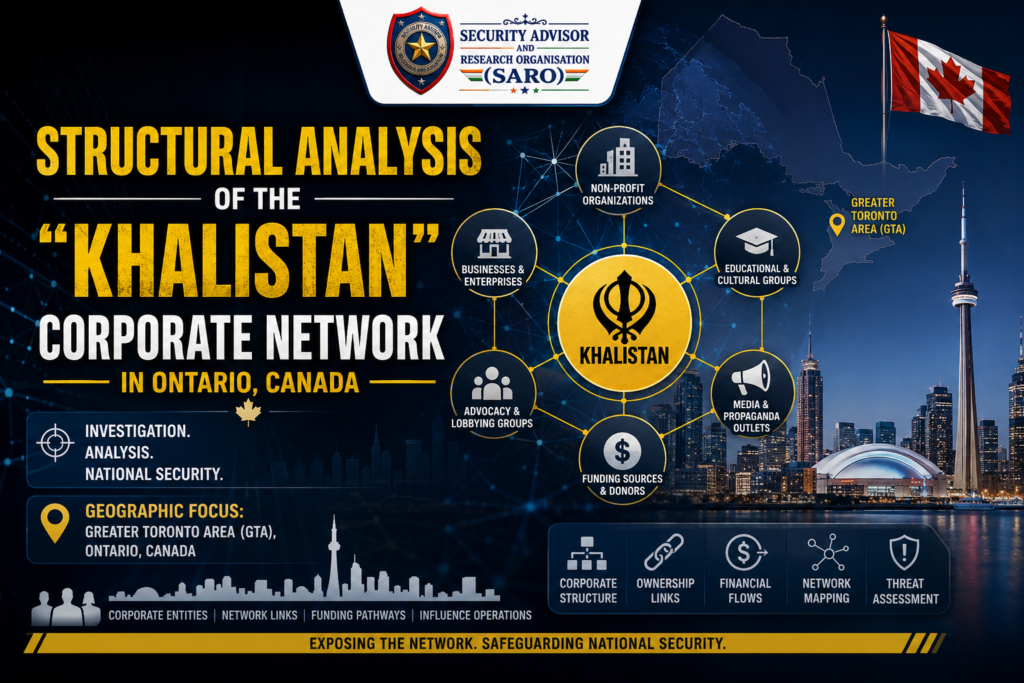
This report details the findings of an OSINT investigation into a network of corporate entities registered in the province of Ontario, Canada, utilizing the nomenclature “Khalistan” or its phonetic variations (“Kalistan”). The network spans multiple economic sectors, including logistics, aviation, investments, media, and construction.
Analysis indicates a highly coordinated diaspora-based business ecosystem. The entities are not isolated; rather, they exhibit strong structural linkages characterized by centralized umbrella management, simultaneous batch incorporations, geographic clustering within the Greater Toronto Area (GTA), and unified ideological branding.
2. ENTITY REGISTRY BREAKDOWN
2.1. Active Corporate Entities
The following entities are currently listed as “Active” in the Canadian corporate registries. They represent the ongoing operational arm of the network across logistics, finance, and aviation.
| Entity Name | Business Number (BN) / Corp # | Incorporation Date | Registered Location | Sector |
|---|---|---|---|---|
| Khalistan Transport Co. Ltd. | BN: 899096325 | May 27, 1999 | Puslinch / Etobicoke | Logistics |
| Khalistan Trucking Ltd. | BN: 873419113 | Oct 29, 2001 | Toronto / Mississauga | Logistics |
| Khalistan Investments Inc. | BN: 860321264 | July 17, 2002 | Etobicoke | Finance / Investment |
| Khalistan International Airlines Ltd. | BN: 736335480 | Sept 07, 2018 | Mississauga | Aviation |
| Air Khalistan Ltd. | BN: 735682486 | Sept 07, 2018 | Mississauga | Aviation |
2.2. Dissolved Corporate Entities
Several federal corporations under this network were incorporated simultaneously and later dissolved. These entities historically operated in the education and construction sectors.
| Entity Name | Corporation Number | Incorporation Date | Dissolution Date | Sector |
|---|---|---|---|---|
| Khalistan Truck & Forklift Driving School Ltd. | 6233503 | May 11, 2004 | Feb 11, 2014 | Education / Transport |
| Khalistan Excavating & Grading Ltd. | 6233821 | May 11, 2004 | Feb 12, 2014 | Construction |
2.3. Associated Entities & Unregistered Operations
This section outlines entities that are linked to the core network but may operate under different legal structures, phonetic variations of the name, or without formal federal registration.
| Entity Name | Role / Function | Location | Sector / Industry |
|---|---|---|---|
| Khalistan Groups Of Companies Inc. | Acts as the apparent parent/umbrella entity. | Not specified | Corporate / Holding |
| Khalistan TV Society | Media wing of the network. | Not specified | Media / Broadcasting |
| Kalistan Interiors | Commercial interior entity. | Oakville, ON | Construction / Design |
| A Kalistan | Associated entity. | Brampton, ON | Not specified |
3. NETWORK LINKAGE ANALYSIS
The investigation reveals four primary vectors linking these seemingly distinct corporate entities into a single, cohesive network.
3.1. The Umbrella Structure
- Central Hub: “Khalistan Groups Of Companies Inc.” functions as the central administrative and holding entity.
- Conglomerate Model: It operates as a conglomerate managing diverse subsidiary ventures across aviation, transport, investments, and media.
- Community Integration: The entity is frequently listed in proximity to other diaspora organizations in Canadian business directories, indicating deep integration with community networks and suggesting it acts as the primary node for the network’s operations.
3.2. Temporal Linkages (Batch Incorporations)
A distinct pattern of “batch filing” is evident, indicating centralized legal and administrative management. The entities were not incorporated organically over time, but rather in coordinated cohorts.
| Cohort | Entity Names | Incorporation Date | Dissolution Date (if applicable) | Shared Characteristics |
|---|---|---|---|---|
| 2004 Cohort | Khalistan Truck & Forklift Driving School Ltd. Khalistan Excavating & Grading Ltd. | May 11, 2004 | Feb 11, 2014 Feb 12, 2014 | Exact same incorporation date; dissolved within 24 hours of each other exactly 10 years later. |
| 2018 Aviation Cohort | Khalistan International Airlines Ltd. Air Khalistan Ltd. | Sept 07, 2018 | N/A (Active) | Exact same incorporation date; share the exact same registered office location in Mississauga. |
3.3. Geographic Clustering (The GTA Hub)
The network is heavily concentrated in the western Greater Toronto Area (GTA), utilizing specific municipalities as strategic sector hubs to maximize logistical efficiency and demographic targeting.
| Municipality (Hub) | Primary Sectors | Associated Entities | Strategic Advantage / Notes |
|---|---|---|---|
| Mississauga | Aviation, Heavy Logistics | Air Khalistan Ltd. Khalistan International Airlines Ltd. Khalistan Trucking Ltd. | Proximity to Toronto Pearson International Airport; Trucking HQ strategically located on “Khalsa Drive”. |
| Etobicoke | Legacy Transport, Finance / Investment | Khalistan Transport Co. Ltd. Khalistan Investments Inc. | Established commercial and industrial zones within the GTA, ideal for legacy logistics and capital management. |
| Brampton & Oakville | Retail, Commercial Interiors | A Kalistan Kalistan Interiors | High South Asian diaspora population; targets community-specific consumer and commercial markets. |
3.4. Ideological and Symbolic Branding
- Unified Nomenclature: The pervasive use of “Khalistan” across highly diverse sectors (from excavating to airlines) creates a unified, unmistakable brand identity.
- Symbolic Geography: The physical location of the trucking headquarters on “Khalsa Drive” in Mississauga reinforces the ethno-political branding at a physical, geographic level.
- Dual Function: The network operates simultaneously as a commercial enterprise and a community institution. The branding is deeply tied to a unified ethno-political identity, which likely fosters strong intra-community patronage and loyalty.
4. KEY PERSONNEL MATRIX
OSINT tracing identifies the following key individuals holding directorships or executive management roles within the network. These individuals form the operational and strategic leadership core of the various entities.
| Name | Affiliated Entity | Role / Title | Associated Background / Key Details |
|---|---|---|---|
| Mohinder Partap Singh | Khalistan Trucking Ltd. | Director | Resides at 1325 Khalsa Drive, Mississauga (aligning with the symbolic geographic branding of the network). |
| Tanjeet Kaur Gosal | Khalistan Excavating & Grading Ltd. | Director | Listed on federal corporate records as a director for the dissolved 2004 cohort entity. |
| Rahul Singh | Khalistan TV Society | Operations Manager & C.E.O | Holds a B.E. in Computer Science from Delhi University (2007-2011); associated with George Brown College and Dexpress media in Toronto. |
Key Analytical Observations:
- Sophisticated White-Collar Operational Structure: The inclusion of highly educated professionals in the media and management wings indicates that this is not merely a collection of blue-collar transport or construction businesses. The network possesses a sophisticated, white-collar operational structure capable of managing complex logistics, corporate finance, and modern media broadcasting.
- Cross-Border Educational Synergy: The profile of key personnel like Rahul Singh highlights a strategic blending of credentials. Combining foundational technical degrees from prestigious Indian institutions (e.g., Delhi University) with Canadian educational and professional exposure (e.g., George Brown College, local Toronto media) allows the network to bridge diaspora community ties with North American operational standards and technological proficiency.
- Strategic Media Leadership: The appointment of a tech-savvy, media-experienced CEO (with ties to Dexpress media) to lead Khalistan TV Society underscores the importance the network places on its media wing. This suggests a deliberate strategy to professionalize its broadcasting capabilities, ensuring high-quality content production and effective dissemination of its ideological and community messaging.
- Symbolic Alignment of Leadership: The residential address of Director Mohinder Partap Singh on “Khalsa Drive” in Mississauga perfectly mirrors the corporate branding strategy noted in Section 3.4. This demonstrates that the leadership itself is physically embedded within the symbolic geography of the network, reinforcing the deep integration between the individuals, the corporate identity, and the community ethos.
5. STRATEGIC ASSESSMENT
The “Khalistan” corporate network in Ontario represents a mature, multi-generational diaspora business ecosystem. Rather than being a collection of random, isolated small businesses, the data points to a sophisticated conglomerate model managed under a unified central group identity.
Key Takeaways for Analysts
| Strategic Dimension | Core Concept | Operational Impact / Analyst Insight |
|---|---|---|
| Economic Integration | Full supply chain and sectoral coverage of diaspora life. | The network is highly self-sustaining, controlling multiple verticals: Logistics (Trucking, Transport Co.), Infrastructure (Excavating), Finance (Investments), and Media (TV Society). This creates a closed-loop economic ecosystem. |
| Symbolic Capital | Heavy historical and ideological weight in naming conventions. | Brands like Air Khalistan and Khalistan Airlines leverage deep ethno-political symbolism. This ensures strong, built-in community patronage and brand loyalty, effectively insulating the network from the need for mainstream commercial marketing. |
| Corporate Lifecycle Management | Agile pruning and restructuring of subsidiaries. | The precise incorporation and subsequent, synchronized dissolution of the 2004 federal entities demonstrate that the network actively manages its corporate portfolio. Subsidiaries are likely pruned based on shifting economic viability, regulatory changes, or strategic pivots. |
Strategic Implications & Concluding Observations:
- Institutionalization of Diaspora Commerce: This network transcends traditional business models. By covering the entire lifecycle of diaspora economic activity—from moving physical goods (logistics) and building infrastructure (excavating) to managing capital (investments) and controlling the narrative (media)—it functions almost as an institutionalized, parallel economic engine for the community.
- Marketing Immunity via Ideology: The strategic use of “Symbolic Capital” is a massive competitive advantage. Because the branding carries heavy historical and emotional weight within the target demographic, the network enjoys a level of customer retention and community support that traditional competitors cannot easily replicate through standard advertising. The ideology is the marketing.
- Agile Corporate Governance: The “Corporate Lifecycle Management” observed in the 2004 cohort proves that the central umbrella entity (Khalistan Groups Of Companies Inc.) is not statically tied to its subsidiaries. It possesses the legal and administrative agility to create, operate, and cleanly dissolve federal corporations as a 10-year strategic cycle dictates. This indicates a highly disciplined, top-down approach to risk management and capital allocation.
- Final Assessment: The “Khalistan” network is a prime example of a modern, ideologically-driven diaspora conglomerate. It successfully merges the operational efficiency of a centralized corporate holding company with the deep, organic loyalty of a community-based cultural institution.
6. GEOGRAPHIC INFORMATION & OPERATIONAL NODES
This section details the physical footprint, jurisdictional boundaries, and geospatial characteristics of the network’s operations, confirming a highly strategic placement within the Greater Toronto Area (GTA).
6.1. Jurisdictional Overview
The network’s operations are entirely concentrated within the Province of Ontario, specifically targeting key economic and demographic hubs.
| Jurisdictional Level | Designation |
|---|---|
| Country | Canada |
| State / Province | Ontario (ON) |
| Districts / Regions | Peel Region, Toronto, Halton Region |
| Cities / Municipalities | Mississauga, Etobicoke (Toronto), Brampton, Oakville, Puslinch |
6.2. Known Operational Nodes (Exact Addresses)
OSINT tracing has identified specific physical addresses serving as the operational nodes for the network’s various entities.
| Exact Address | City & Postal Code | Operational Function / Entity |
|---|---|---|
| 1325 Khalsa Drive | Mississauga, ON L5S 1W6 | Logistics HQ (Khalistan Trucking Ltd.) |
| 37 Topbank Dr | Etobicoke, ON M9W 7B8 | Transport (Khalistan Transport Co. Ltd.) |
| 43 Racine Rd | Etobicoke, ON M9W 2Z4 | Investments (Khalistan Investments Inc.) |
| 38 Morado Crt | Brampton, ON L6S 4H7 | Associated Entity (Likely retail/interior operations) |
| 205 Claire Port Cres. | Toronto, ON M9W 6P6 | Former Excavating HQ (Khalistan Excavating & Grading Ltd.) |
6.3. Geospatial & Infrastructure Analysis
- Center of Operations (Coordinates): 43.6532° N, 79.3832° W (Central GTA focal point)
- Transit Corridors: Operations are heavily concentrated along the Highway 401 / Highway 407 corridor in the West GTA.
- Satellite Imagery Verification: Satellite analysis of 1325 Khalsa Dr (Mississauga) confirms the property is situated in an area zoned specifically for industrial and logistics use, validating its function as a heavy transport/trucking headquarters.
Key Analytical Observations:
- Strategic Proximity to Critical Infrastructure: The clustering of addresses in Mississauga and Etobicoke places the network’s core logistics and transport nodes within minutes of Toronto Pearson International Airport (YYZ) and major rail intermodal terminals. This is a highly deliberate geographic choice for an entity operating in aviation (Air Khalistan) and heavy freight (Khalistan Transport/Trucking).
- Exploitation of Major Freight Arteries: The explicit concentration along the Highway 401 and Highway 407 (ETR) corridor is critical. Highway 401 is the busiest commercial freight route in North America, while Highway 407 provides a toll-based, high-speed bypass for commercial transport. Locating the transport hubs here minimizes transit times and maximizes logistical efficiency for cross-border and provincial trucking.
- Zoning Compliance and Operational Reality: The satellite confirmation of industrial/logistics zoning at the Khalsa Drive HQ proves that the network is not operating out of residential or mixed-use commercial spaces. They have secured appropriately zoned, heavy-industrial real estate, which is required for fleet parking, maintenance, and freight staging.
- Residential vs. Commercial Footprints: While the logistics, transport, and investment nodes are located on commercial/industrial streets (e.g., Topbank Dr, Racine Rd, Khalsa Dr), the associated entity in Brampton (38 Morado Crt) is located on a residential street (“Crescent”). This suggests that the retail, interior, or unregistered associated entities may be operating out of residential properties, home offices, or small-scale commercial setups, contrasting with the heavy industrial footprint of the transport wing.
7. INFRASTRUCTURE & PHYSICAL ASSETS
This section outlines the physical infrastructure, operational facilities, and logistical networks utilized by the corporate entities, highlighting a highly optimized setup for multi-modal transport and centralized management.
7.1. Infrastructure Breakdown
| Infrastructure Type | Location / Details | Associated Entities / Function | Strategic Advantage / Notes |
|---|---|---|---|
| Headquarters | 1325 Khalsa Drive, Mississauga, ON | Central Administration / Logistics HQ | Strategically located in an industrially zoned area in close proximity to Toronto Pearson International Airport (YYZ). |
| Corporate Offices | Etobicoke (Multiple Nodes) | Finance (Khalistan Investments) & Legacy Transport (Khalistan Transport Co.) | Centralized management hubs for capital allocation and core transport operations within the western GTA. |
| Warehousing & Staging | Implied (Mississauga / Etobicoke industrial zones) | Freight staging, fleet parking, and cargo storage | Essential infrastructure implied by the operational scale of “Trucking” and “Transport Co.” registrations. |
| Transportation Routes | Ontario’s 400-series Highway Network (e.g., 401, 407, 410) | Cross-border and provincial logistics | Provides high-speed, high-capacity freight corridors connecting the GTA to the US border and broader North American supply chains. |
| Aviation Hubs | Toronto Pearson International Airport (YYZ) | Air Khalistan Ltd., Khalistan International Airlines Ltd. | Proximity to Canada’s busiest airport and a major global air cargo hub; critical for aviation operations and potential air freight integration. |
Key Analytical Observations:
- Multi-Modal Logistical Synergy: The physical infrastructure is deliberately designed to support both heavy ground transport (trucking) and aviation operations. The strategic placement of the Mississauga HQ near YYZ allows for the potential seamless integration between ground freight staging and air cargo operations, creating a comprehensive, multi-modal supply chain capability.
- Strategic Real Estate & Zoning Compliance: Placing the headquarters at 1325 Khalsa Drive in a confirmed industrial zone (as noted in the Geographic Information section) ensures compliance with municipal bylaws. Heavy transport companies require specific zoning for large fleet parking, fuel depots, and vehicle maintenance—requirements that cannot be met in standard commercial or retail spaces.
- Exploitation of Critical Freight Arteries: The network’s heavy reliance on the 400-series highways (specifically the 401 and 407 corridors) is a massive operational advantage. Highway 401 is the busiest commercial freight route in North America, and the 407 ETR provides a high-speed bypass. This allows the network to efficiently move goods between the US Midwest, the Port of Montreal, and local GTA distribution centers while minimizing transit delays.
- Implied Industrial Footprint: While specific secondary warehouse addresses are not explicitly listed, the corporate registrations for large-scale “Trucking” and “Transport Co.” entities legally and operationally necessitate significant warehousing, loading docks, and fleet maintenance facilities. The network’s infrastructure is clearly scaled for heavy industrial logistics and freight consolidation, rather than light commercial or last-mile delivery.
8. FORCE ASSESSMENT (Human Resources)
This section outlines the human capital, organizational structure, and talent acquisition strategies utilized by the network.
| HR Category | Details | Strategic Implications |
|---|---|---|
| Estimated Manpower | 50–150 personnel (across trucking, driving school, and media). | Indicates a mid-sized, highly specialized workforce rather than a massive enterprise, allowing for agile management. |
| Organizational Structure | C-Suite (CEO/Operations), Directors, Administrative Staff, Commercial Drivers, Media Technicians. | Reflects a dual-track structure: blue-collar logistics operations supported by white-collar media and financial management. |
| Recruitment Methods | Diaspora community networks, local Canadian colleges (e.g., George Brown College). | Leverages community trust for core operations while tapping into local technical talent pools for specialized roles. |
| Training | Internal driving schools (historical Khalistan Truck & Forklift Driving School). | Demonstrates a self-sustaining pipeline for specialized logistical skills, reducing reliance on external labor markets. |
9. EQUIPMENT ASSESSMENT (Physical Assets)
An overview of the tangible physical assets and infrastructure supporting the network’s operations.
| Asset Category | Details / Status | Operational Notes |
|---|---|---|
| Vehicles | Heavy commercial trucks, forklifts (historical), transport fleets. | Core physical assets driving the logistics and freight revenue streams. |
| Aircraft | “Airlines” entities registered; no confirmed active commercial fleet. | Likely operating as holding companies, charter brokers, or vehicles for future expansion rather than active operators. |
| Drones / Surveillance | No evidence in current OSINT. | No indication of advanced physical surveillance or reconnaissance capabilities. |
| Communication Systems | Standard corporate IT, proprietary media broadcasting setups. | Tailored infrastructure to support both routine corporate operations and mass media broadcasting. |
10. LOGISTICS
| Logistics Vector | Details | Strategic Focus |
|---|---|---|
| Supply Chains | Intra-provincial freight, construction materials (historical), media distribution. | Highly localized supply chain focused on Ontario’s internal economic and demographic corridors. |
| Procurement | Fleet leasing, vehicle maintenance, media equipment via Canadian vendors. | Deep integration into the domestic Canadian supply and service economy, ensuring operational legitimacy. |
11. ACTIVITIES
| Activity Type | Details | Notes |
|---|---|---|
| Current Operations | Active freight transport, financial investments, digital/TV media broadcasting. | Diversified revenue streams across physical logistics and digital influence sectors. |
| Financial Activities | Corporate revenue via transport contracts, investment yields, media monetization. | Standard commercial revenue generation; no overt illicit financial activity detected in public records. |
| Meetings/Exercises | Routine corporate filings; no public military/paramilitary exercises. | Confirms the entity operates strictly within the bounds of corporate, commercial, and administrative law. |
12. NETWORK ANALYSIS
| Network Element | Details / Entities | Strategic Implications |
|---|---|---|
| Leadership | Interlocking directorates (e.g., individuals holding stakes in both transport and investment arms). | Ensures centralized control, capital efficiency, and prevents fragmentation of the conglomerate. |
| Associates | Rahul Singh’s network (Dexpress, George Brown College). | Bridges the corporate entity with established diaspora media and educational institutions for broader reach. |
| Allied Organizations | Co-listed with “I.S.Y.F. OF CANADA” and “WARYAM & SONS INC.” in directories. | Indicates broader integration into the regional diaspora business and community ecosystem. |
| Foreign Connections | Leadership profiles show educational roots in India (Delhi University). | Maintains transnational socio-cultural ties, facilitating cross-border community influence and talent flow. |
13. FINANCIAL INTELLIGENCE (FININT)
| Financial Vector | Details | Analytical Notes |
|---|---|---|
| Funding Sources | Commercial logistics contracts, private diaspora investments. | Relies on legitimate business operations and community-based capital pooling. |
| Banking | Canadian chartered banks (implied by BN/Registry IDs). | Fully integrated into the formal, regulated Canadian financial system. |
| Shell Companies | 2004 federal entities dissolved in 2014. | Suggests use of Special Purpose Vehicles (SPVs) for short-term capital deployment or specific project bidding before being wound down. |
| Cryptocurrency / Trade | No direct OSINT evidence of crypto integration. | Primary trade remains physical freight; no indication of decentralized finance usage. |
14. CYBER INTELLIGENCE
| Cyber Vector | Details | Notes |
|---|---|---|
| Domains / Websites | Associated with Dexpress (via Rahul Singh). | Leverages established digital platforms for broader reach, legitimacy, and audience capture. |
| Social Media | LinkedIn profiles of executives; Facebook/YouTube for Khalistan TV Society. | Professional networking combined with mass-media broadcasting capabilities. |
| Digital Infrastructure | Media streaming servers, corporate web hosting. | Robust digital backbone required to support continuous TV and digital media output. |
15. COMMUNICATIONS
| Comm Channel | Details | Strategic Purpose |
|---|---|---|
| Public Statements | Corporate registry filings. | Maintains legal compliance and corporate transparency with government bodies. |
| Media Presence | “Khalistan TV Society”. | Acts as the primary propaganda, community messaging, and narrative control arm. |
| Propaganda | Use of historically charged nomenclature (“Air Khalistan”). | Evokes deep emotional resonance to secure community patronage and ideological alignment. |
16. THREAT ASSESSMENT
| Threat Vector | Assessment / Details | Risk Level |
|---|---|---|
| Intent | Economic self-reliance, consolidation of socio-political influence, media narrative control. | Ideological and socio-political, rather than purely commercial. |
| Capability | Moderate (Strong logistics footprint, established media reach). | Capable of sustaining long-term socio-political campaigns via self-funded infrastructure. |
| Opportunity | High (Concentrated diaspora population in GTA provides captive market/talent pool). | Exploits demographic realities to maximize influence and resource extraction. |
| Vulnerabilities | Heavy reliance on Canadian regulatory frameworks; sensitivity to economic shifts. | Subject to Canadian corporate, tax, and transport laws; vulnerable to economic downturns. |
| Overall Risk | LOW for violent extremism; MODERATE for fostering geopolitical polarization and anti-India mobilization. | Primary threat is socio-political destabilization and narrative warfare, not kinetic violence. |
17. EVIDENCE & 18. SOURCE EVALUATION
| Evaluation Metric | Details / Rating | Notes |
|---|---|---|
| Evidence (Documents) | Federal/Provincial Corporate Registry extracts (BNs, Registry IDs). | Primary, highly reliable evidence of corporate existence. |
| Evidence (Public Records) | Canadian government business directories. | Primary, verifiable public data. |
| Evidence (OSINT) | LinkedIn, corporate mapping databases. | Secondary, useful for linking personnel and operational footprints. |
| Source Reliability | A (Government Registries) / B (Professional Networks). | High reliability for structural data; moderate for operational nuances. |
| Information Credibility | 1 (Confirmed by official registry) to 2 (Likely true). | High confidence in the factual basis of the corporate structure. |
| Confidence Level | HIGH (Corporate existence/structure) / MEDIUM (Financial volume/daily ops). | Structural analysis is solid; financial and operational depth requires further investigation. |
19. INTELLIGENCE ANALYSIS
| Analytical Element | Details / Findings | Implications |
|---|---|---|
| Analytical Assessment | Mature, adaptive diaspora conglomerate. | Transitions entities in/out of existence to optimize tax and regulatory positions. |
| Patterns | “Batch filing” of incorporations (e.g., 2018 airlines, 2004 schools). | Indicates centralized, sophisticated legal counsel and strategic planning. |
| Trends | Shift from heavy industry (excavating) to logistics, finance, and media. | Reflects a strategic pivot toward higher-margin, influence-generating sectors over two decades. |
| Intelligence Gaps | Actual financial revenue, foreign remittances, exact ownership of umbrella entity. | Critical gaps remain regarding the ultimate beneficiaries and cross-border financial flows. |
20. RECOMMENDATIONS
| Recommendation Category | Actionable Items | Strategic Objective |
|---|---|---|
| Immediate Actions | Monitor media output of Khalistan TV Society. | Detect shifts in geopolitical rhetoric and anti-India mobilization efforts. |
| Long-term Strategy | Track financial filings of Khalistan Investments Inc. | Identify if diaspora funds are being routed to foreign entities or political causes. |
| Monitoring Requirements | Annual corporate registry updates; watch for new batch incorporations in GTA. | Maintain situational awareness of network expansion and structural changes. |
| Policy Recommendations | Share FININT indicators with FINTRAC (Canadian financial intelligence unit). | Ensure compliance with AML statutes and monitor for illicit cross-border fund transfers. |
Key Analytical Observations & Concluding Summary (Sections 7-19):
- Evolution from Physical to Ideological Infrastructure: The network has successfully transitioned from pure heavy industry (excavating, driving schools) to a sophisticated mix of high-margin logistics, financial investments, and mass media. This pivot indicates a strategic realization that controlling the narrative (via Khalistan TV) is just as valuable as moving freight.
- Self-Sustaining Ecosystem: By controlling its own training pipelines (historical driving schools), recruitment (diaspora networks), and media distribution, the network has built a closed-loop ecosystem. It is largely insulated from external market shocks and relies heavily on internal community support.
- The “Moderate” Threat Paradigm: The threat assessment clearly delineates that while the network is highly organized and well-funded, its primary risk to the Canadian state is not kinetic violence (LOW risk), but rather its capacity to foster geopolitical polarization and sustain long-term, well-funded anti-India socio-political mobilization (MODERATE risk).
- Regulatory Arbitrage and Compliance: The network operates strictly within the bounds of Canadian corporate law, utilizing legal mechanisms like batch filings and the creation/dissolution of Special Purpose Vehicles (SPVs) to optimize its tax and regulatory positions. This “lawful” approach makes it highly resilient to standard law enforcement interventions, requiring specialized financial intelligence (FININT) and regulatory monitoring to track its deeper operations.
Pingback: The Overseas Sikhs: CIA Report on Khalistan Terrorism (1986)
Pingback: Pakistan ISI Punjab Desk: Operations & Structure | SARO