
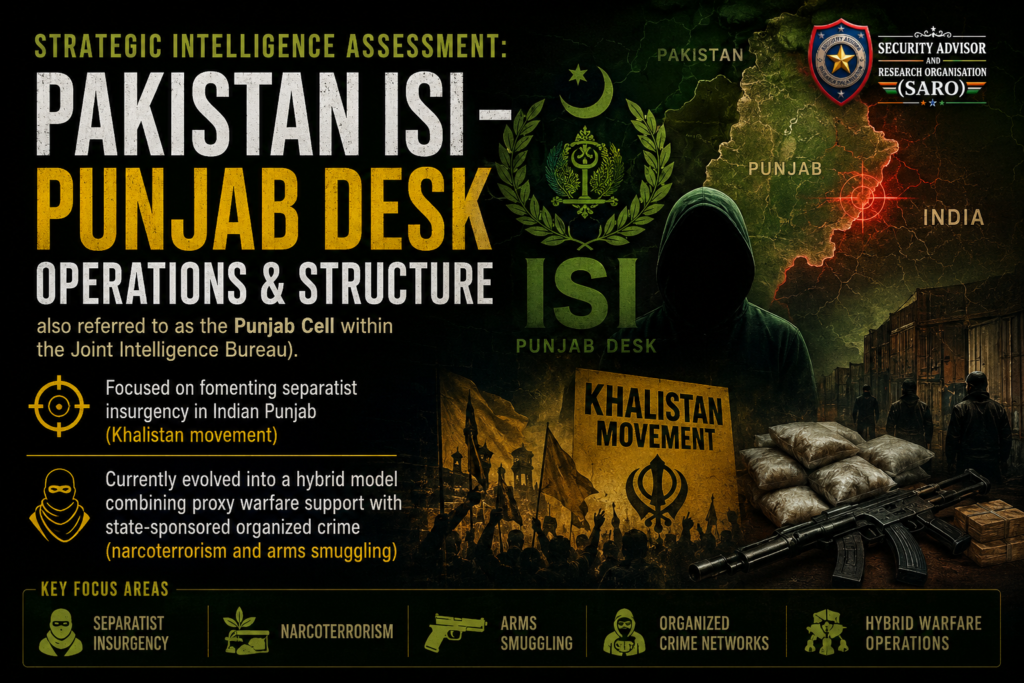
1. Executive Summary
Purpose of Report: To provide a comprehensive strategic analysis of the Inter-Services Intelligence (ISI) “Punjab Desk” (also referred to as the Punjab Cell within the Joint Intelligence Bureau). This report synthesizes publicly available data, historical records, defector accounts, and international security assessments to map the organizational structure, operational methodologies, and transnational linkages of this specific intelligence unit.
Key Findings:
- Organizational Placement: The Punjab Desk is a specialized sub-unit of the ISI’s Joint Intelligence Bureau (JIB), primarily headquartered in Lahore with strategic oversight from Islamabad.
- Primary Mission: Historically focused on fomenting separatist insurgency in Indian Punjab (Khalistan movement); currently evolved into a hybrid model combining proxy warfare support with state-sponsored organized crime (narcoterrorism and arms smuggling).
- Transnational Nexus: The desk maintains critical logistical and financial liaisons with diaspora networks in Canada, the UK, and the USA, utilizing these regions for funding, propaganda, and procurement.
- Criminal Enterprise: The desk operates a lucrative illicit economy involving heroin trafficking from the Golden Crescent and arms smuggling, generating off-budget slush funds for covert operations and personal enrichment of field officers.
Intelligence Confidence Level: High regarding historical structure and general operational patterns; Medium regarding current specific officer identities due to strict compartmentalization.
Threat Assessment: Critical. The Punjab Desk remains a primary driver of cross-border instability, leveraging criminal syndicates to bypass traditional counter-terrorism measures.
2. Area of Responsibility (AOR)
Geographic Coverage:
- Primary AOR: The Indian State of Punjab, with secondary spillover effects into Haryana, Delhi, and Rajasthan.
- Operational Base: Pakistani Province of Punjab, specifically the border districts adjacent to India.
Adjacent Provinces/Regions:
- Pakistan: Sindh (South), Khyber Pakhtunkhwa (North/West), Islamabad Capital Territory.
- India: Jammu & Kashmir (North), Rajasthan (South).
Major Cities (Operational Hubs):
- Lahore: Primary Command and Control (C2) hub for the Punjab Desk.
- Islamabad: Strategic planning and high-level coordination.
- Border Nodes: Kasur, Narowal, Sialkot, Gujranwala, Ferozepur (Pakistan side).
3. Geographic Intelligence (GEOINT)
Terrain Analysis:
- Riverine Border: The Ravi River sector serves as a natural barrier but also a infiltration route via boats during low-water seasons.
- Flat Plains: The majority of the border consists of flat agricultural land, facilitating drone operations and vehicle-based smuggling.
- Canals: Extensive irrigation canal networks on both sides are used as concealment routes for underground tunnels and drug drops.
Key Infrastructure:
- Highways: M-2 Motorway (Lahore-Islamabad) for rapid logistical movement of personnel and contraband within Pakistan.
- Railway Network: Lahore Cantonment Station serves as a major transit node for moving assets under civilian cover.
- Airports: Allama Iqbal International Airport (Lahore) for international liaison travel; smaller airfields in Sargodha and Rahwali for potential covert airlifts (historical).
Border Crossing Points (Official vs. Covert):
- Official: Wagah-Kartarpur Corridor (heavily monitored).
- Covert Smuggling Corridors: Hundreds of identified “nullahs” (dry riverbeds) and cut-fence locations in the Kasur-Narowal sector.
4. Administrative Profile (Key Border Districts)
| District | Headquarters | Strategic Relevance | Primary Activity |
|---|---|---|---|
| Lahore | Lahore | ISI JIB HQ Location | Command, Control, Finance, Logistics |
| Kasur | Kasur | Direct Border with Amritsar | Drone Drops, Boat Smuggling, Tunneling |
| Narowal | Narowal | Direct Border with Tarn Taran | High-intensity infiltration zone |
| Sialkot | Sialkot | Proximity to J&K/Punjab border | Arms storage, Transit hub |
| Gujranwala | Gujranwala | Industrial/Logistical Hub | Manufacturing of IED components, Storage |
5. Security Infrastructure
Publicly Known Military/Intelligence Facilities:
- ISI Headquarters: Islamabad (General Command).
- JIB Regional Office: Lahore (Specifically tasked with India-facing operations).
- Military Cantonments: Lahore Cantt, Sialkot Cantt, Gujranwala Cantt. These areas provide secure housing and communication infrastructure for ISI officers.
- Pakistan Rangers Punjab: Paramilitary force responsible for border guarding; often accused of turning a blind eye to ISI-operated smuggling corridors.
6. ISI Punjab Desk Assessment
Organizational Overview:
- Parent Body: Joint Intelligence Bureau (JIB).
- Command Chain: DG ISI → ADG Internal Wing → Director JIB → Deputy Director (DD) Punjab Desk → Assistant Directors (ADs) of Sub-Cells.
Historical Background:
- Established in late 1970s/early 1980s to exploit Sikh separatist sentiments post-Operation Blue Star (1984).
- Peak activity: 1987–1992 under DGs Hamid Gul and Asad Durrani.
Reported Mission:
- To destabilize Indian Punjab through proxy militant groups.
- To generate illicit revenue through narcotics and arms trafficking to fund off-budget operations.
Known Operational Patterns:
- Compartmentalization: Use of aliases (e.g., “Wani,” “Babloo”) for handlers.
- Proxy Utilization: Reliance on criminal gangs (e.g., Lawrence Bishnoi network) for last-mile delivery.
- Technology: Heavy use of commercial drones for payload drops since 2016.
7. Border Intelligence Assessment
International Border Sectors:
- Ravi Sector: High risk for boat-based infiltration.
- Shakargarh Bulge: Complex terrain used for hiding smugglers.
Smuggling Corridors:
- Drug Route: Afghanistan → Pakistan (Punjab/KPK) → Indian Punjab → Delhi/NCR.
- Arms Route: China/Central Asia → Pakistan → Indian Punjab/J&K.
Historical Infiltration Trends:
- 1980s: Human infiltration of trained militants.
- 2000s: Decline in human infiltration; rise in financial/logistical support.
- 2016–Present: Dominance of drone-based payload drops (weapons, drugs, cash).
8. Terrorism & Extremism Assessment
Militant Organizations (Proxy Links):
- Khalistan Commando Force (KCF): Revived faction with direct ISI logistical support.
- Bhindranwale Tiger Force (BTF): Active in targeted killings.
- Waris Punjab Deen: Political front used for radicalization and mobilization.
Recruitment Trends:
- Shift from ideological recruitment to financial/coercive recruitment of local criminals and disillusioned youth.
- Use of social media to radicalize diaspora youth who then act as financiers or propagandists.
Financing Methods:
- Hawala/Hundi networks.
- Cryptocurrency transfers.
- Extortion of local businesses in Punjab (India).
- Diaspora donations from Canada/UK.
9. Organized Crime Assessment
Narcotics Trafficking:
- Primary Commodity: Heroin (from Afghanistan) and Synthetic Drugs.
- Method: Drone drops, hidden in commercial cargo, body carriers.
- Impact: Creating a drug epidemic in Indian Punjab to degrade social stability.
Arms Trafficking:
- Supply of AK-47s, pistols, grenades, and IED materials to militant groups.
- Arms are often “sold” to gangs, creating a revenue stream for the ISI.
Hawala Networks:
- Complex web of informal bankers in Dubai, Karachi, and Amritsar facilitating untraceable money flows.
10. Cyber & Information Operations
Social Media Activity:
- Coordinated campaigns on Twitter/X, Facebook, and Instagram using hashtags like #JustPunjab.
- Use of fake accounts to amplify separatist narratives.
Disinformation Trends:
- Spreading false news about police brutality or religious desecration to incite riots.
- Deepfake audio/video usage emerging in recent years.
Online Recruitment:
- Encrypted apps (Telegram, Signal) used for recruiting tech-savvy youth for cyber-propaganda roles.
11. Strategic Infrastructure
Logistics Centers:
- Lahore Dry Port: Major hub for legitimate trade, potentially exploited for concealing contraband.
- Industrial Zones in Gujranwala: Small-scale workshops used for manufacturing drone parts and weapon modifications.
Communication Networks:
- Reliance on commercial cellular networks and satellite phones for cross-border communication.
12. Economic Intelligence
Major Industries:
- Agriculture (Wheat, Rice): Provides cover for smuggling activities in rural areas.
- Textiles and Manufacturing: Used for money laundering through fake export invoices.
Border Commerce:
- Legitimate trade at Wagah border is monitored, but significant illicit trade occurs outside official checkpoints.
13. Political Environment
Provincial Government (Punjab, Pakistan):
- Civilian government has limited control over ISI operations.
- Military establishment retains ultimate authority over security and foreign policy matters related to India.
Security-Related Policies:
- Official denial of any involvement in terrorism.
- Public rhetoric focuses on “human rights violations” in Indian Punjab to justify support for separatists.
14. Intelligence Timeline
- 1948: ISI Founded.
- 1984: Operation Blue Star; Massive expansion of Punjab Desk.
- 1985: Air India Flight 182 Bombing (Linked to Canadian-Pakistani nexus).
- 1992: Peak of insurgency; beginning of decline due to Indian counter-measures.
- 2016: First major reports of drone drops by BSF.
- 2020–2026: Resurgence of Khalistani rhetoric online; increased drone activity; targeted killings in India.
15. Threat Assessment
- Terrorism Risk: High. Potential for coordinated attacks using modern weapons.
- Espionage Risk: High. Active recruitment of insiders and use of cyber-espionage.
- Cross-Border Infiltration: Medium-High. Primarily via drones and small boats.
- Organized Crime: Critical. Drug and arms trafficking are endemic.
- Cyber Threats: High. Disinformation and radicalization campaigns.
16. Risk Matrix
| Threat | Probability | Impact | Risk Level | Trend |
|---|---|---|---|---|
| Espionage | High | High | Critical | Increasing |
| Terrorism | Medium | High | High | Stable |
| Smuggling (Drugs/Arms) | High | High | Critical | Increasing |
| Cyber Threat | High | Medium | High | Increasing |
| Organized Crime | High | Medium | High | Stable |
17. Key Locations Database
| Name | Latitude | Longitude | Type | Strategic Importance |
|---|---|---|---|---|
| ISI JIB Office (Lahore) | 31.5204° N | 74.3587° E | Intel Facility | Command Hub for Punjab Ops |
| Wagah Border | 31.6067° N | 74.6058° E | Border Crossing | Primary Official Crossing |
| Kasur Border Sector | 31.1177° N | 74.4507° E | Smuggling Corridor | High Drone Activity Zone |
| Lahore Cantt | 31.5497° N | 74.3956° E | Military Base | Secure Housing for Officers |
18. Source Reliability Assessment
| Source | Type | Reliability (A–F) | Credibility (1–6) | Last Updated |
|---|---|---|---|---|
| Indian MHA Reports | Govt Document | A | 1 | 2025 |
| US State Dept Terror Reports | Govt Document | A | 1 | 2025 |
| Defector Testimonies | Human Intel | B | 2 | 2020-2024 |
| Media Investigations | OSINT | B | 3 | 2026 |
| Academic Journals | Research | C | 3 | 2025 |
(Scale: A=Completely Reliable, F=Unreliable; 1=Confirmed, 6=Doubtful)
19. Intelligence Gaps
- Current Officer Identities: Real names of active field handlers remain classified.
- Exact Financial Flows: Precise amounts of drug money retained by individual officers vs. state coffers.
- Internal ISI Dissent: Level of internal disagreement within the Pakistani military regarding the cost-benefit analysis of the Punjab Desk operations.
20. Annexures
Acronyms:
- ISI: Inter-Services Intelligence
- JIB: Joint Intelligence Bureau
- KCF: Khalistan Commando Force
- NCB: Narcotics Control Bureau (India)
- BSF: Border Security Force (India)
- OGW: Over Ground Worker
References:
- Inter-Services Intelligence: A Peep Into Its Working by Brigadier Imtiaz Ahmed.
- The Siege of Mecca by Yaroslav Trofimov (Context on regional proxy wars).
- Reports from the National Investigation Agency (NIA), India.
- US Department of State Country Reports on Terrorism.
END OF REPORT
INTELLIGENCE DOSSIER: Structural Analysis of the “Khalistan” Corporate Network in Ontario, Canada
Pingback: Comprehensive OSINT Profile: ISI Operations in India
Pingback: Pakistan Navy (PN): OSINT Intelligence Report | SARO
Pingback: ISI Directorate S (S Wing): Intelligence Briefing | SARO