
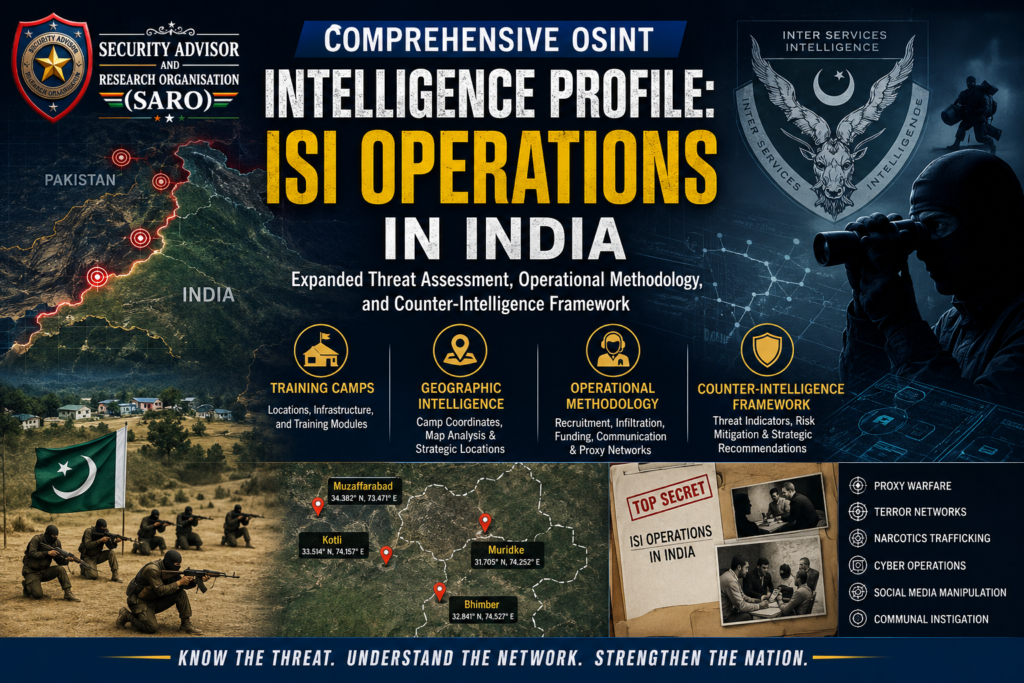
1. EXECUTIVE THREAT MATRIX
| Threat Category | Risk Level | Current Trend | Priority | Likelihood | Impact |
|---|---|---|---|---|---|
| Terrorism | High | Stable | Critical | High | Catastrophic |
| Espionage | High | Increasing | Critical | High | Severe |
| Cyber Operations | Medium-High | Rapid Growth | High | High | Moderate-Severe |
| Financial Networks | Medium | Increasing | High | Medium | Severe |
| Information Warfare | High | Rapid Growth | Critical | High | Moderate |
| Social Media Manipulation | High | Increasing | High | High | Moderate |
ORGANIZATIONAL HIERARCHY (INDIA DESK)
| Organizational Level | Bureau / Directorate | Sub-Unit / Desk | Key Personnel / Rank | Primary Responsibilities / Focus Areas | Locations / Notes |
|---|---|---|---|---|---|
| Top Leadership | Director General (DG) ISI | N/A | Lt. Gen. Muhammad Asim Malik (Appointed Sept 2024) | Oversees all strategic India-facing operations. | Headquarters, Islamabad |
| Senior Leadership | Deputy Directors | N/A | 2–3 Major Generals (Addl. DG level) | Manage the overall India portfolio; report directly to the DG. | Headquarters, Islamabad |
| Intelligence Bureau | Joint Intelligence Bureau (JIB) | India Political Desk | Desk Chiefs / Brigadier Level | Monitors Indian political parties, elections, and civil society. | Focus on political intelligence gathering. |
| Intelligence Bureau | Joint Intelligence Bureau (JIB) | Internal Security Desk | Desk Chiefs / Brigadier Level | Tracks dissent, farmer protests, and minority grievances for exploitation. | Focus on internal vulnerabilities in India. |
| Counter-Intelligence | Joint Counter-Intelligence Bureau (JCIB) | Joint Intelligence North (JIN) | Operational Commanders | Primary operational wing for Jammu & Kashmir. Manages infiltration, exfiltration, and Overground Worker (OGW) networks. | Active in J&K theater. |
| Signal Intelligence | Joint Signal Intelligence Bureau (JSIB) | SIGINT India Desk | SIGINT Specialists / Officers | Intercepts cross-border communications, monitors Indian military frequencies, and manages communication relays for infiltrators. | Electronic and signals surveillance. |
| Technical Intelligence | Joint Intelligence Technical Bureau (JITB) | Cyber India Cell | Cyber Warfare Specialists | Conducts phishing, malware deployment (e.g., APT36), and manages digital dead drops. | Focus on cyber espionage and digital operations. |
| Operations Bureau | Joint Intelligence Operations Bureau (JIOB) | Covert Action Division | Operations Directors | Directs proxy groups (LeT, JeM, TRF), manages drone logistics, and oversees arms smuggling. | Paramilitary and covert action execution. |
| Regional Command | Regional Directorates | Lahore Directorate | Regional Director (Maj. Gen. / Brig.) | Punjab and Khalistan-focused operations. | Lahore, Pakistan |
| Regional Command | Regional Directorates | Karachi Directorate | Regional Director (Maj. Gen. / Brig.) | Sindh and maritime-focused operations. | Karachi, Pakistan |
| Regional Command | Regional Directorates | Peshawar / Quetta Directorate | Regional Director (Maj. Gen. / Brig.) | Afghan border operations; serves as a logistics hub for J&K operations. | Peshawar / Quetta, Pakistan |
| Infrastructure & Logistics | Safe Houses & Forward Operating Bases (FOBs) | Staging & Logistics Networks | Logistics Handlers / Facilitators | Staging infiltrators, storing logistics, and facilitating cross-border movement. | PoJK: Muzaffarabad, Neelum Valley Punjab, Pak: Muridke, Lahore outskirts |
AREA-WISE OPERATIONS (INDIA DESK)
| Operational Area | Operational Category | Key Activities & Tactics | Target Demographics / Assets | Specific Locations / Corridors | Notable Examples / Notes |
|---|---|---|---|---|---|
| Jammu & Kashmir | Recruitment | Radicalization and recruitment via social media campaigns and influence peddling by local clerics. | Unemployed local youth, radicalized students, displaced families. | Valley-wide, with digital reach across all districts. | Focus on exploiting local socio-economic grievances. |
| Infiltration Routes | Utilizing “new routes” mapped by Pakistani Army guides to bypass Indian border fences and surveillance. | Infiltrating Foreign Terrorists (FTs) and handlers. | Poonch, Rajouri, and Kupwara sectors. | Dynamic route shifting to counter Indian border security upgrades. | |
| OGW Networks | Provision of ground-level logistics including food, shelter, local SIM cards, and cash. | Foreign Terrorists (FTs) and visiting handlers. | Distributed sleeper cells across rural and semi-urban areas. | Overground Workers (OGWs) act as the critical backbone for FT survival. | |
| Communication | Use of encrypted messaging, physical dead drops, and coded messages relayed through local businesses. | Operational commanders and field operatives. | Telegram, Signal, and front businesses (e.g., shops, transport). | Low-tech (dead drops) combined with high-tech (encryption) for resilience. | |
| Command & Control | Operational direction and tactical planning delegated to mid-level commanders. | Local militant cadres and OGW networks. | Operating primarily from Pakistan-occupied Kashmir (PoK). | Historical figures like Bashir Ahmed Malik (neutralized); current ops led by mid-level LeT/JeM/TRF commanders. | |
| Punjab | Khalistan Support | Providing funding, training, and logistical support to destabilize the state and fuel separatist sentiment. | Pro-Khalistan outfits and radical elements. | State-wide, with focus on Malwa and Majha regions. | Outfits include Waris Punjab Deen, Sikhs for Justice (SFJ), etc. |
| Narcotics Trafficking | Facilitating the cross-border flow of drugs to fund terror activities and corrupt local youth. | Youth demographics and criminal syndicates. | Afghan heroin routed through Pakistan into Punjab. | Drug money is directly funneled into terror financing networks. | |
| Drone Operations | Heavy reliance on modified commercial drones for cross-border payload delivery. | Smuggling networks and recipient cells. | Night-time operations over border villages. | Payloads include weapons, ammunition, cash, and narcotics. | |
| Cross-Border Smuggling | Exploiting geographical vulnerabilities for nocturnal human and contraband smuggling. | Human smugglers, drug peddlers, and arms traffickers. | Fazilka, Amritsar, and Gurdaspur (fertile, flat border terrain). | Terrain makes physical fencing and surveillance challenging. | |
| Delhi NCR | Espionage | Intelligence gathering via honey traps, fake employment offers, and social engineering. | Defense personnel, DRDO scientists, and government bureaucrats. | New Delhi, Gurugram, Noida, and Ghaziabad. | High-value target acquisition for strategic and defense intelligence. |
| Sleeper Cells | Activation of dormant modules for specific, time-bound reconnaissance or sabotage tasks. | Local recruits with clean backgrounds and access. | Urban and peri-urban centers (e.g., Ghaziabad). | Example: The publicly reported 2025–2026 Ghaziabad spy module. | |
| Diplomatic Cover | Conducting clandestine meetings, intelligence handovers, and asset handling under diplomatic immunity. | Field operatives and recruited assets. | Pakistan High Commission, New Delhi. | Misuse of diplomatic channels for covert operational management. | |
| Front Organizations | Establishing fake entities to gain legitimate access to sensitive government and policy circles. | Policymakers, journalists, and mid-level government staff. | Registered as NGOs, research think tanks, or media outlets. | Provides a veneer of legitimacy for intelligence gathering. |
Key Abbreviations & Acronyms Used:
- OGW: Overground Worker
- FT: Foreign Terrorist
- LeT: Lashkar-e-Taiba
- JeM: Jaish-e-Mohammed
- TRF: The Resistance Front
- PoK: Pakistan-occupied Kashmir
- NCR: National Capital Region (India)
- SFJ: Sikhs for Justice
RECRUITMENT METHODOLOGY (INDIA DESK)
| Recruitment Category | Sub-Category / Platform | Target Demographic / Audience | Modus Operandi / Tactics | Primary Objective / End Goal |
|---|---|---|---|---|
| Honey Traps | Social Media / Online Dating | Indian military, paramilitary personnel, and defense contractors | Creation of fake female personas to initiate contact, build trust, and establish relationships. | Extract sensitive information, map networks, or compromise targets for future blackmail/coercion. |
| Fake Employment Offers | Online Job Portals, Social Media | Students and unemployed youth, particularly in border states | Posting deceptive job openings for roles like data entry, translation, or “independent research.” | Recruit low-level assets, gather local intelligence, or establish logistical footholds under the guise of legitimate work. |
| Front Organizations | Fake NGOs & Research Orgs | Academics, researchers, policy analysts, and journalists | Offering fake grants, fellowships, or collaborative research projects to build rapport. | Extract policy insights, establish intellectual influence, or map sensitive government/defense networks. |
| Ideological Infiltration | Religious & Student Groups | University students, campus political groups, and youth leaders | Infiltrating campus politics and providing covert funding to radical or fringe student unions. | Foster anti-state narratives, normalize dissent, and identify radicalized individuals for long-term recruitment. |
| Social Media: Telegram | Encrypted Messaging App | General public, potential recruits, and existing OGWs | Utilizing broadcast channels for mass propaganda and encrypted 1-on-1 direct messaging. | Mass radicalization and secure, covert one-on-one recruitment and vetting. |
| Social Media: WhatsApp | Encrypted Messaging App | Overground Workers (OGWs) and local sympathizer networks | Mass messaging campaigns and closed, invite-only group coordination. | Day-to-day operational coordination, rapid dissemination of instructions, and maintaining group cohesion. |
| Social Media: Instagram | Visual Social Media Platform | Minors, teenagers, and young adults | Disseminating visual propaganda and using Direct Messaging (DM) for targeted grooming. | Early-stage radicalization, exploitation of vulnerabilities, and grooming of minors for future operational use. |
| Fake Journalism | Media / Field Operations | Defense personnel, bureaucrats, and restricted area staff | Operatives posing as freelance journalists, stringers, or documentary filmmakers. | Gain unauthorized physical or informational access to restricted areas, border zones, or defense installations for reconnaissance. |
Key Abbreviations & Acronyms Used:
- OGW: Overground Worker
- DM: Direct Message
- NGO: Non-Governmental Organization
DIGITAL INFRASTRUCTURE (INDIA DESK)
| Infrastructure Category | Specific Tools / Examples | Target Profile | Modus Operandi / Mechanism | Strategic Objective |
|---|---|---|---|---|
| Malware Families | Transparent Tribe (APT36), SideWinder, GravityRAT, custom Android spyware | Defense personnel, government employees, civilian targets | Disguised as legitimate utility apps (e.g., PDF readers, battery savers) to bypass initial suspicion. | Persistent surveillance, keystroke logging, and exfiltration of sensitive data from compromised devices. |
| Phishing Campaigns | Spear-phishing emails with malicious attachments or links | Defense contractors, senior government officials, bureaucrats | Mimicking legitimate Indian government portals (e.g., fake NIC or MeitY domains) to build false trust. | Credential theft, initial network access, and deployment of secondary malware payloads. |
| Fake Domains | Typosquatting domains (e.g., slight misspellings of legitimate URLs) | General public, government employees, media consumers | Registering domains that visually mimic major Indian news outlets or official government services. | Harvest login credentials, distribute malware, and lend credibility to disinformation campaigns. |
| Command & Control (C2) | Rotated C2 servers, compromised legitimate websites | Infected endpoints and recruited digital assets | Hosting C2 infrastructure on compromised WordPress/Joomla sites or using “bulletproof” hosting in jurisdictions with lax cyber laws. | Maintain resilient, hard-to-trace, and takedown-resistant communication channels with infected assets. |
| Cryptocurrency Financing | USDT (Tether), Bitcoin (BTC) wallets | Local recruits, Overground Workers (OGWs), facilitators | Executing micro-payments laundered through decentralized exchanges (DEXs) and mixing services. | Enable covert, cross-border, and largely untraceable financing and payroll for operational networks. |
| Operational Security (OPSEC) | Commercial VPNs, TOR bridges, proxy chains | ISI handlers, cyber operatives, field coordinators | Mandatory routing of all operational traffic through multiple anonymizing layers to mask true origin. | Evade Indian cyber defense attribution, geolocation, and network traffic analysis (masking Pakistan-based IPs). |
| Dark Web Utilization | Darknet marketplaces and encrypted forums | N/A (Acquisition channel) | Occasional procurement of zero-day exploits or hiring freelance cybercriminals for targeted DDoS attacks. | Acquire advanced offensive capabilities or outsource disruptive attacks while maintaining plausible deniability. |
Key Abbreviations & Acronyms Used:
- APT: Advanced Persistent Threat
- NIC: National Informatics Centre (India)
- MeitY: Ministry of Electronics and Information Technology (India)
- C2: Command and Control
- DEX: Decentralized Exchange (Cryptocurrency)
- OPSEC: Operational Security
- TOR: The Onion Router
- DDoS: Distributed Denial of Service
DRONE OPERATIONS (INDIA DESK)
| Operational Category | Specific Assets / Details | Modus Operandi / Tactics | Target Locations / Drop Zones | Strategic Objective / Impact |
|---|---|---|---|---|
| Hardware | DJI (Mavic, Phantom series) and Chinese-made agricultural drones | Commercially available drones modified internally for increased payload capacity and extended battery life. | N/A (Operational Asset) | Utilize reliable, off-the-shelf technology that is easy to replace and difficult to trace back to state sponsors. |
| Flight Tactics | Autonomous GPS waypoint programming | Night drops (post-midnight) to avoid visual and thermal detection; pre-programmed autonomous border crossing and return flights. | Punjab border villages and fields | Minimize risk to human operators, evade border surveillance, and ensure drone recovery for reuse. |
| Payloads: Narcotics | Heroin, MDMA, and synthetic opioids | Packaged in weather-resistant, GPS-tracked bundles. This is the primary payload by volume. | Pre-arranged or dynamically coordinated OGW drop zones | Fund terror networks, sustain proxy operations, and corrupt local youth demographics. |
| Payloads: Arms & Finance | Pistol parts, magazines, Chinese-made pistols, and cash bundles | Disassembled or compactly packaged to maximize weight limits and evade basic visual identification. | Secure OGW reception points in Punjab | Arm sleeper cells and Overground Workers without the high risk of traditional human border infiltration. |
| Target Sectors | Fazilka, Amritsar, Tarn Taran, and Gurdaspur | Exploitation of flat, fertile terrain and specific blind spots in border fencing and surveillance. | International Border (IB), Punjab | Establish reliable, high-volume, and low-risk smuggling corridors. |
| Counter-Operational Context | Border Security Force (BSF) Interceptions | Public reports indicate active electronic warfare (jamming), kinetic neutralization, and physical seizures by Indian forces. | Punjab border sectors (2022–2025) | Note: Over 150+ drones and significant contraband seized in this period alone, highlighting the scale of the threat and the ongoing cat-and-mouse dynamic. |
Key Abbreviations & Acronyms Used:
- DJI: Da-Jiang Innovations (Chinese drone manufacturer)
- OGW: Overground Worker
- BSF: Border Security Force (India)
- IB: International Border
COMMUNICATION TECHNIQUES (INDIA DESK)
| Communication Category | Specific Tools / Mechanisms | Modus Operandi / Tactics | Target Users / Operational Context | Strategic Objective / Advantage |
|---|---|---|---|---|
| Encrypted Messaging | Telegram (Secret Chats), Signal, WhatsApp (disappearing messages), Briar, Matrix | Utilization of End-to-End Encryption (E2EE), self-destructing messages, and decentralized protocols. | Field operatives, handlers, and Overground Worker (OGW) networks. | Prevent content interception and metadata analysis by intelligence and law enforcement agencies. |
| Satellite Phones | Thuraya, Iridium devices | Direct-to-satellite communication that completely bypasses local terrestrial cellular towers and infrastructure. | High-Value Targets (HVTs) and top-tier militant commanders in Jammu & Kashmir. | Evade terrestrial network monitoring, cell tower triangulation, and IMSI-catcher (Stingray) devices. |
| VOIP Services | Voice Over IP routed through proxy servers | Calls are deliberately routed through servers in third-party countries (e.g., Thailand, Sri Lanka, Indonesia) to spoof caller ID. | Remote handlers communicating with assets or recruits inside India. | Create false geographic attribution, complicate traceback efforts, and bypass domestic telecom monitoring. |
| Burner Phones | Pre-paid Indian SIM cards | Procured via fraudulent KYC documentation or through local OGWs; used for short, specific operational windows and then physically destroyed. | Local recruits, logistics coordinators, and temporary field operatives. | Maintain operational anonymity, prevent long-term “pattern of life” tracking, and sever digital links to handlers. |
| Physical Dead Drops | Hollow trees, magnetic boxes under bridges, loose bricks | Asynchronous, contactless exchange of physical items (cash, fresh SIM cards, USB drives) at pre-arranged, concealed locations. | OGWs and field operatives in urban, semi-urban, or border environments. | Eliminate the high risk of face-to-face meetings and subsequent physical surveillance detection. |
| Encrypted Storage | Hardware-encrypted USB drives | Concealed within everyday, innocuous objects to transfer large datasets, intelligence reports, or malware payloads. | Cyber operatives, intelligence couriers, and technical handlers. | Enable secure, offline data transfer, bypassing network-based Data Loss Prevention (DLP) and firewall systems. |
Key Abbreviations & Acronyms Used:
- E2EE: End-to-End Encryption
- HVT: High-Value Target
- OGW: Overground Worker
- VOIP: Voice Over Internet Protocol
- KYC: Know Your Customer (identity verification process)
- IMSI: International Mobile Subscriber Identity (often targeted by “IMSI catchers” or Stingrays)
- DLP: Data Loss Prevention
WEAPONS INTELLIGENCE (INDIA DESK)
| Weapon Category | Specific Variants / Types | Characteristics / Composition | Primary Use / Operational Context | Source / Strategic Notes |
|---|---|---|---|---|
| Firearms: Assault & Combat | AK-47 variants (including Chinese Type 56), M4 carbines, MP5 submachine guns | Standard-issue military assault rifles and high-rate-of-fire close-quarters weapons. | Primary tools for kinetic ambushes, attacking security camps, and sustained firefights with security forces. | High-grade foreign arms smuggled across the LoC/IB via drones, infiltration routes, or underground networks. |
| Firearms: Concealable | Glock pistols, locally made “country-made” pistols | Compact, easily concealable handguns with varying degrees of reliability and stopping power. | Targeted assassinations, urban skirmishes, personal defense for handlers/OGWs, and snatching operations. | Glocks are smuggled internationally; country-made pistols are procured cheaply from domestic illegal arms markets. |
| Explosives: Military-Grade | RDX, PETN, TNT | High-velocity, military-grade chemical explosives requiring specialized detonators. | Fabrication of sophisticated IEDs, shaped charges for bunkers, and targeted vehicle sabotage. | Infiltrated primarily from across the border; tightly controlled and highly sought after for high-profile attacks. |
| Explosives: Commercial / IEDs | Ammonium nitrate-based IEDs | Utilizes commercially available agricultural fertilizer mixed with fuel oil (ANFO) or other sensitizers. | Large-volume Vehicle-Borne IEDs (VBIEDs), road-side bombs, and infrastructure sabotage. | Sourced locally from agricultural or industrial markets to bypass border checks and reduce reliance on smuggled military explosives. |
| Ordnance: Anti-Armor | RPG-7 rocket launchers | Shoulder-fired, unguided, anti-tank rocket-propelled grenades. | High-impact ambushes on armored security convoys, fortified checkpoints, and bunkers. | Extremely difficult to smuggle due to size and weight; requires dedicated, high-risk logistical chains to move across borders. |
| Ordnance: Indirect Fire | Mortar shells (60mm / 81mm) | Indirect fire, high-explosive projectiles designed for plunging fire. | Harassment fire on military installations, border outposts (BOPs), and staging areas from concealed positions. | Used to attack fortified targets without exposing operatives to direct line-of-sight return fire. |
| Ordnance: Anti-Personnel | Hand grenades (F1 variants) | Defensive fragmentation grenades designed to scatter shrapnel over a wide radius. | Urban skirmishes, escaping security cordons, and attacking soft targets in crowded areas. | Easy to conceal and transport; frequently recovered from militant caches and OGW hideouts. |
TRAINING CAMPS (PUBLICLY REPORTED)
| Camp Location | Province / Region | Primary Purpose | Est. Capacity | Key Focus Areas / Tactics | Strategic Significance |
|---|---|---|---|---|---|
| Muzaffarabad | PoJK | Basic Terrorist Training & Ideology | 300+ | Radicalization, basic firearms handling, physical conditioning, indoctrination. | Initial induction and ideological grooming center for new recruits before advanced facilities. |
| Muridke | Punjab, Pakistan | LeT Headquarters & Advanced Weapons | 500+ | Advanced marksmanship, complex explosives handling, tactical urban warfare, strategic planning. | Primary, historically significant hub for Lashkar-e-Taiba (LeT); major logistical, financial, command center. |
| Balakot | Khyber Pakhtunkhwa | Advanced Guerrilla & Mountain Warfare | 150+ | High-altitude survival, ambush tactics, navigation in rugged terrain, cold-weather operations. | Specifically designed to prepare operatives for harsh, mountainous terrain of Jammu & Kashmir. |
| Manshera | Khyber Pakhtunkhwa | IED Fabrication & Survival Tactics | 200+ | Construction of IEDs, evasion techniques, fieldcraft, counter-interrogation. | Focuses on technical sabotage skills and sustaining operatives in hostile, denied environments. |
| Kotli | PoJK | Infiltration Staging & Drone Operations | 100+ | Commercial drone piloting, payload attachment, route mapping, final briefings before crossing LoC/IB. | Forward staging area and specialized training node for modern asymmetric warfare. |
GEOGRAPHIC INTELLIGENCE
Disclaimer: Coordinates are approximate, publicly reported reference points for known historical facilities, and do not constitute real-time targeting data.
| Facility / Location | Approximate Coordinates (Lat/Long) | Elevation | Terrain Characteristics | Strategic / Operational Notes |
|---|---|---|---|---|
| Muridke (LeT Headquarters) | ~31.45° N, 74.25° E | ~220m | Flat, agricultural plains near Lahore. | High visibility area but features a heavily guarded, fortified compound. Serves as a primary logistical, financial, and command hub. |
| Muzaffarabad Training Complex | ~34.37° N, 73.47° E | ~730m | Hilly, forested, proximate to the Neelum River. | Provides natural canopy cover from commercial satellite imagery. Located approximately ~30 km from the Line of Control (LoC), facilitating rapid staging. |
| Balakot Area | ~34.85° N, 73.35° E | ~1,000m+ | Rugged, mountainous, dense forest. | Ideal environment for covert, advanced mountain warfare training, high-altitude survival, and evasion tactics away from urban surveillance. |
HISTORICAL & OPERATIONAL TIMELINE (1948–2026)
| Year / Period | Event / Operation | Key Actors / Groups Involved | Operational Impact / Strategic Shift | Notes / Context |
|---|---|---|---|---|
| 1948 | Establishment of ISI | Inter-Services Intelligence (ISI) | Formalization of Pakistan’s premier intelligence agency following the first Indo-Pak war. | Initially focused on conventional military intelligence gathering. |
| 1965 | Covert Activity in J&K | ISI, local proxies | Increased sabotage and covert operations in Jammu & Kashmir during the second Indo-Pak war. | Marked the early use of non-state actors to supplement conventional military efforts. |
| 1971 | Post-War Intelligence Restructuring | ISI, Military Leadership | Major strategic pivot following the Bangladesh Liberation War. | Shifted focus from conventional warfare to asymmetric warfare and proxy cultivation. |
| 1980 | Operation Tupac | ISI, militant proxies | Systematic initiation of insurgency and destabilization campaigns in J&K and Punjab. | Long-term strategic blueprint for fomenting unrest and supporting separatist movements. |
| 1993 | Mumbai Serial Bombings | D-Company, alleged ISI links | Large-scale urban terror attack demonstrating the capability to strike deep inside Indian economic hubs. | Highlighted the nexus between organized crime syndicates and state-sponsored intelligence. |
| 1999 | IC-814 Hijacking | Harkat-ul-Ansar / Harkat-ul-Mujahideen | High-profile aviation hijacking to Kandahar, Afghanistan, resulting in the release of imprisoned militants. | Demonstrated the use of extreme coercion and international leverage for prisoner exchanges. |
| 2001 | Indian Parliament Attack | Jaish-e-Mohammed (JeM), Lashkar-e-Taiba (LeT) | Direct assault on the seat of the Indian government, bringing the two nations to the brink of war. | Catalyzed massive Indian military mobilization (Operation Parakram) and global designation of involved groups as terrorist entities. |
| 2008 | 26/11 Mumbai Attacks | Lashkar-e-Taiba (LeT), alleged ISI logistical support | Highly coordinated, multi-site urban siege lasting several days, causing massive casualties and global condemnation. | Showcased advanced training, real-time remote command and control, and maritime infiltration tactics. |
| 2019 | Pulwama Suicide Attack | Jaish-e-Mohammed (JeM) | Devastating vehicle-borne IED (VBIED) attack on a Central Reserve Police Force (CRPF) convoy in J&K. | Led to Indian airstrikes (Balakot) and a significant escalation in cross-border military posturing. |
| 2020–2024 | Drone Smuggling Surge | ISI, OGWs, criminal syndicates | Massive increase in the use of commercial drones for cross-border narcotics and weapons smuggling into Punjab. | Adaptation to heightened border security (fencing, surveillance) by shifting to low-altitude, autonomous aerial logistics. |
| 2025 | Pahalgam Attack & Cyber Surge | The Resistance Front (TRF), JITB / APT36 | Attack on tourist infrastructure in J&K, coupled with a documented spike in state-sponsored cyber-espionage campaigns. | Reflects a dual-track strategy: kinetic attacks on soft economic targets (tourism) and non-kinetic digital infiltration. |
| 2026 | Ghaziabad/Delhi NCR Spy Modules | ISI, front organizations, recruited minors | Uncovering of major espionage networks in the National Capital Region and subsequent crackdowns on social media grooming. | Highlights the persistent threat to the strategic heartland and the evolving tactic of radicalizing minors via digital platforms. |
MAJOR TERRORIST ATTACKS (1993–2025)
| Date | Event / Location | Casualties | Perpetrator / Details | Alleged ISI Link / Modus Operandi |
|---|---|---|---|---|
| Mar 1993 | Mumbai Bombings Mumbai, Maharashtra | 257 killed, 1,400+ injured | 13 coordinated explosions targeting Bombay Stock Exchange, Air India Building, and major hotels. | Dawood Ibrahim’s D-Company allegedly received ISI support; RDX sourced with ISI assistance; conspirators trained in Pakistan. |
| May 1996 | Lajpat Nagar Blast Delhi | 13 killed, 39 injured | Jammu Kashmir Islamic Front (JKIF). | Bombers maintained close contact with ISI handlers. Delhi court convicted JKIF members in 2012, explicitly noting ISI links. |
| Feb 1998 | Coimbatore Bombings Coimbatore, Tamil Nadu | 58 killed, 200+ injured | 12 bomb attacks timed before a BJP rally by L.K. Advani. | Local group Al-Umma allegedly served as fertile ground and logistical conduit for ISI activities in South India. |
| Dec 2000 | Red Fort Attack Delhi | 2 soldiers, 1 civilian killed | Lashkar-e-Taiba (LeT). | LeT is a Pakistan-based group with alleged ISI backing. Recovered weapons featured Urdu markings, indicating cross-border supply. |
| Dec 1999 | IC-814 Hijacking Kathmandu to Kandahar | 1 killed (passenger), 160+ held hostage | Indian Airlines flight hijacked to Kandahar, Afghanistan. | All 5 hijackers were Pakistani nationals. Planned in Kathmandu (an ISI hub) over 2 months. Dawood Ibrahim facilitated airport access. Former RAW chief A.S. Dulat stated: “No doubt ISI had a role.” ISI officers reportedly present in Kandahar. |
| Dec 2001 | Parliament Attack New Delhi | 9 killed (incl. 5 terrorists) | Jaish-e-Mohammed (JeM). | All 5 terrorists were Pakistani nationals. Delhi Police stated the operation was guided by ISI. Key conspirator Mohammad Afzal Guru was trained at an ISI camp in Muzaffarabad and assigned tasks by Pakistani national Gazi Baba. |
| Sep 2002 | Akshardham Attack Gujarat | 33 killed, 80+ injured | Lashkar-e-Taiba (LeT). | Attackers directly linked to LeT. Weapons were supplied by a LeT operative who fled to PoK. Training was provided by Pakistan-based outfits. |
| Oct 2005 | Delhi Bombings Delhi (Satyam & Liberty Cinema) | Multiple injured | Babbar Khalsa International (BKI) / Kashmiri militants. | BKI was allegedly part of an ISI-sponsored network. ISI actively forged coordination between Khalistani and Kashmiri terrorist factions. |
| Jul 2006 | Mumbai Train Bombings Mumbai Suburban Railway | 209 killed, 800+ injured | 7 bombs detonated in 11 minutes during evening rush hour. | 4 of 13 accused were Pakistani nationals. LeT masterminded and provided training/arms. Mumbai police chief alleged direct ISI involvement. SIMI had developed links with Pakistani jihadi groups/ISI. |
| Nov 2008 | 26/11 Mumbai Attacks Mumbai (multiple locations) | 166 killed, 300+ injured | Lashkar-e-Taiba (LeT). | Zabiuddin Ansari testified that ISI and Pakistani army officials were involved in planning. David Headley interrogation revealed ISI provided funding for reconnaissance. LeT commander Zaki-ur-Rahman Lakhvi had close ISI ties. |
| Feb 2019 | Pulwama Attack Pulwama, J&K | 40 CRPF personnel killed | Jaish-e-Mohammed (JeM) suicide bombing on a CRPF convoy. | JeM operates with alleged ISI logistical, financial, and strategic support. |
| Apr 2025 | Pahalgam Attack Pahalgam, J&K | Multiple tourist deaths | The Resistance Front (TRF), an LeT offshoot. | TRF is allegedly backed, funded, and directed by ISI to maintain plausible deniability while targeting soft economic assets (tourism). |
ESPIONAGE CASES (2020s)
Note: These cases highlight the shift toward hybrid warfare, leveraging cyber tools, social media grooming, and criminal networks to recruit assets within India.
| Date / Year | Case Name / Target | Location | Modus Operandi / Tactics | ISI Link / Handler | Strategic Implication |
|---|---|---|---|---|---|
| 2023 | Labhshankar Maheshwari | Nationwide (Delhi HQ) | Pakistani origin, resided in India for 17 years. Assisted agents in procuring Indian SIM cards; facilitated hacking of defense personnel’s children’s phones. | Direct coordination with Pakistani intelligence agents. | Highlights the use of long-sleeper, deep-cover assets for logistical and cyber facilitation. |
| Feb 2024 | Satendra Siwal | Meerut / Moscow | Indian Embassy employee in Moscow. Arrested for sharing classified military information. | Direct transmission of classified data to ISI handlers. Booked under the Official Secrets Act. | Demonstrates targeting of Indian diplomatic and defense personnel stationed abroad. |
| Jun 2025 | Gurpreet Singh & Sahil Masih | Amritsar, Punjab | Arrested by Amritsar Rural Police for transmitting sensitive information via concealed pen drives. | Direct contact with ISI operatives. Handler identified as Rana Javed. | Classic human intelligence (HUMINT) recruitment in a sensitive border state. |
| Dec 2025 | Nazir Ahmad Malik & Sabir Ahmed Mir | Kupwara, J&K / Arunachal Pradesh | Posed as clothes sellers in Arunachal Pradesh to map and collect Indian Army movement data. | Transmitted collected data via encrypted Telegram channel “Al-Aqsa” to ISI handlers. | Use of commercial cover for strategic reconnaissance in a sensitive, non-traditional theater (Arunachal Pradesh). |
| Jan 2026 | Ambala Contractor | Ambala, Haryana | Honey-trapped by ISI operatives over a 7-month period. Attempted to pass defense installation information. | Sustained psychological manipulation and coercion by ISI handlers. | Exploitation of personal vulnerabilities to compromise individuals with access to defense infrastructure. |
| Mar 2026 | Ghaziabad Spy Module | Ghaziabad / Delhi NCR | 22+ arrests. Youths recruited to film military sites and conduct surveillance along the Delhi-Jammu railway corridor. | Handlers: Suhail Malik, Naushad Ali, Sameer “Shooter”. 450+ files traced back to Pakistan. | Large-scale, organized espionage ring targeting strategic transportation and military infrastructure in the National Capital Region. |
| Jan 2026 | Minor from Pathankot | Pathankot, Punjab | 15-year-old groomed via social media. Shared sensitive details of local security installations. | ISI handlers conducting targeted online grooming. ~37 other minors currently under scanner for similar exploitation. | Alarming shift toward radicalizing and weaponizing minors via digital platforms. |
| May 2026 | YouTuber Espionage Ring | New Delhi / Online | Indian YouTuber Jyoti Malhotra arrested. Cultivated as an asset since 2023 to target Indian influencers visiting Pakistan. | Handler: Ex-Pak sub-inspector turned YouTuber “Nasir”. Facilitated by Mohammad Ehsan Ur Rahim (Pak High Commission staffer, declared persona non grata). | Exploitation of media and social influence for intelligence gathering and narrative shaping under diplomatic cover. |
| 2025–2026 | Shahzad Bhatti Network | Delhi, Punjab, UP | Pakistan-based gangster masterminded a grenade attack on a Gurdaspur police station. Recruited youth via Instagram/WhatsApp, directed weapons consignments, and promised US settlement. | Shahzad Bhatti acting as a proxy facilitator for ISI-directed destabilization in Punjab. | Convergence of organized crime, social media recruitment, and state-sponsored terrorism. |
Key Abbreviations & Acronyms Used:
- OSINT: Open-Source Intelligence
- LeT / JeM / TRF: Lashkar-e-Taiba / Jaish-e-Mohammed / The Resistance Front
- SIMI: Students’ Islamic Movement of India
- BKI: Babbar Khalsa International
- CRPF: Central Reserve Police Force
- RAW: Research and Analysis Wing (India’s external intelligence agency)
- PoK: Pakistan-occupied Kashmir
- HUMINT: Human Intelligence
NETWORK ANALYSIS (RELATIONSHIP MAPPING)
| Source Entity (Sponsor) | Nature of Relationship / Support | Primary Proxy / Affiliate Node | Secondary / Sub-Affiliated Nodes | Strategic Function / Operational Impact |
|---|---|---|---|---|
| ISI (JCIB / JIOB) | Funds, Arms, Training | Lashkar-e-Taiba (LeT) | The Resistance Front (TRF) | Primary proxy for cross-border terrorism and J&K operations. TRF serves as a rebranded operational front to maintain plausible deniability. |
| ISI (JCIB / JIOB) | Funds, Arms, Training | Jaish-e-Mohammed (JeM) | N/A | Executes high-impact, ideological, and suicide-oriented attacks in J&K and mainland India. |
| ISI (JCIB / JIOB) | Logistical Support | Hizbul Mujahideen (HM) | N/A | Indigenous J&K militant group; relies on state sponsorship for cross-border weapons, funds, and tactical direction. |
| ISI (JCIB / JIOB) | Financial / Criminal Nexus | D-Company / Underworld Syndicates | Hawala Operators / Shell Companies | Facilitates covert terror financing, money laundering, and the procurement of illegal arms and narcotics. |
| ISI (JCIB / JIOB) | Cyber Enablement | Transparent Tribe (APT36) / Freelance Hackers | N/A | Conducts state-sponsored cyber espionage, data exfiltration, and digital infrastructure disruption against Indian targets. |
| ISI (JCIB / JIOB) | Destabilization Funding | Pro-Khalistan Outfits (e.g., WFJ, SPJ) | N/A | Fuels separatist sentiment and unrest in Punjab; coordinates with narcotics smugglers and drone operators to destabilize the region. |
Key Abbreviations & Acronyms Used:
- JCIB: Joint Counter-Intelligence Bureau
- JIOB: Joint Intelligence Operations Bureau
- LeT: Lashkar-e-Taiba
- TRF: The Resistance Front
- JeM: Jaish-e-Mohammed
- HM: Hizbul Mujahideen
- APT36: Advanced Persistent Threat 36 (Transparent Tribe)
- WFJ / SPJ: Pro-Khalistan Outfits (as referenced in the network data)
INTELLIGENCE INDICATORS & WARNING (I&W)
| Indicator Category | Specific Warning Signs | Modus Operandi / Mechanism | Target / Affected Area | Strategic Implication / Required Action |
|---|---|---|---|---|
| Physical / Border | Increased LoC Movement | Unusual artillery suppression fire or covert movement of Pakistani Army / border units near known infiltration launch pads. | Line of Control (LoC), Jammu & Kashmir | High Alert: Imminent attempt to infiltrate Foreign Terrorists (FTs) or push logistics across the border. Requires heightened surveillance and rapid response deployment. |
| Aerial / Logistics | Drone Activity Surge | Spike in civilian drone purchases, unauthorized flights, or visual sightings of low-flying UAVs in border villages. | Punjab and J&K border districts | Interdiction Required: High probability of impending cross-border payload drops (weapons, narcotics, cash). Requires activation of anti-drone (C-UAS) systems and local vigilance. |
| Digital / Cyber | Anomalous Digital Footprints | Sudden creation of new, anonymous Telegram channels targeting specific Indian demographics; spike in phishing emails mimicking Indian government domains (e.g., NIC, MeitY). | National (Digital Infrastructure), Defense & Govt. Personnel | Cyber Defense Posture: Indicates active reconnaissance, recruitment drives, or preparation for a coordinated cyber-espionage or disruption campaign. Requires immediate threat hunting and user awareness alerts. |
| Financial / Economic | Suspicious Transaction Patterns | Unexplained spikes in USDT/crypto transfers to Indian wallets; sudden registration of multiple shell companies with identical nominee directors. | National Banking Networks, Crypto Exchanges | Financial Intelligence (FININT) Action: Strong indicator of terror financing, money laundering, or funding for sleeper cells. Requires immediate flagging by FIU-IND and freezing of suspect accounts. |
| Human / Social | Anomalous Human Behavior | Multiple prepaid SIM purchases by a single individual; unusual contact between local youth and foreign nationals via social media; suspicious inquiries by “journalists” or “researchers” near defense installations. | Urban centers, border towns, vicinity of defense installations | Counter-Intelligence (CI) Action: Indicates active recruitment, sleeper cell activation, or physical reconnaissance. Requires discreet surveillance, KYC audits, and coordination with local law enforcement. |
Key Abbreviations & Acronyms Used:
- I&W: Indicators and Warning
- LoC: Line of Control
- FT: Foreign Terrorist
- C-UAS: Counter-Unmanned Aircraft Systems
- NIC / MeitY: National Informatics Centre / Ministry of Electronics and Information Technology (India)
- FIU-IND: Financial Intelligence Unit – India
- KYC: Know Your Customer
STRATEGIC INTELLIGENCE ASSESSMENT: PAKISTAN ISI – PUNJAB DESK: OPERATIONS, STRUCTURE & EVOLUTION