
AGENCY: Central Intelligence Agency (CIA) – Office of Global Issues (OGI) & Office of Near Eastern and South Asian Analysis (NESA)
DATE OF PUBLICATION: June 1986
CLASSIFICATION: Originally SECRET // Declassified & Sanitized (2011)
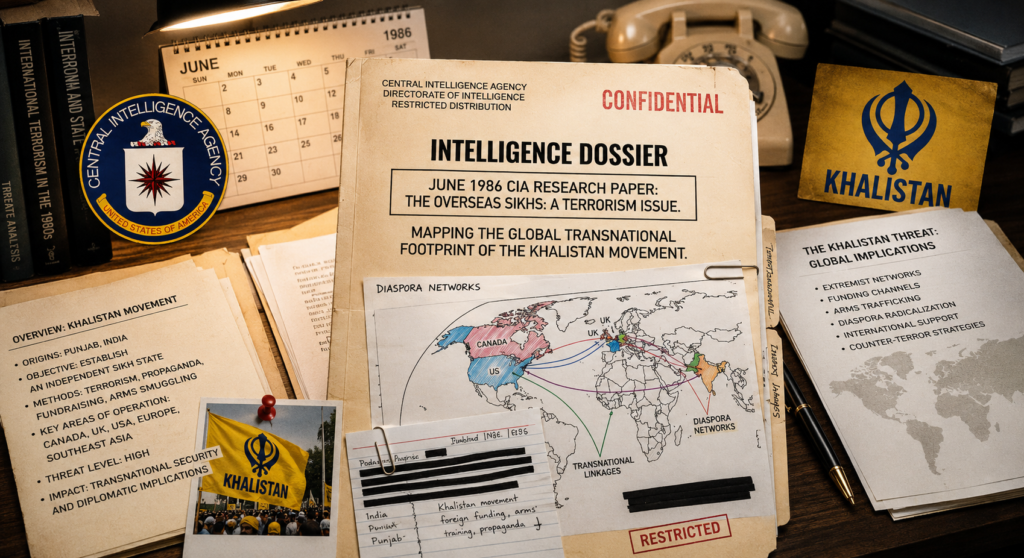
Document Overview
This 1986 intelligence assessment analyzes the global Sikh separatist movement (the push for an independent fundamentalist nation called Khalistan) and evaluates the threat posed by Sikh extremists operating outside of India. The report was prepared during a highly volatile period in Indian history, shortly after the 1984 Indian Army assault on the Golden Temple (Operation Blue Star), the assassination of Prime Minister Indira Gandhi, and the ongoing insurgency in Punjab.
Key Findings & Themes
1. The Core Conflict & Radicalization
- Political to Militant Shift: The report notes that while most Sikhs historically sought greater autonomy for Punjab within India, the 1984 military assault on the Golden Temple and subsequent anti-Sikh violence radicalized a significant portion of the community.
- Extremist Goals: A hardcore fringe, led by fundamentalist leaders, rejected political compromises (like the 1985 Rajiv-Longowal accord) and resorted to a “holy war” to establish an independent Khalistan.
2. The Role of the Overseas Diaspora
- Global Footprint: Of the 18 million Sikhs worldwide, about 2 million live outside India.
- Hubs for Extremism: The United Kingdom, Canada, and the United States are identified as the primary hubs for Sikh militant operations, fundraising, and internal violent clashes between moderates and extremists for control of local temples (gurdwaras).
- Transit & Safe Havens: The document identifies several countries as logistical waystations or safe havens for militants moving internationally. These include Pakistan (accused of harboring terrorists), Nepal (porous border), Mexico, The Bahamas, Thailand, and West Germany (used as transit routes for illegal immigration to the U.S.).
3. Anticipated Terrorist Targets The CIA assessed that Sikh extremists were highly likely to attack Indian interests abroad. Key targets included:
- Indian Political Leaders: Specifically Prime Minister Rajiv Gandhi and President Zail Singh (who was viewed as a traitor by extremists).
- Air India: Identified as a highly attractive target globally due to its extensive international route network.
- Diplomatic & Commercial Missions: Indian embassies and government-owned banks worldwide.
4. Identified Extremist Organizations The report profiles several key separatist groups operating internationally:
- Khalistan National Organization (KNO): Based in London, led by the self-proclaimed leader of the “Republic of Khalistan,” Jagjit Singh Chauhan.
- Babbar Khalsa: Based heavily in Vancouver, Canada, led by Talwinder Singh Parmar (implicated in the 1985 Air India bombing).
- International Sikh Youth Federation (ISYF) & All India Sikh Students’ Federation (AISSF): Highly active in the UK and Canada, known for using violence to take over local temples.
- Dal Khalsa & World Sikh Organization (WSO): Noted for their radical tactics and international lobbying efforts, respectively.
5. Country Profiles (Appendix) The document concludes with a detailed breakdown of Sikh populations in over 20 countries, categorizing them by their susceptibility to violence, level of pro-separatist sentiment, and likelihood of serving as a terrorist haven (e.g., noting that communities in Malaysia, Australia, and the Middle East were largely peaceful and assimilated, whereas those in the UK, Canada, and Kenya had high pro-separatist sentiments).
PART 1: Extracted Specific Data
A. Principal Overseas Extremist Organizations
The 1986 CIA report identifies six key organizations driving the separatist movement abroad. They ranged from political lobbying groups to violent militant factions:
- Khalistan National Organization (KNO):
- Base: London, UK.
- Leader: Dr. Jagjit Singh Chauhan (self-proclaimed leader of the “Republic of Khalistan”).
- Role: Primarily political and financial. Chauhan created the “Khalistan Council” as an umbrella group and publicly offered financial support to the families of those who assassinated Indira Gandhi.
- Babbar Khalsa:
- Base: Vancouver, Canada (with global reach).
- Leader: Talwinder Singh Parmar.
- Role: Highly violent. Involved in armed clashes for temple control and weapons stockpiling. Parmar was a prime suspect in the 1985 Air India/ Narita Airport bombings.
- International Sikh Youth Federation (ISYF):
- Base: United Kingdom and Canada.
- Role: The most potentially violent group in the UK. Used暴力 (violence) to take over local temples. Four members were charged with conspiring in Indira Gandhi’s assassination.
- All India Sikh Students’ Federation (AISSF):
- Base: Punjab, India (with a branch in Norway).
- Role: The parent organization of the ISYF. Outlawed by India in 1984-1985 for bombings and assassinations.
- Dal Khalsa:
- Base: Punjab, India (banned), with units in the UK, US, and West Germany.
- Role: Modeled after the PLO. Conducted aircraft hijackings and assassinations to establish a fundamentalist religious state.
- World Sikh Organization (WSO):
- Base: Washington, D.C., USA.
- Role: Founded in 1984 as a global umbrella group. Functioned primarily as a political lobby to appeal to Western democracies for Khalistan’s recognition.
B. Country Profiles: Threat Categorization
The CIA categorized the global diaspora based on their threat level, operational utility, and sympathy for the cause:
- Tier 1: High Threat / Operational Hubs (UK, Canada, USA)
- UK: Largest diaspora (300k-400k). Major hub for militant operations, massive fundraising, and the headquarters of the “Republic of Khalistan.”
- Canada: 100k-150k Sikhs. Strong support for Khalistan. Origin point for the 1985 Air India bombing. Active violent clashes between moderates and extremists.
- USA: Target cities include LA, Chicago, and NY. Used for setting up safehouses, recruiting, and receiving illegal immigrants via transit routes.
- Tier 2: Transit Routes & Safe Havens
- Pakistan: Accused of harboring terrorists and allowing border transit.
- Nepal: Porous borders made it a prime transit/safehaven point.
- Mexico, The Bahamas, Thailand, West Germany: Used strictly as logistical waystations for illegal Sikh immigration into the United States.
- Tier 3: High Sympathy, Low Operational Threat
- Kenya: 90% of the community sympathized with separatists. Outraged by the Golden Temple assault, but lacked the infrastructure for global terrorism.
- Tier 4: Assimilated / Quiescent / Low Threat
- Middle East (Kuwait): Conservative businessmen; many actually supported Rajiv Gandhi’s Congress Party.
- Southeast Asia (Malaysia, Thailand, Burma, Indonesia): Well-integrated, focused on business. Openly critical of New Delhi but refused to participate in violence.
- Oceania (Australia, New Zealand): Remote locations, peaceful, law-abiding, and largely integrated.
- Northern Europe (Denmark, Finland): Very small populations, completely assimilated, no radical groups.
PART 2: Historical Analysis (1986 Predictions vs. Reality)
Looking back from the vantage point of 2026, how accurate was this 1986 CIA assessment?
What the CIA Got Right:
- The Diaspora as a Permanent Fault Line: The CIA correctly identified that the overseas diaspora would keep Khalistan an “international issue” indefinitely. While the violence died down in the 1990s, the diaspora networks in Canada, the UK, and the US maintained the political and financial infrastructure that has resurfaced in recent years (e.g., the 2023-2024 diplomatic crises between India and Canada/US over Khalistani militants).
- Air India as a Prime Target: The report accurately identified Air India as a highly vulnerable global target. The 1985 Kanishka bombing had just occurred, and the report correctly predicted that Air India facilities worldwide would remain under constant threat.
- Temple Control as a Battleground: The CIA accurately noted that extremists would use violence to take over gurdwaras (temples) in the West to control funding and community narrative. This remains a defining feature of diaspora Sikh politics today.
What the CIA Got Wrong (or Missed):
- The Imminent Collapse of the Insurgency: The report predicted that “hardcore extremists… will continue their violence indefinitely.” In reality, the Punjab insurgency collapsed much faster than anticipated. By 1992–1995, the Indian state effectively crushed the militancy through aggressive policing, the elimination of key leaders, and the fact that the extremist brutality had alienated the mainstream Sikh population.
- The Assassination of Rajiv Gandhi: The CIA correctly assessed that Rajiv Gandhi was at extreme risk. However, he was assassinated in 1991 by the Liberation Tigers of Tamil Eelam (LTTE), a Sri Lankan Tamil separatist group, not by Sikh extremists.
- Underestimating the “Lull”: The report failed to predict that the movement would transition from violent terrorism in the 1980s to political lobbying and referendums in the 2010s and 2020s.
PART 3: Drafting & Summarization Deliverables
Here are three distinct ways to package this intelligence for different professional uses.
Deliverable A: Executive Presentation Outline
Use this structure if you need to brief a team, class, or policymaker on the document.
- Slide 1: Title & Context
- Document: The Overseas Sikhs: A Terrorism Issue (CIA, June 1986).
- Context: Post-Operation Blue Star (1984), post-Indira Gandhi assassination, peak Punjab insurgency.
- Slide 2: The Core Threat
- Shift from moderate political demands (autonomy) to extremist “holy war” for an independent Khalistan.
- The transformation of the Golden Temple into a terrorist stronghold.
- Slide 3: The Global Diaspora Network
- 2 million Sikhs abroad.
- The “Global Mechanism”: Fundraising, safehouses, and illegal transit routes (e.g., via Mexico/Bahamas to the US).
- Slide 4: Key Extremist Factions
- Violent wings: Babbar Khalsa (Canada), ISYF (UK).
- Political wings: KNO (UK), WSO (USA).
- Slide 5: Vulnerable Targets
- Indian diplomatic missions and banks globally.
- Air India (global route network).
- High-value political targets (Rajiv Gandhi, President Zail Singh).
- Slide 6: Geographic Threat Matrix
- High Threat: UK, Canada, USA.
- Transit Hubs: Pakistan, Nepal, Mexico, West Germany.
- Low Threat: Middle East, Southeast Asia, Oceania.
SUBJECT: Historical Analysis of CIA Assessment on Overseas Sikh Militancy (1986) DATE OF DOCUMENT: June 1986 SUMMARY: This 1986 National Intelligence Estimate details the globalization of the Sikh separatist movement following the 1984 Indian Army assault on the Golden Temple. The report concludes that the diaspora of 2 million Sikhs has inadvertently created a global support network for extremists seeking to establish “Khalistan.” KEY ASSESSMENTS:
- Operational Hubs: The UK, Canada, and the US are the primary centers for militant fundraising, recruitment, and the establishment of terrorist safehouses.
- Transit Networks: Extremists utilize a complex global transit route—often transiting through Frankfurt, Moscow, and Mexico City—to illegally enter the United States.
- Target Vulnerability: Air India and Indian diplomatic missions are assessed as highly vulnerable to transnational terror attacks. Indian political leadership, specifically PM Rajiv Gandhi, faces severe assassination risks. CONCLUSION: The report warns that unless the Indian government concedes to maximalist Sikh demands (which it will not), the transnational terrorist threat will persist indefinitely, fueled by diaspora wealth and global safe havens.
Deliverable C: Comparative Analysis (1986 vs. 2024/2026)
Use this to connect the historical document to modern geopolitical realities.
The Evolution of the Khalistan Threat: 1986 vs. Today
| Feature | 1986 CIA Assessment Context | Modern Context (2020s – 2026) |
|---|---|---|
| Nature of Threat | Active, violent terrorism (bombings, assassinations, temple shootouts). | Primarily political agitation, protests, and intelligence/assassination plots. Violent terror in the West is rare, but targeted killings have occurred. |
| Primary Hubs | UK, Canada, USA identified as the “Big Three” for militant operations. | Canada and the UK remain the epicenters. The US has recently taken a harder stance after foiling assassination plots on its soil. |
| Diaspora Role | Diaspora provides safehouses, funds, and illegal transit routes for Indian-based militants. | Diaspora is the primary actor. The movement is now entirely driven by overseas populations demanding referendums, rather than supporting an active insurgency inside India. |
| State Sponsorship | Pakistan accused of harboring terrorists and allowing border transit. | Pakistan’s role has diminished as the physical insurgency in Punjab died in the 1990s. However, intelligence agencies still accuse Pakistan’s ISI of trying to revive the issue via social media and overseas proxies. |
| Diplomatic Impact | Viewed as a “terrorism issue” and a security threat to Indian embassies and Air India. | Viewed as a massive diplomatic crisis. The issue has severely strained India-Canada and India-US relations, shifting from a security issue to a sovereignty and free speech geopolitical dispute. |
Final Takeaway: The 1986 CIA report was highly accurate in mapping the infrastructure of the diaspora (who lives where, how they fund, which temples are flashpoints). While it incorrectly predicted that violent terrorism would continue indefinitely, it correctly foresaw that the overseas Sikh communities would ensure Khalistan remained a permanent, thorny international issue for the Indian state—a reality fully visible in today’s geopolitical landscape.
EXECUTIVE SUMMARY
Between 1986 and 1987, India faced a complex, two-front challenge regarding the Sikh separatist movement. Internally, a hardcore fringe of Sikh extremists waged a violent insurgency in Punjab to establish an independent, fundamentalist state called Khalistan. Externally, a global diaspora of approximately 2 million Sikhs—primarily in the UK, Canada, and the US—provided financial, logistical, and operational support to the militants.
The Indian Government, led by Prime Minister Rajiv Gandhi, pursued a dual strategy of politically empowering moderate Sikhs while unleashing a heavy-handed security crackdown. For the United States, the crisis posed significant strategic risks: the survival of Prime Minister Gandhi was deemed critical to the future of US-India relations, and the presence of Sikh extremists on US soil required active monitoring by the FBI and INS.
SECTION I: THE ORIGINS AND INTERNAL DYNAMICS OF THE SIKH CHALLENGE
1. Demographic and Socio-Economic Profile
Sikhs constitute about 2% of India’s population (approx. 14.5 million in 1987), with over 60% residing in the state of Punjab, where they form a 60% majority. They are disproportionately represented in the Indian military (making up 11% of enlisted men and 25% of the officer corps) and dominate Punjab’s highly productive agricultural sector. Politically, the movement is heavily driven by the Jat caste (rural, landowning farmers), whose demands have historically focused on agricultural subsidies, water rights, and land issues.
2. The Radicalization of the Movement
While Sikh political demands were largely moderate and non-violent for decades, the movement radicalized in the late 1970s and early 1980s. The turning point was the Indian Army’s assault on the Golden Temple (Operation Blue Star) in June 1984 to root out militants holed up inside. The operation, ordered by Prime Minister Indira Gandhi, resulted in massive destruction and over 1,000 Sikh deaths. This was followed by Indira Gandhi’s assassination by her Sikh bodyguards in October 1984, which triggered anti-Sikh riots resulting in 2,000 to 3,000 Sikh deaths. These events profoundly alienated the Sikh populace, transforming a political autonomy movement into a violent separatist insurgency.
3. The Internal Political Factions (1987)
The CIA categorized the Sikh political landscape into three distinct groups:
- The Moderates (Akali Dal – Barnala Faction): Led by Punjab Chief Minister Surjit Singh Barnala. They rejected violence, supported the 1985 Punjab Accord with New Delhi, and focused on economic reforms, water rights, and the transfer of Chandigarh.
- The Dissidents (Akali Dal – Badal/Tohra Faction): Led by former CM Prakash Singh Badal and SGPC head Gurcharan Singh Tohra. They demanded maximalist autonomy (restricting New Delhi’s powers only to defense, foreign affairs, and currency) and used extremist rhetoric to undermine Barnala, acting as political opportunists.
- The Extremists (AISSF, Khalistan Commando Force, Dal Khalsa): Composed mostly of rural Jat Sikh students and militants. They demanded a completely independent, fundamentalist Khalistan and relied entirely on terrorism and assassination.
SECTION II: THE EXTREMIST INSURGENCY: TACTICS, FUNDING, AND CAPABILITIES
1. Size and Organization
Despite their outsized impact, hardcore Sikh extremists in Punjab were relatively few. Indian intelligence estimated only about 200 active militants, operating in roughly 12 gangs of 10 to 50 members. Some of these gangs were purely criminal, using the guise of extremism for bank robberies.
2. Strategy and Tactics
The extremists’ primary strategy was to make the state ungovernable and provoke a massive communal war.
- Assassinations: They systematically targeted moderate Sikh politicians, Hindu leaders, police officers, and judges. In 1986 alone, they killed 520 people, including a retired Army Chief of Staff who led the 1984 Golden Temple assault.
- Forcing Demographic Shifts: They executed mass killings of Hindus (e.g., pulling Hindus off buses and shooting them) to force the Hindu minority (approx. 7 million) to flee Punjab, thereby creating a homogeneous Sikh state.
- Provoking Reprisals: They actively sought to provoke Hindu massacres of Sikhs in the rest of India, hoping to radicalize the moderate Sikh middle class and force them to flee to Punjab.
3. Funding and Logistics
The insurgency was surprisingly well-funded and well-armed:
- Temple Funds: The primary source of legitimate funding came from the Shiromani Gurudwara Prabandhak Committee (SGPC) and local gurudwaras (temples), which collect massive religious donations.
- Crime and Smuggling: Extremists funded operations through bank robberies (e.g., a $100,000 heist) and stealing weapons from Indian Army stocks (including rumors of stolen surface-to-air missiles).
- Narcotics: Diplomatic reporting indicated that extremists used heroin as payment for terrorist attacks, utilizing traditional smuggling routes across the Indo-Pakistani border, though narcotics provided only a fraction of overall funding.
- Foreign Support: Pakistan provided limited sanctuary, training, and transit routes for infiltrators, though the CIA assessed Pakistan would only significantly increase support if a full-scale war broke out with India.
SECTION III: THE GLOBAL DIMENSION: OVERSEAS SIKHS AND TRANSNATIONAL TERRORISM
1. The Diaspora Network
Approximately 2 million Sikhs live outside India, with nearly one-third residing in the UK (300k-400k), Canada (100k-150k), and the US (150k). While the vast majority are law-abiding and assimilated, a radical fringe has turned the Khalistan issue into a global crisis.
2. Principal Overseas Extremist Organizations
- Khalistan National Organization (KNO): Based in London, led by Dr. Jagjit Singh Chauhan, who declared himself the leader of the “Republic of Khalistan.”
- Babbar Khalsa: Based in Vancouver, Canada, led by Talwinder Singh Parmar. Highly violent, implicated in the 1985 Air India bombing.
- International Sikh Youth Federation (ISYF): Active in the UK and Canada, known for using violence to take over local temples.
- World Sikh Organization (WSO): Headquartered in Washington D.C., functioning as a political lobby group.
3. Transnational Threat and Logistics
- Terrorist Targets: The diaspora targeted Indian diplomatic missions, banks, and Air India globally. The 1985 Air India bombing (329 dead) was orchestrated from Canada. Plots to assassinate Prime Minister Rajiv Gandhi in the US and The Bahamas were also uncovered.
- Safehouses and Transit: Extremists used the global network to set up safehouses for militants fleeing India. The US INS identified complex illegal immigration routes for militants transiting through Frankfurt, Moscow, Mexico City, and The Bahamas to enter the US.
- Temple Control: Extremists engaged in violent shootouts with moderates in the UK and Canada to seize control of local gurdwaras, which serve as spiritual centers, hostels, and fundraising hubs.
SECTION IV: NEW DELHI’S COUNTER-INSURGENCY STRATEGY
Prime Minister Rajiv Gandhi pursued a delicate two-track strategy to defeat the insurgency without alienating the entire Sikh population.
1. The Political Track: Empowering Moderates
New Delhi viewed Chief Minister Surjit Singh Barnala as the vital bridge to the Sikh community. Gandhi provided Barnala with political cover, Congress Party legislative votes to keep him in power against dissident defections, and support for the 1985 Punjab Accord (which addressed water rights and the transfer of Chandigarh). The goal was to keep the state government in Sikh hands to deny the extremists a narrative of “Hindu occupation.”
2. The Security Track: The “Heavy Hand”
To combat the militants, New Delhi empowered Punjab Police Director General Julio Ribeiro (“India’s supercop”).
- Paramilitary Integration: Ribeiro was given direct command of central paramilitary forces (BSF and CRPF) to merge them with state police.
- Border Sealing: The Border Security Force (BSF) heavily cracked down on the Pakistani border, killing hundreds of infiltrators in 1986 and severely disrupting the flow of arms and fighters.
- Intelligence and Penetration: Police utilized expanded anti-terror laws to arrest suspects, penetrated extremist gangs using informants, and exploited rivalries among militant leaders. Over a third of the extremist leadership was captured or killed by 1987.
SECTION V: STRATEGIC IMPLICATIONS FOR THE UNITED STATES
The CIA explicitly linked the Sikh crisis to core US foreign policy interests in South Asia:
- The “Rajiv Gandhi” Factor: The CIA assessed that Prime Minister Gandhi’s personal survival was the linchpin of improving US-India relations. Gandhi was highly favorable to Washington; the CIA warned that if he were assassinated by Sikhs, no successor would possess the political standing or motivation to continue strengthening ties with the US.
- The Pakistan Complication: India frequently accused Pakistan of harboring Sikh terrorists. This created a diplomatic minefield for the US, which was heavily arming Pakistan due to the Soviet-Afghan war. New Delhi was highly sensitive to any perceived US complicity, and Soviet disinformation campaigns actively tried to convince Indians that the US was secretly funding the Khalistanis.
- Domestic US Security: The presence of 150,000 Sikhs in the US, some of whom were funneling money to extremists, required active monitoring. The FBI and INS worked to disrupt the establishment of terrorist safehouses and intercept illegal immigration routes used by militants.
SECTION VI: HISTORICAL RETROSPECTIVE (1980s vs. 2026 Reality)
Looking back from the vantage point of 2026, the 1986-1987 intelligence assessments were highly detailed but contained a critical miscalculation regarding the timeline of the conflict.
What the CIA Got Right:
- Strategic Stakes: The CIA correctly identified that Punjab was an existential strategic frontier for India. Losing Punjab would have severed the land route to Kashmir and pushed the defense line dangerously close to New Delhi. India never relaxed its grip on the state.
- Transnational Threat: The assessment that the diaspora would keep Khalistan an “international issue” was entirely accurate. The overseas networks in Canada, the UK, and the US successfully maintained the financial and political infrastructure of the movement.
- Air India Vulnerability: The identification of Air India as a prime global target was validated by the tragic 1985 Kanishka bombing.
What the CIA Got Wrong:
- The Timeline of the Insurgency: The most significant intelligence failure was the conclusion that the extremism was a “long-term terrorist threat that the government probably cannot eradicate.” In reality, the Indian state crushed the insurgency by 1992-1993. Through a combination of relentless policing (under Ribeiro and his successor K.P.S. Gill), mass surrenders, and the fact that extremist brutality had completely alienated the mainstream Sikh populace, the kinetic war inside Punjab was effectively over in less than a decade.
- Underestimating the State’s Capacity: The CIA predicted a prolonged stalemate and feared the collapse of the moderate government. Instead, the Indian security apparatus proved capable of dismantling the militant networks entirely.
The Evolution of the Threat (2020s Context):
While the CIA correctly mapped the infrastructure of the diaspora, it could not foresee how the movement would evolve. Today, the Khalistan movement is no longer a rural, kinetic insurgency in India. It has transitioned into a sophisticated, diaspora-led political and legal movement. Groups operating openly in Canada, the UK, and the US now utilize social media, referendums, and lobbying. Consequently, the issue has shifted from an internal Indian security crisis to a major geopolitical flashpoint, severely straining India’s diplomatic relations with the US and Canada in the 2020s over issues of sovereignty, terrorism designations, and freedom of speech.
INTELLIGENCE DOSSIER: Structural Analysis of the “Khalistan” Corporate Network in Ontario, Canada
Pingback: ISI–MIT Nexus: Pakistan-Turkey Intelligence Cooperation