INTELLIGENCE BRIEFING: INTER-SERVICES INTELLIGENCE (ISI) – DIRECTORATE S
Directorate S is the covert action and external operations arm of Pakistan’s Inter-Services Intelligence (ISI). Unlike other wings focused on domestic security or signal intelligence, Directorate S is tasked with managing “strategic assets”—primarily Islamist militant groups—to advance Pakistan’s geopolitical interests in Afghanistan and India. It operates with a high degree of autonomy, utilizing a network of active and retired military officers to maintain plausible deniability for the Pakistani state. Historically, it has been implicated in supporting the Taliban, the Haqqani Network, and Kashmiri separatist groups, often acting at cross-purposes with international counter-terrorism efforts.
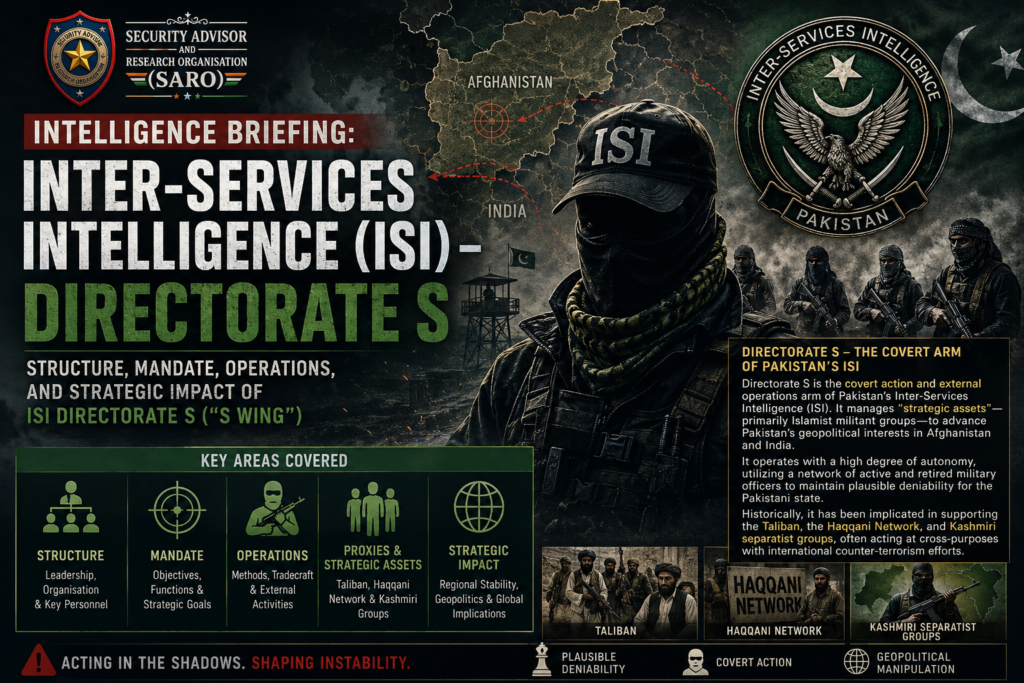
Structure, Mandate, Operations, and Strategic Impact of ISI Directorate S (“S Wing”)
1. Executive Summary
Directorate S is the covert action and external operations arm of Pakistan’s Inter-Services Intelligence (ISI). Unlike other wings focused on domestic security or signal intelligence, Directorate S is tasked with managing “strategic assets”—primarily Islamist militant groups—to advance Pakistan’s geopolitical interests in Afghanistan and India. It operates with a high degree of autonomy, utilizing a network of active and retired military officers to maintain plausible deniability for the Pakistani state. Historically, it has been implicated in supporting the Taliban, the Haqqani Network, and Kashmiri separatist groups, often acting at cross-purposes with international counter-terrorism efforts.
2. Organizational Structure & Positioning
2.1 Hierarchy within ISI
The ISI is headed by the Director General (DGISI), a three-star Lieutenant General from the Pakistan Army. The current DGISI is Lt. Gen. Asim Malik. Directorate S operates under the broader ISI umbrella but maintains significant operational independence, often reporting directly to the Chief of Army Staff (COAS) and the Prime Minister’s secretariat on highly sensitive “strategic” matters.
| Wing Designation | Primary Function | Operational Focus |
|---|---|---|
| A Wing | Internal analysis and assessment | Domestic intelligence evaluation |
| B Wing | External intelligence acquisition | Strategic affairs & foreign intelligence |
| C Wing | Counter-intelligence | Internal security & threat neutralization |
| S Wing (Directorate S) | Covert external operations | Proxy management & strategic assets |
| CT Wing | Counter-terrorism | Anti-terror operations & intelligence |
| T Wing | Technical & signals intelligence | Cyber operations & communications |
| I Wing | Internal monitoring | ISI personnel oversight & loyalty |
2.2 Personnel Composition
Directorate S is characterized by its unique staffing model designed for absolute secrecy:
| Personnel Category | Role & Function | Operational Advantage |
|---|---|---|
| “Retired” Officers | Recently retired ISI and Army officers | Operates outside formal military chains while maintaining establishment loyalty |
| Civilian Proxies | Plainclothes operatives | Specialized training in guerrilla warfare, logistics, and finance |
| Compartmentalized Units | Tightly held information structure | Even senior ISI officials lack full visibility into specific operations |
| Charitable & NGO Fronts | State-aligned organizations (e.g., Falah-e-Insaniat Foundation) | Moves personnel, funds, and materiel under humanitarian guise |
3. Primary Mandate & Strategic Objectives
| Strategic Objective | Description | Current Status (2026) |
|---|---|---|
| “Strategic Depth” in Afghanistan | Ensure friendly/neutral government in Kabul to prevent Indian encirclement and secure western border | Evolved Shifted from installing to managing an allied but independent sovereign entity |
| Counter-India Strategy | Divert Indian military/intelligence resources by sustaining low-intensity conflict in Kashmir | Active Continues to internationalize Kashmir dispute and bleed Indian resources |
| Plausible Deniability | Use non-state actors and “retired” personnel to deny direct state involvement | Active Shields Pakistan from diplomatic fallout and sanctions |
4. Operational Theaters & Modalities
4.1 Afghanistan & The Post-2021 Reality
Directorate S is most notorious for its role in the Afghan conflict. Its current posture involves complex statecraft and proxy management:
| Operational Element | Relationship with S Wing | Current Role (2026) |
|---|---|---|
| Taliban & Haqqani Network | Deep institutional ties; Haqqani Network integrated into Afghan Taliban’s interior and defense ministries | Most reliable conduit for S Wing’s influence in Kabul |
| Intelligence Integration | S Wing officers operate in advisory roles within Afghan Taliban’s General Directorate of Intelligence (GDI) | Ensures Kabul’s intelligence apparatus remains aligned with Rawalpindi’s interests |
4.2 India & Kashmir
| Operational Domain | Modus Operandi | Key Examples/Targets |
|---|---|---|
| Kashmir Militancy | Shifted from large-scale infiltrations to indigenous sleeper cells and “Over-The-Horizon” (OTH) support | Indian-administered Kashmir since early 1990s |
| Proxy Groups | Manages relationships; directs rebranding to bypass UN sanctions | Lashkar-e-Taiba (LeT), Jaish-e-Mohammed (JeM) → Tehreek-e-Ghazwa-e-Hind |
| Major Attacks Linked | Planning, coordination, and real-time guidance | 2008 Mumbai (26/11), 2001 Parliament Attack, 2008 Kabul Embassy, 2019 Pulwama |
| Drone Warfare | Facilitates commercial-off-the-shelf (COTS) drones for weapons/IED drops across LoC | Fundamentally altered tactical landscape in Jammu since 2020 |
5. Historical Evolution
| Era | Key Developments | Strategic Impact |
|---|---|---|
| 1980s Soviet-Afghan War |
Roots in ISI’s Joint Intelligence North (JIN) directorate; distributed CIA and Saudi-funded weapons to Afghan Mujahideen | Institutionalized ISI’s role as manager of militant proxies |
| 1990s Civil War & Taliban Rise |
Retained networks post-Soviet withdrawal; ISI officers directly created and supported Taliban (1994–1996) | Secured trade routes and established friendly regime in Afghanistan |
| Post-9/11 Era 2001-2020 |
Under Gen. Musharraf, ISI formally aligned with US; S Wing continued Taliban support as “insurance policy” | Countered Indian influence in Afghanistan while maintaining US alliance |
| 2020s Post-US Withdrawal |
Following 2021 US exit and Taliban victory; shifted from insurgency support to statecraft support | Attempting to integrate Taliban into regional economic framework while managing TTP insurgency fallout |
6. Key Leadership & Notable Figures
| Name & Rank | Position/Role | Period | Notable Contributions |
|---|---|---|---|
| Lt. Gen. Asim Malik | Director General ISI (DGISI) | Current (2026) | Oversees strategic direction including pivot toward cyber and economic warfare |
| Major General Amir Azim | Former Head, Directorate S | ~2018 | Taliban liaison; restructuring of proxy networks |
| Major General Nadeem Zaki Manj | Former Head, Directorate S | ~2018-2020 | External operations; Afghan peace process negotiations |
| General Hamid Gul | Former DGISI | 1987–1989 | “Architect of the Taliban”; foundational role in 1980s jihad and Kashmiri insurgency |
7. International Reaction & Controversy
| Country/Organization | Position & Actions | Current Status (2026) |
|---|---|---|
| United States | Repeatedly accused Pakistan of “double game”; tracked S Wing’s residual networks | Overt military aid ceased; continues intelligence tracking of transnational terror capabilities (Al-Qaeda, IS-K) |
| India | Identifies Directorate S as primary source of cross-border terrorism; demands dismantling | Responding with covert actions, diplomatic isolation campaigns, and targeted strikes |
| FATF | Grey-listed Pakistan for years due to failure to curb financing of S Wing-linked groups | Forced superficial compliance measures; S Wing has adapted to evade monitoring |
8. The Post-2021 Paradigm Shift & The TTP Blowback Critical
The Taliban’s return to power in August 2021 was heralded as the ultimate victory for Directorate S’s “strategic depth” policy. However, by 2026, this victory has produced a severe strategic blowback:
| Challenge | Description | Impact on S Wing |
|---|---|---|
| The TTP Insurgency | Tehrik-i-Taliban Pakistan (TTP), emboldened by Afghan Taliban’s victory, refuses to be contained; Afghan Taliban refuses Islamabad’s demands to crack down | Massive surge in terrorist attacks inside Pakistan; strategic victory turned into liability |
| Friction with Afghan Taliban | Delicate and often hostile diplomatic/covert struggle with the very proxy S Wing helped install | Forced to conduct covert cross-border targeted operations and leverage tribal militias; strains “brotherly” narrative |
| Strategic Recalculation | Realization that proxy state cannot be controlled like proxy militia | Forced rethink of Afghan policy; shifting focus toward border hardening and internal counter-insurgency |
9. Hybrid Warfare, Cyber Operations, and 5GW
Directorate S has heavily integrated cyber and information capabilities into its proxy toolkit, embracing the military’s “5th Generation Warfare” (5GW) doctrine:
| Capability Domain | Methods & Tools | Strategic Objectives |
|---|---|---|
| Information Warfare | Bot farms, troll networks, deepfake technologies | Manipulate social media narratives in India/Afghanistan; incite communal violence; undermine state legitimacy; polarize societies |
| Cyber Espionage | Collaboration with T-Wing and private contractors; phishing campaigns; malware deployment | Breach Indian military, diplomatic, and critical infrastructure networks |
| Narrative Control | Funding/directing sympathetic media houses, think tanks, academic institutions globally | Shape discourse on Kashmir, Afghanistan, and Pakistan’s internal politics |
10. Financial Architecture & Sanctions Evasion
To sustain operations without triggering state-level financial sanctions, Directorate S has evolved its funding mechanisms to bypass traditional banking oversight:
| Funding Mechanism | Operational Details | Advantage/Evasion Method |
|---|---|---|
| Hawala & Front Companies | Informal value transfer systems (Hawala/Hundi) routed through UAE, Malaysia, Southeast Asia | Funds Kashmiri and Afghan proxies outside formal banking system |
| Cryptocurrency | Privacy coins, decentralized exchanges, mixers for procuring drones, communications gear, paying operatives | Bypasses traditional banking system and FATF monitoring |
| State Budget Black Holes | Funding absorbed within broader Pakistani defense budget under classified “Special Projects” headings | Shields from IMF, FATF, or domestic parliamentary audits |
| Real Estate & Charitable Fronts | Front companies purchase real estate; registered NGOs receive foreign donations diverted to militant logistics | Laundering and legitimization of funds |
11. The China Factor & CPEC Dynamics Emerging
Beijing maintains a pragmatic but increasingly frustrated view of Directorate S, creating a complex triangular dynamic:
| Issue Area | China’s Concern | S Wing’s Position | Current Dynamic |
|---|---|---|---|
| Economic Imperatives vs. Proxy Warfare | Relies on Pakistan for regional stability to protect multi-billion-dollar CPEC | Historical support for Baloch separatist proxies (used as leverage in Afghan negotiations) resulted in deadly attacks on Chinese engineers/diplomats by BLA | Intense, quiet pressure from Beijing on Pakistani military establishment |
| Uyghur Militants | Major red line; zero tolerance for Uyghur militant activity | Historically tolerated/utilized Uyghur militants (ETIM/TIP) in Afghan theater | Beijing demands severance of these ties; Pakistani establishment under pressure |
| Intelligence Sharing | Security of Chinese assets in Pakistan; monitoring Indian movements | Maintains deep intelligence-sharing protocols despite tactical disagreements | “All-weather” relationship persists despite frustrations |
12. Assessment & Caveats
| Assessment Area | Key Points | Implications |
|---|---|---|
| Sourcing Limitations | Most information from anonymous US/Pakistani officials, defectors, journalistic investigations (e.g., Steve Coll’s Directorate S); Pakistan officially denies existence | Official Pakistani narrative dismisses as “Indian and Western propaganda” |
| Current Status (2026) | Historical role well-documented; real-time intelligence on internal structure scarce due to tight operational security | Wing has heavily decentralized command structure to survive targeted sanctions, cyber-attacks, and decapitation strikes |
| Strategic Impact | Remains critical, disruptive factor in South Asian security dynamics; evolved from kinetic proxy warfare to cyber-financial hybrid warfare | Explains persistence of militant ideologies and low-intensity conflicts despite decades of counter-terrorism; however, TTP blowback and Afghan Taliban friction suggest “strategic depth” model reaching limits |