
Exercise AMAN-2025, the 9th edition of the Pakistan Navy’s biennial multinational naval exercise, was conducted in the Northern Arabian Sea from 7–11 February 2025.
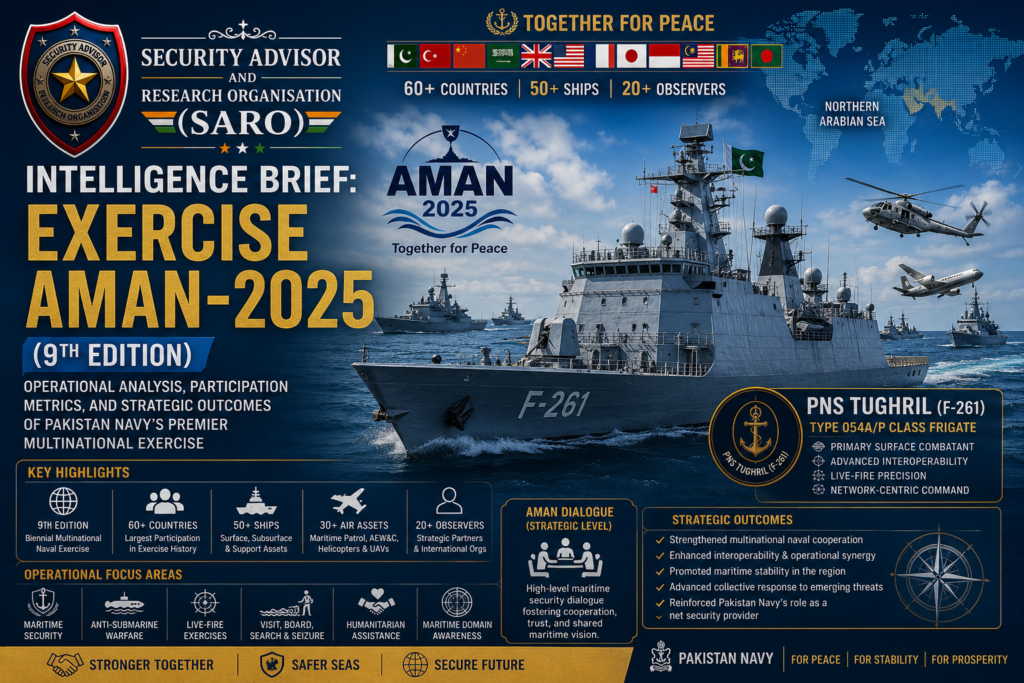
INTELLIGENCE BRIEF: EXERCISE AMAN-2025 (9th EDITION)
1. Executive Summary
Exercise AMAN-2025, the 9th edition of the Pakistan Navy’s biennial multinational naval exercise, was conducted in the Northern Arabian Sea from 7–11 February 2025. Held under the core theme “Together for Peace,” this iteration marked a significant expansion in scope, diplomatic engagement, and operational complexity, featuring participation from over 60 nations. For the first time, the exercise integrated a high-level strategic dialogue (AMAN Dialogue) alongside traditional tactical drills. PNS Tughril (F-261) served as a primary surface combatant and command node, demonstrating advanced interoperability, live-fire precision, and network-centric warfare capabilities alongside international partners.
2. Participation & Scale
| Metric | Details & Enhancements |
|---|---|
| Participating Nations | >60 countries, including major naval powers (China, Russia, Turkey, United Kingdom, France, Italy, Japan, USA in observer/liaison capacity) and regional neighbors (Oman, Saudi Arabia, Iran, Bangladesh, Malaysia, Sri Lanka). |
| Naval Assets Deployed |
~45 warships (Frigates, Corvettes, OPVs, and Auxiliary vessels, including Chinese Type 052D, Turkish MILGEM, and Western FREMM-class equivalents). Aircraft: Multiple Maritime Patrol Aircraft (MPA), naval helicopters, and fixed-wing support assets. |
| Personnel | >5,000 naval personnel, encompassing Special Operations Forces (SOF), aviation detachments, and senior naval leadership. |
| Key Innovation | The maiden AMAN Dialogue in Karachi, convening Chiefs of Navies and Coast Guards to address global maritime security, counter-piracy frameworks, HADR coordination, and blue economy protection. |
3. Exercise Structure & Phases
| Phase / Domain | Activities & Tactical Objectives |
|---|---|
| Phase I: Harbour Phase (Karachi, 7–8 Feb) |
• SMEEs: Subject Matter Expert Exchanges on Counter-Terrorism, Maritime Law Enforcement, HADR, and CBRN (Chemical, Biological, Radiological, Nuclear) defense. • Planning: Joint operational planning, establishing common communication protocols, and harmonizing Rules of Engagement (ROE). • Diplomacy: Flag receptions, ship tours, and cultural exchanges to strengthen bilateral defense ties. |
| Phase II: Sea Phase (Northern Arabian Sea, 9–11 Feb) |
• Complex Maneuvers: Multi-national formation steaming, station-keeping, and cross-decking (helicopter operations between foreign ships and PN platforms). • Communications: Testing interoperability of Link-11/Link-16 data links and secure voice channels across disparate national systems. • Live-Firing (GUNEX/MISSILEX): 76mm and 30mm CIWS live-fire against surface/aerial targets; simulated and live ASCM/SAM launches against drone targets and decommissioned hulls. • ASW Exercises: Coordinated submarine hunting using hull-mounted sonars, dipping sonars, and lightweight torpedoes. • Special Operations: Joint VBSS (Visit, Board, Search, and Seizure) drills for simulated hostage rescue/illicit cargo interdiction, and high-speed counter-piracy intercepts using FACs and RHIBs. |
4. PNS Tughril’s Specific Role & Performance
As one of the most advanced platforms present, PNS Tughril (F-261) served as a key asset in demonstrating Pakistan’s modernized naval capabilities:
| Capability Demonstrated | Operational Detail & Metrics |
|---|---|
| Area Air Defense (AAD) | Successfully tracked and engaged multiple simulated aerial drone targets using its HHQ-16 VLS and SR2410C AESA Radar, providing critical air cover for slower-moving international OPVs during live-fire drills. |
| Network-Centric C2 | Utilized the GENESIS ADVENT CMS to fuse sensor data from participating international frigates, creating a shared, high-fidelity Recognized Maritime Picture (RMP) for the Task Group Commander. |
| Anti-Surface Warfare | Conducted simulated Harbah/C-802AK missile launches against designated target zones, validating fire-control solutions and terminal guidance with international spotting assets. |
| Interoperability | Hosted liaison officers from three partner navies onboard during the sea phase, facilitating real-time knowledge transfer on combat management, damage control, and bridge resource management. |
| Helicopter Ops | Executed seamless cross-deck landing and takeoff operations with a Turkish T129 ATAK helicopter and a Chinese Z-9EC, proving deck compatibility and RAST system reliability in Sea State 4 conditions. |
5. Strategic Outcomes & Intelligence Value
- Diplomatic Signaling: The unprecedented participation of 60+ nations reinforced Pakistan’s position as a neutral, stabilizing maritime actor and a reliable convening power in the Indian Ocean Region (IOR).
- Capability Benchmarking: PN personnel gained direct exposure to Western (UK/France) and Eastern (China/Russia) tactical doctrines, allowing for a valuable comparative assessment and refinement of the PN’s own Tactics, Techniques, and Procedures (TTPs).
- Technology Validation: The seamless integration of Turkish CMS (GENESIS) with Chinese sensors (SR2410C) and weapons (HHQ-16) on PNS Tughril during multi-national drills proved the robustness and flexibility of Pakistan’s “hybrid” procurement strategy.
- Regional Security Framework: The AMAN Dialogue culminated in a non-binding “Karachi Consensus,” establishing a framework for enhanced real-time information sharing for counter-piracy and anti-smuggling operations in the Northern Arabian Sea.
6. Limitations & Observations
| Observed Limitation | Analytical Impact & Mitigation |
|---|---|
| Data Link Compatibility | While voice and basic data exchange were successful, full integration of encrypted tactical data links remained limited to trusted bilateral partners (e.g., China/Turkey) due to differing national cryptographic protocols and NATO vs. non-NATO system architectures. |
| Logistical Strain | Supporting 45+ warships in Karachi Harbor required immense logistical coordination (fresh water, fuel, waste management, and provisioning), highlighting potential bottlenecks in port infrastructure for future, larger-scale iterations of the exercise. |
| ASW Coordination | Complex multi-national anti-submarine warfare drills revealed minor discrepancies in active sonar frequency coordination, requiring ad-hoc deconfliction measures to prevent acoustic interference during live torpedo exercises in littoral zones. |
| Environmental Factors | Unexpected localized fog and Sea State 4+ conditions on Day 2 of the Sea Phase temporarily degraded optical/EO targeting and limited small boat (RHIB) VBSS operations, underscoring the need for all-weather sensor redundancy. |
Acronym Legend: OSINT = Open Source Intelligence, SMEE = Subject Matter Expert Exchange, HADR = Humanitarian Assistance and Disaster Relief, CBRN = Chemical, Biological, Radiological, and Nuclear, ROE = Rules of Engagement, VBSS = Visit, Board, Search, and Seizure, FAC = Fast Attack Craft, RHIB = Rigid-Hull Inflatable Boat, AAD = Area Air Defense, CMS = Combat Management System, RMP = Recognized Maritime Picture, ASW = Anti-Submarine Warfare, TTPs = Tactics, Techniques, and Procedures, IOR = Indian Ocean Region.