
INTELLIGENCE REPORT: IISS Military Balance 2025/2026 – Pakistan Navy Order of Battle & Assessment
This intelligence report analyzes the IISS Military Balance 2025/2026 assessment of the Pakistan Navy, examining its order of battle, modernization programs, strategic priorities, and evolving maritime capabilities. It reviews the transition toward a network-centric naval force, the Hangor-class submarine program, A2/AD capabilities, and the protection of critical Sea Lines of Communication (SLOCs) in the Northern Arabian Sea.
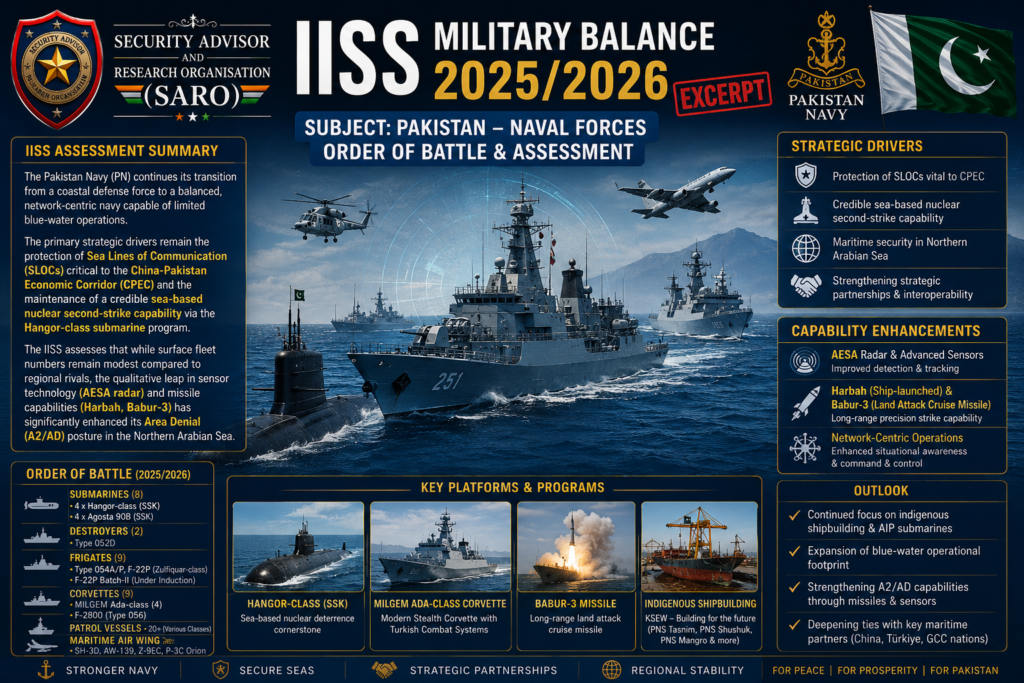
IISS MILITARY BALANCE 2025/2026 EXCERPT
1. Strategic Overview
The Pakistan Navy (PN) continues its transition from a coastal defense force to a balanced, network-centric navy capable of limited blue-water operations. The primary strategic drivers remain the protection of Sea Lines of Communication (SLOCs) critical to the China-Pakistan Economic Corridor (CPEC) and the maintenance of a credible sea-based nuclear second-strike capability via the Hangor-class submarine program. The IISS assesses that while surface fleet numbers remain modest compared to regional rivals, the qualitative leap in sensor technology (AESA radar) and missile capabilities (Harbah, Babur-3) has significantly enhanced its Area Denial (A2/AD) posture in the Northern Arabian Sea.
2. Personnel Strength
| Category | Estimated Strength & Role |
|---|---|
| Total Active Duty | ~30,000 personnel |
| Reserves | ~5,000 personnel |
| Pakistan Marines | ~2,500 personnel (Specialized littoral and amphibious warfare force) |
| Naval Aviation | ~1,500 personnel (Integrated command structure) |
3. Fleet Inventory (Verified by IISS 2025/2026)
A. Principal Surface Combatants
| Class | Type | In Service | Notes |
|---|---|---|---|
| Tughril (Type 054A/P) |
Frigate | 4 | PNS Tughril (F-261), Tariq (F-262), Taimur (F-263), Tippu Sultan (F-264). Equipped with HHQ-16 VLS and SR2410C AESA radar. Primary area air defense assets. |
| Zulfiquar (F-22P) |
Frigate | 4 | PNS Zulfiqar (F-251), Shamsheer (F-252), Saif (F-253), Aslat (F-254). Multi-role frigates with FM-90N SAM and C-802AK ASCM. |
| Babur (MILGEM) |
Corvette | 2 | PNS Babur (F-280), Khaibar (F-282). Indigenous construction under Turkish license featuring GENESIS ADVENT CMS. PNS Badr (F-281) and Tariq (F-283) under construction/fitting out. |
| Yarmook (Damen OPV 1900) |
Offshore Patrol Vessel | 4 | PNS Yarmook (P-171), Tabuk (P-172), plus two additional units. Enhanced maritime surveillance and law enforcement capabilities. |
| Azmat | Fast Attack Craft (Missile) | 4 | Indigenous FACs armed with C-802AK missiles. |
| Jalalat / Jurrat | Fast Patrol Boat | 8+ | Small, agile coastal defense craft. |
B. Submarine Fleet
| Class | Type | In Service | Notes |
|---|---|---|---|
| Hangor | Attack Submarine (AIP) | 1 | PNS Hangor (S-131). Commissioned April 2026. First of 8. Capable of launching Babur-3 SLCM. |
| Agosta 90B (Khalid) |
Attack Submarine (AIP) | 3 | PNS Khalid, Saad, Hamza. French-designed with MESMA AIP. Undergoing mid-life upgrades with Turkish assistance. |
| Agosta 70 (Hashmat) |
Attack Submarine | 2 | PNS Hashmat, Hurmat. Older diesel-electric boats. Limited operational status due to age. |
| Cosmos (MG110) |
Midget Submarine | 3 | Italian-designed. Used for special forces (SSG-N) insertion and shallow-water reconnaissance. |
IISS Note: Confirms that three additional Hangor-class submarines (PNS Tasnim, Shushuk, Mangro) have been launched at KSEW but are not yet commissioned as of mid-2026.
C. Amphibious & Auxiliary Vessels
| Class | Type | In Service | Notes |
|---|---|---|---|
| Moawin | Replenishment Oiler | 1 | PNS Moawin (A-39). Critical for extending fleet endurance. Built at KSEW with Turkish collaboration. |
| Nasr | Tanker | 1 | PNS Nasr. Older auxiliary tanker. |
| LST | Amphibious (Tank Landing Ship) | 3 | Used primarily for logistics and Marine Corps transport. |
| Hovercraft | LCAC | 3 | Newly acquired (June 2025) for littoral mobility. |
4. Naval Aviation
| Aircraft | Role | Quantity | Notes |
|---|---|---|---|
| P-3C Orion | Maritime Patrol / ASW | 5–6 | Upgraded variants. Backbone of long-range Maritime Domain Awareness (MDA). |
| Sea Sultan (Embraer Lineage 1000) |
Maritime Patrol | 2 (Delivered) | New acquisition to replace aging P-3C fleet. More deliveries expected in 2026–2027. |
| ATR-72 MPA | Maritime Surveillance | 4 | Medium-range patrol and EEZ monitoring. |
| Z-9EC | Helicopter (ASW/SAR) | 10+ | Primary shipborne helicopter. Equipped with dipping sonar and lightweight torpedoes. |
| Sea King Mk 45 | Helicopter (ASW/SAR) | 4–6 | Aging platform, being phased out in favor of Z-9EC and future acquisitions. |
5. Weapon Systems & Missiles
| Category | System | Specifications & Notes |
|---|---|---|
| Anti-Ship Missiles (ASCM) | C-802AK / Harbah |
C-802AK: Chinese subsonic sea-skimming missile (Range: ~180 km). Standard fit on F-22P and Type 054A/P. Harbah: Indigenous dual-purpose (anti-ship/land-attack) cruise missile (Range: ~280 km). Integrated on MILGEM corvettes and Type 054A/P. |
| Surface-to-Air Missiles (SAM) | HHQ-16 / FM-90N / MICA VL |
HHQ-16 (LY-80N): Medium-range SAM (Range: 40–70 km). Launched from VLS on Type 054A/P. FM-90N: Short-range SAM. Fit on F-22P frigates. MICA VL: Very short-range SAM integrated into SIMBAD-RC launchers on MILGEM corvettes. |
| Cruise Missiles | Babur-3 (SLCM) | Submarine-Launched Cruise Missile. Range: ~450 km. Provides sea-based nuclear deterrent. Operational on Hangor-class submarines. |
| Torpedoes | F21 / Yu-7 / ET-52C |
F21: Heavyweight torpedo (French) for Agosta 90B. Yu-7 / ET-52C: Lightweight ASW torpedoes for helicopters and surface ships. |
6. IISS Analytical Assessment (2025/2026)
| Strengths | Weaknesses |
|---|---|
|
• Submarine Deterrence: The induction of the Hangor-class with AIP and SLCM capability represents a significant strategic upgrade, complicating adversary anti-submarine warfare (ASW) planning. • Network-Centric Warfare: Integration of Turkish GENESIS ADVENT CMS with Chinese sensors has created a robust, interoperable combat management system. • Indigenous Construction: KSEW’s ability to build complex platforms like MILGEM corvettes and Hangor-class submarines demonstrates growing industrial self-reliance. |
• Surface Fleet Size: The total number of major surface combatants (8 frigates/corvettes) remains low for sustained high-intensity conflict against a larger regional navy. • Air Defense Depth: Only four ships (Type 054A/P) possess medium-range area air defense. The rest of the fleet relies on short-range or point-defense systems, creating vulnerability to saturation attacks. • Logistical Bottlenecks: Dependence on foreign suppliers for critical components (e.g., the shift from MTU to CHD-620 engines due to export license issues) highlights supply chain vulnerabilities. |
Strategic Outlook
The PN is well-positioned to maintain maritime security in the Northern Arabian Sea and protect CPEC interests. However, its ability to project power beyond the immediate region remains limited by fleet size and logistical constraints. The focus for the next decade will likely be on completing the Hangor-class program and acquiring additional multi-role frigates to address the surface fleet gap.
Acronym Legend: IISS = International Institute for Strategic Studies, SLOCs = Sea Lines of Communication, CPEC = China-Pakistan Economic Corridor, A2/AD = Anti-Access/Area Denial, AIP = Air-Independent Propulsion, SLCM = Submarine-Launched Cruise Missile, KSEW = Karachi Shipyard & Engineering Works, ASCM = Anti-Ship Cruise Missile, SAM = Surface-to-Air Missile, VLS = Vertical Launch System, ASW = Anti-Submarine Warfare, MDA = Maritime Domain Awareness, EEZ = Exclusive Economic Zone, SAR = Search and Rescue, CMS = Combat Management System.