
Pakistan’s Military Transformation: The Army Rocket Force Command (ARFC)
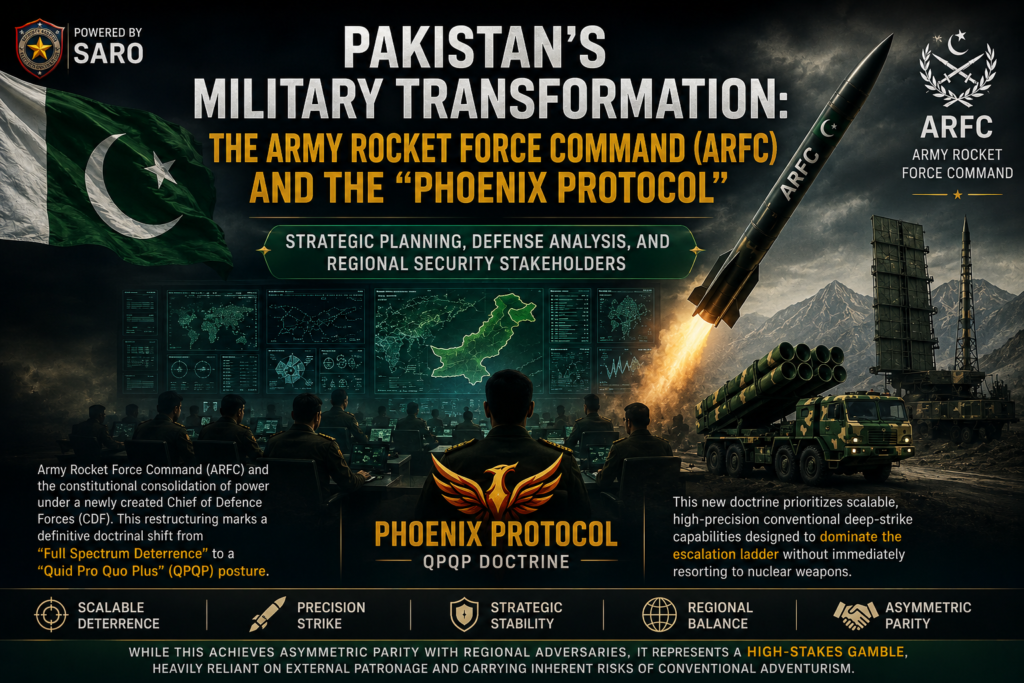
Following the May 2025 regional conflict, the subject nation has undergone the most aggressive and rapid military restructuring in its history, codified internally as the “Phoenix Protocol.” The cornerstone of this transformation is the establishment of the Army Rocket Force Command (ARFC) and the constitutional consolidation of power under a newly created Chief of Defence Forces (CDF).
While this achieves asymmetric parity with regional adversaries, it represents a high-stakes gamble, heavily reliant on external patronage and carrying inherent risks of conventional adventurism.
Prior to 2025, the nation’s missile forces were dual-use, creating dangerous “entanglement” where any launch risked triggering an adversary’s strategic nuclear response. The QPQP doctrine explicitly separates conventional and nuclear forces to create a deliberate “firebreak.”
The doctrine emphasizes short, swift, network-centric operations designed to inflict punitive, high-value conventional damage (e.g., against adversary airfields, radar sites, and logistics hubs) while signaling restraint, thereby dominating the escalation ladder below the nuclear threshold.
The military has demonstrated a willingness to prolong crises using deniable, low-intensity assets (e.g., drones, cross-border shelling) to refocus international attention, before accepting ceasefires once strategic messaging goals are met.
Passed in November 2025, the 27th Constitutional Amendment legally codifies the military’s absolute primacy in national affairs to rectify command inefficiencies observed during the 2025 conflict.
- Abolished the Chairman Joint Chiefs of Staff Committee (CJCSC)
- The CDF now possesses direct operational command authority over the Army, Navy, and Air Force
- Moving the nation toward a unified, land-centric command model
- The CDF position is held concurrently by the Chief of Army Staff (COAS)
- The incumbent was elevated to the five-star rank of Field Marshal
- Granted lifetime immunity from criminal prosecution
- Mandate to “remain in uniform for life”
- Reset five-year tenure extending command stability through 2030
- Created to centralize nuclear assets under a direct military chain of command
- The Commander NSC (a four-star Army general) is appointed by the Prime Minister solely on the recommendation of the CDF
- Effectively hollowing out the civilian-led National Command Authority (NCA)
- Removing meaningful civilian oversight
Established on August 13, 2025, the ARFC is a Corps-level formation tasked with controlling and operating conventional rockets, missiles, and multi-rocket launchers. It reports directly to the CDF via General Headquarters (GHQ) in Chaklala.
Headed by a three-star Lieutenant General, housing a centralized C4ISR directorate for satellite links and over-the-horizon targeting.
Regional Missile Bases commanded by Major Generals, acting as administrative and logistical hubs for specific geographic theaters.
Fully autonomous “Missile Groups” categorized by system type:
- SRBM / Guided Rocket Groups: Operate highly mobile Transporter Erector Launchers (TELs) for tactical and operational depth strikes
- Land-Attack Cruise Missile (LACM) Groups: Operate ground-launched cruise missiles from concealed or mobile platforms for deep-strike interdiction
- Loitering Munition & Drone Battalions: Organic unmanned systems designed to act as decoys, saturating adversary advanced multi-layered air defense radars prior to kinetic missile strikes
Each Missile Group is reinforced with organic Mobile Air Defense Regiments (SHORAD), Base Security Infantry, Logistics/Transloading Companies, and Meteorological/Telemetry sections.
The ARFC has demonstrated a rapid operational tempo, validating its systems through a series of publicly acknowledged tests since its formation.
Primary Weapons (Operational)
| System | Type | Range | Speed | Strategic Role |
|---|---|---|---|---|
| Fatah-I | Guided MLRS | 70 – 140 km | Subsonic | Tactical battlefield strikes; counter-battery fire |
| Fatah-II | Quasi-Ballistic Missile | 400 – 450 km (ER) | Subsonic | Operational depth strikes against forward airbases Tested: Apr 2026 |
| Fatah-III | Cruise Missile | 300 – 650 km | Supersonic | High-speed penetration of layered air defenses Unveiled: May 2026 |
| Fatah-IV | Cruise Missile | 750 km | Subsonic | Deep interdiction; terrain-hugging profile targeting C2 nodes Tested: Sep 2025, May 2026 |
| Fatah-V | Advanced Rocket/Missile | ~1,000 km (Expected) | Unknown | Strategic-depth conventional strike; expected MaRV/glide trajectory Expected |
Secondary Weapons (Suspected / Support)
- Ghazab & PHL-81 “Azar”: 122mm MLRS (40 km range) for volume fire and saturation
- A-100E: 300mm Semi-guided MLRS (100–120 km range) for extended-range saturation strikes
Primary HQ in Rawalpindi/Chaklala; secondary redundant nodes in Sargodha and underground facilities in the capital.
- Northern/Central Region: Mountainous terrain providing natural camouflage, likely hosting LACM groups
- Southern Desert Region: Flat terrain ideal for rapid TEL movement, hosting SRBM groups to place adversary western formations within immediate range
During heightened alert, units disperse into pre-surveyed hide sites, utilizing national highway networks, agricultural camouflage, and suspected underground tunnel networks.
- Extensive use of radar-reflective inflatable decoys
- Strict Emissions Control (EMCON) during mobilization
- Heavy compartmentalization of targeting data fed to launch crews only moments before execution
The ARFC is part of a broader, externally financed military renaissance:
Transitioning to generational leaps, including:
- Acquisition of 5th-generation stealth fighters (e.g., J-31/FC-31)
- Expanded 4.5-generation fleets (J-10C)
- Turkish-modified Stand-Off Jamming (SOJ) platforms
Focused on “Sea Denial” via:
- Induction of eight Chinese Type 039B Yuan-class “Hangor” AIP submarines (assessed as the long-term platform for sea-based nuclear deterrents)
- Development of hypersonic anti-ship ballistic missiles (ASBMs) to create Anti-Access/Area Denial (A2/AD) bubbles
- Saudi Arabia: A September 2025 Strategic Mutual Defence Agreement provides massive financial patronage and deferred oil payments in exchange for Pakistan acting as a security guarantor and defense industrial partner
- United States: A transactional pivot has yielded critical F-16 sustainment packages and reports of Pakistan offering naval facility access, positioning the nation as indispensable to broader regional containment strategies
- China: Remains the primary supplier of advanced hardware (stealth fighters, submarines, Fatah rockets), ensuring a reliable supply chain insulated from Western embargoes
The “Phoenix Protocol” represents a definitive, monolithic centralization of strategic power. By streamlining command under the CDF, formalizing conventional precision-strike options via the ARFC, and advancing supersonic/hypersonic capabilities, the state has successfully blunted the conventional superiority of its regional rivals.
However, this parity is fragile. It is built on a narrow economic base and heavy reliance on external patrons. Furthermore, the “stability-instability paradox” suggests that by making conventional stand-off warfare “safer” (less likely to immediately trigger nuclear escalation), the military may be emboldened to engage in large-scale missile duels or sponsor sub-conventional triggers, believing it can now control the escalation ladder.