
Pakistan Navy (PN) Comprehensive Assessment
1. Executive Summary
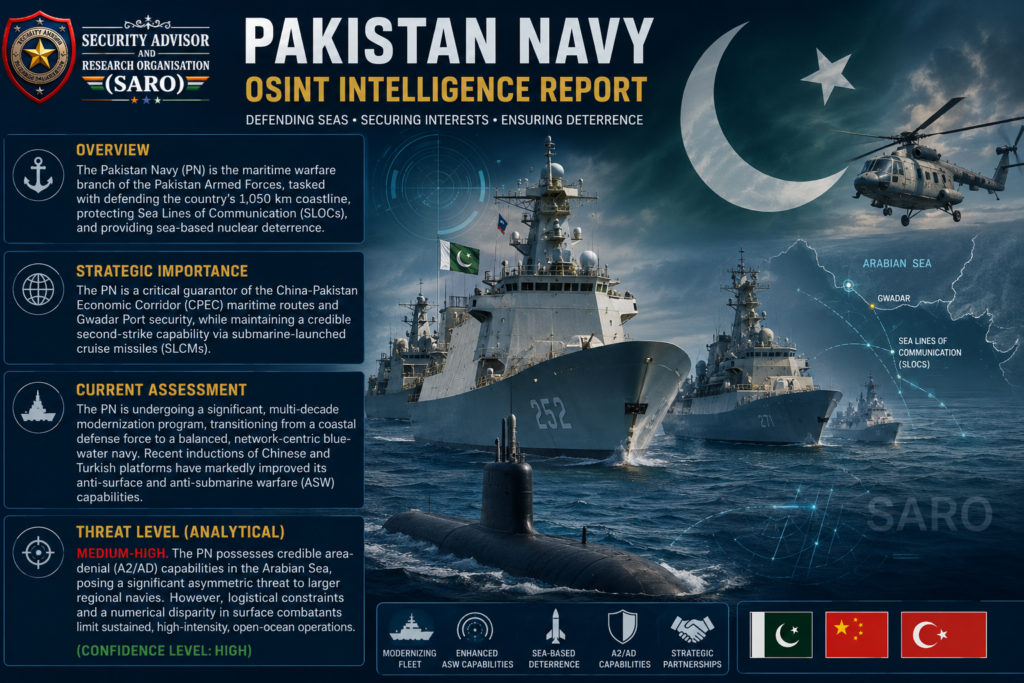
- Overview: The Pakistan Navy (PN) is the maritime warfare branch of the Pakistan Armed Forces, tasked with defending the country’s 1,050 km coastline, protecting Sea Lines of Communication (SLOCs), and providing sea-based nuclear deterrence.
- Strategic Importance: The PN is a critical guarantor of the China-Pakistan Economic Corridor (CPEC) maritime routes and Gwadar Port security, while maintaining a credible second-strike capability via submarine-launched cruise missiles (SLCMs).
- Current Assessment: The PN is undergoing a significant, multi-decade modernization program, transitioning from a coastal defense force to a balanced, network-centric blue-water navy. Recent inductions of Chinese and Turkish platforms have markedly improved its anti-surface and anti-submarine warfare (ASW) capabilities.
- Threat Level (Analytical): Medium-High. The PN possesses credible area-denial (A2/AD) capabilities in the Arabian Sea, posing a significant asymmetric threat to larger regional navies. However, logistical constraints and a numerical disparity in surface combatants limit sustained, high-intensity, open-ocean operations. (Confidence Level: High)
2. Geographic & Strategic Locations
| Name | Latitude | Longitude | Province | Nearest City | Strategic Importance | Distance from Indian Coast | Nearby Military Installations |
|---|---|---|---|---|---|---|---|
| PNS Mehran (Naval Air Station) | 24.8333° N | 66.9833° E | Sindh | Karachi | Primary hub for PN Naval Aviation (P-3C, ATR-72, helicopters). | ~85 km (Gujarat coast) | Faisal Naval Base, PNS Qasim, Karachi Port. |
| Jinnah Naval Base (Ormara) | 25.2087° N | 64.6358° E | Balochistan | Ormara | Second-largest PN base; forward operating base for fleet deployment and submarine operations. | ~250 km | Ormara Airport, Pakistan Coast Guards station. |
| PNS Ahsan (Naval Air Station) | 25.2766° N | 64.5883° E | Balochistan | Ormara/Gwadar | Supports maritime patrol and helicopter operations along the Makran coast. | ~260 km | Jinnah Naval Base, PNS Akram (surveillance). |
| PNS Akram (Surveillance Station) | 25.1263° N | 62.3244° E | Balochistan | Gwadar | Critical for monitoring maritime traffic near Gwadar Port and CPEC routes. | ~350 km | Gwadar Port, Pakistan Marines coastal posts. |
| Pasni Airfield (Joint Use) | 25.2905° N | 63.3451° E | Balochistan | Pasni | Forward operational base and dispersal airfield for the Pakistan Air Force (PAF), providing geographical depth to avoid long-range radar detection and offering aerial oversight of the northern Arabian Sea. Also serves as a potential strategic logistics node. | ~650 km (Gujarat coast, e.g., Dwarka) | PNS Siddique (Naval Air Station, Turbat), Pakistan Coast Guard stations, and Jinnah Naval Base (Ormara) to the east. |
3. Naval Headquarters & Commands
| Command / Entity | Primary Location / Base | Primary Role & Responsibility |
|---|---|---|
| Naval Headquarters (NHQ) | Islamabad | Central policy formulation, strategic planning, and interservice coordination. |
| Commander Karachi (COMKAR) | Karachi | Operational and logistical control of the primary naval hub and its associated facilities. |
| Commander Coastal Command (COMCOAST) | Makran Coast | Oversees coastal defense, Jinnah Naval Base (Ormara), and other Makran coast installations. |
| Commander Pakistan Fleet (COMPAK) | Fleet Operational Areas | Directs and commands all operational surface combatants and submarines of the Pakistan Navy. |
| Training Commands | Various (PNS Rahbar, PNS Bahadur, PNS Himalaya, PNEC) | Conducts officer cadet training (Naval Academy), combat training, basic training, and advanced engineering education. |
| Special Service Group (Navy) [SSG-N] | PNS Iqbal, Karachi | Elite special operations force specializing in maritime counter-terrorism, VBSS (Visit, Board, Search, and Seizure), and amphibious raids. |
| Pakistan Maritime Security Agency (PMSA) | Pakistan’s Exclusive Economic Zone (EEZ) | Civilian-manned, Pakistan Navy-controlled agency responsible for maritime law enforcement, anti-smuggling, and Search and Rescue (SAR) operations. |
4. Fleet Inventory (Major Surface Combatants)
PNS Tughril
Hull No.: F-261
Class: Tughril (Type 054A/P)
Type: Frigate
Displacement: ~4,000 t
Length/Beam: 134m / 16m
Speed/Range: 27+ kts / 4,000 nm
Primary Weapons: 1x 76mm H/PJ-26
Air Defence/CIWS: HHQ-16 SAM (VLS), Type 730 CIWS
Anti-Ship Missiles: C-802AK / Harbah
ASW Weapons: 2x 324mm ASW Torpedo Tubes
Sensors/Radar: SR2410C AESA Radar, SJD-9 Sonar
Helo Capacity: 1x Z-9EC
Status: Active
PNS Tariq
Hull No.: F-262
Class: Tughril (Type 054A/P)
Type: Frigate
Displacement: ~4,000 t
Length/Beam: 134m / 16m
Speed/Range: 27+ kts / 4,000 nm
Primary Weapons: 1x 76mm H/PJ-26
Air Defence/CIWS: HHQ-16 SAM (VLS), Type 730 CIWS
Anti-Ship Missiles: C-802AK / Harbah
ASW Weapons: 2x 324mm ASW Torpedo Tubes
Sensors/Radar: SR2410C AESA Radar, SJD-9 Sonar
Helo Capacity: 1x Z-9EC
Status: Active
PNS Taimur
Hull No.: F-263
Class: Tughril (Type 054A/P)
Type: Frigate
Displacement: ~4,000 t
Length/Beam: 134m / 16m
Speed/Range: 27+ kts / 4,000 nm
Primary Weapons: 1x 76mm H/PJ-26
Air Defence/CIWS: HHQ-16 SAM (VLS), Type 730 CIWS
Anti-Ship Missiles: C-802AK / Harbah
ASW Weapons: 2x 324mm ASW Torpedo Tubes
Sensors/Radar: SR2410C AESA Radar, SJD-9 Sonar
Helo Capacity: 1x Z-9EC
Status: Active
PNS Tippu Sultan
Hull No.: F-264
Class: Tughril (Type 054A/P)
Type: Frigate
Displacement: ~4,000 t
Length/Beam: 134m / 16m
Speed/Range: 27+ kts / 4,000 nm
Primary Weapons: 1x 76mm H/PJ-26
Air Defence/CIWS: HHQ-16 SAM (VLS), Type 730 CIWS
Anti-Ship Missiles: C-802AK / Harbah
ASW Weapons: 2x 324mm ASW Torpedo Tubes
Sensors/Radar: SR2410C AESA Radar, SJD-9 Sonar
Helo Capacity: 1x Z-9EC
Status: Active
PNS Zulfiqar
Hull No.: F-251
Class: Zulfiquar (F-22P)
Type: Frigate
Displacement: ~2,600 t
Length/Beam: 122m / 14.4m
Speed/Range: 29 kts / 4,000 nm
Primary Weapons: 1x 76mm H/PJ-26
Air Defence/CIWS: FM-90N SAM, Type 730 CIWS
Anti-Ship Missiles: C-802AK
ASW Weapons: 2x 324mm ASW Torpedoes, RBU-1200
Sensors/Radar: SR-64 Radar, SJD-9 Sonar
Helo Capacity: 1x Z-9EC / Sea King
Status: Active
PNS Shamsheer
Hull No.: F-252
Class: Zulfiquar (F-22P)
Type: Frigate
Displacement: ~2,600 t
Length/Beam: 122m / 14.4m
Speed/Range: 29 kts / 4,000 nm
Primary Weapons: 1x 76mm H/PJ-26
Air Defence/CIWS: FM-90N SAM, Type 730 CIWS
Anti-Ship Missiles: C-802AK
ASW Weapons: 2x 324mm ASW Torpedoes, RBU-1200
Sensors/Radar: SR-64 Radar, SJD-9 Sonar
Helo Capacity: 1x Z-9EC / Sea King
Status: Active
PNS Saif
Hull No.: F-253
Class: Zulfiquar (F-22P)
Type: Frigate
Displacement: ~2,600 t
Length/Beam: 122m / 14.4m
Speed/Range: 29 kts / 4,000 nm
Primary Weapons: 1x 76mm H/PJ-26
Air Defence/CIWS: FM-90N SAM, Type 730 CIWS
Anti-Ship Missiles: C-802AK
ASW Weapons: 2x 324mm ASW Torpedoes, RBU-1200
Sensors/Radar: SR-64 Radar, SJD-9 Sonar
Helo Capacity: 1x Z-9EC / Sea King
Status: Active
PNS Aslat
Hull No.: F-254
Class: Zulfiquar (F-22P)
Type: Frigate
Displacement: ~2,600 t
Length/Beam: 122m / 14.4m
Speed/Range: 29 kts / 4,000 nm
Primary Weapons: 1x 76mm H/PJ-26
Air Defence/CIWS: FM-90N SAM, Type 730 CIWS
Anti-Ship Missiles: C-802AK
ASW Weapons: 2x 324mm ASW Torpedoes, RBU-1200
Sensors/Radar: SR-64 Radar, SJD-9 Sonar
Helo Capacity: 1x Z-9EC / Sea King
Status: Active
PNS Babur
Hull No.: F-280
Class: Babur (MILGEM)
Type: Corvette
Displacement: ~2,300 t
Length/Beam: 99m / 14.4m
Speed/Range: 29 kts / 3,500 nm
Primary Weapons: 1x 76mm Oto Melara
Air Defence/CIWS: SIMBAD-RC (MICA VL)
Anti-Ship Missiles: Harbah / C-802AK
ASW Weapons: 2x 324mm ASW Torpedoes
Sensors/Radar: GENESIS ADVENT CMS, Aselsan Radar
Helo Capacity: 1x Z-9EC
Status: Active
PNS Khaibar
Hull No.: F-281
Class: Babur (MILGEM)
Type: Corvette
Displacement: ~2,300 t
Length/Beam: 99m / 14.4m
Speed/Range: 29 kts / 3,500 nm
Primary Weapons: 1x 76mm Oto Melara
Air Defence/CIWS: SIMBAD-RC (MICA VL)
Anti-Ship Missiles: Harbah / C-802AK
ASW Weapons: 2x 324mm ASW Torpedoes
Sensors/Radar: GENESIS ADVENT CMS, Aselsan Radar
Helo Capacity: 1x Z-9EC
Status: Active
PNS Yarmook
Hull No.: P-171
Class: Yarmook (Damen OPV 1900)
Type: OPV
Displacement: ~1,900 t
Length/Beam: 90m / 14m
Speed/Range: 22 kts / 4,000 nm
Primary Weapons: 1x 76mm Oto Melara
Air Defence/CIWS: None (Point defense only)
Anti-Ship Missiles: None
ASW Weapons: None
Sensors/Radar: Terma Scanter Radar
Helo Capacity: 1x Medium Helo
Status: Active
PNS Tabuk
Hull No.: P-172
Class: Yarmook (Damen OPV 1900)
Type: OPV
Displacement: ~1,900 t
Length/Beam: 90m / 14m
Speed/Range: 22 kts / 4,000 nm
Primary Weapons: 1x 76mm Oto Melara
Air Defence/CIWS: None (Point defense only)
Anti-Ship Missiles: None
ASW Weapons: None
Sensors/Radar: Terma Scanter Radar
Helo Capacity: 1x Medium Helo
Status: Active
PNS Moawin
Hull No.: A-39
Class: Moawin Class
Type: Replenishment Oiler
Displacement: ~17,000 t
Length/Beam: 160m / 22m
Speed/Range: 18 kts / 8,000 nm
Primary Weapons: 2x 30mm CIWS
Air Defence/CIWS: None
Anti-Ship Missiles: None
ASW Weapons: None
Sensors/Radar: N/A
Helo Capacity: N/A
Status: Active
Submarine Fleet Overview
The submarine arm is the cornerstone of Pakistan’s naval deterrence and Anti-Access/Area Denial (A2/AD) strategy.
| Class / Designation | Quantity & Active Units | Origin | Propulsion / Type | Armament | Key Features & Roles | Status / Base |
|---|---|---|---|---|---|---|
| Agosta-90B (Khalid Class) |
3 Active (PNS Khalid, Saad, Hamza) |
France | Diesel-Electric with MESMA Air-Independent Propulsion (AIP) | F21 heavy-weight torpedoes, Exocet SM39 anti-ship missiles | Extended underwater endurance (~50 days) | Active Base: Karachi |
| Agosta-70 (Hashmat Class) |
2 Active (PNS Hashmat, Hurmat) |
France | Diesel-Electric | A244/S or F17P torpedoes | Older platforms currently undergoing life-extension and sensor upgrades | Active (Upgrading) |
| Cosmos-Class (MG110) |
3 Active | Italy | Diesel-Electric (110-ton midget submarine) |
Specialized payloads for special forces deployment | Clandestine shallow-water operations, intelligence gathering, and SSG-N deployment | Active |
| Hangor-Class (S-26 Program) |
8 on order (4 built in China, 4 to be built at KSEW under tech transfer) |
China | Advanced AIP, Stealth coating | Designed to integrate Babur-3 Submarine-Launched Cruise Missile (SLCM) | Next-generation stealth capabilities. First unit (PNS Hangor) commissioned in 2026. | Under Construction / Commissioning (Confidence Level: High) |
Note: KSEW refers to Karachi Shipyard & Engineering Works. Specifications represent standard configurations and may evolve as life-extension programs and new constructions are completed.
Weapons & Missile Systems
A comprehensive overview of the Pakistan Navy’s offensive and defensive armament, ranging from indigenous cruise missiles to advanced close-in defense systems.
| Category | System Name | Origin | Range / Classification | Key Features & Capabilities | Status / Notes |
|---|---|---|---|---|---|
| Anti-Ship Missiles (ASCM) |
C-802AK | China | ~180 km | Sea-skimming trajectory, active radar homing, proven export variant optimized for surface combatants. | Active |
| Anti-Ship Missiles (ASCM) |
Harbah | Pakistan (Indigenous) | ~280 km | Derived from the Babur cruise missile family. Features dual anti-ship and land-attack capabilities with high subsonic speed. | Active |
| Cruise Missiles (SLCM) |
Babur-3 | Pakistan | ~450 km | Advanced Global Navigation, Terrain, and Scene Matching Systems. Capable of terrain-hugging and sea-skimming flight profiles to evade enemy radar. Provides a “Credible Second Strike Capability”. | Active (High Confidence) |
| Torpedoes (Heavy-weight) |
F21 | France | Heavy-weight | Wire-guided with advanced acoustic homing. Primary offensive armament for Agosta-90B submarines. | Active |
| Torpedoes (Light-weight) |
A244/S & Yu-7 | Italy / China | Light-weight | Designed for anti-submarine warfare (ASW). Deployed via ship-mounted torpedo tubes and helicopter-dropped systems. | Active |
| Air Defence (SAM) |
HHQ-16 & FM-90N | China | Medium / Short-range | HHQ-16 provides area air defense via Vertical Launch Systems (VLS). FM-90N provides short-range point defense against sea-skimming threats. | Active |
| Close-In Weapon Systems (CIWS) |
Type 730 / Phalanx | China / USA | Point Defense | Radars-guided, high-rate-of-fire gatling gun systems serving as the last line of defense against incoming anti-ship missiles and aircraft. | Active |
Acronym Legend: ASCM = Anti-Ship Cruise Missile, SLCM = Submarine-Launched Cruise Missile, SAM = Surface-to-Air Missile, CIWS = Close-In Weapon System. Capabilities and statuses reflect publicly available defense assessments and may evolve with ongoing indigenous development programs.
Coastal Defence & Maritime Domain Awareness
A multi-layered coastal defence architecture designed to secure Pakistan’s coastline, protect critical maritime infrastructure, and maintain comprehensive maritime domain awareness (MDA).
| Category | System / Component | Deployment / Location | Key Features & Capabilities | Status / Integration |
|---|---|---|---|---|
| Coastal Missile Batteries | Mobile ASCM Batteries (Harbah / C-802 variants) |
Makran Coast & Karachi Approaches | Truck-mounted, highly mobile anti-ship cruise missile systems integrated with the broader coastal surveillance network for rapid deployment and strike. | Active (OSINT Confirmed) |
| Surveillance Radar | Sea Giraffe & Indigenous Radar Systems | Pasni, Ormara, Gwadar (Linked to Karachi) |
Networked coastal radar coverage providing early warning, surface picture compilation, and seamless data relay to the Maritime Operations Centre (MOC). | Active / Networked |
| Maritime Patrol Network | Link-11 / Link-16 Tactical Data Links | Fleet-wide & Coastal Command | Secure tactical data link integration combining real-time sensor inputs from P-3C Orions, coastal radars, and surface combatants into a single operational picture. | Active / Integrated |
| AIS Coverage | Automatic Identification System (AIS) Monitoring | Pakistan’s Exclusive Economic Zone (EEZ) | Continuously monitored by the PN and PMSA to track commercial vessel traffic, ensure maritime domain awareness, and identify “dark” (non-transmitting) targets. | Active / Continuous |
Acronym Legend: OSINT = Open Source Intelligence, ASCM = Anti-Ship Cruise Missile, MOC = Maritime Operations Centre, PMSA = Pakistan Maritime Security Agency, EEZ = Exclusive Economic Zone. Specific battery locations remain classified for operational security.
Shipbuilding & Industrial Infrastructure
A robust industrial base combining indigenous construction capabilities with strategic international partnerships to sustain and modernize the fleet.
| Category | Facility / Partner | Key Capabilities & Infrastructure | Notable Projects & Scope |
|---|---|---|---|
| Indigenous Shipbuilding | Karachi Shipyard & Engineering Works (KSEW) | Features Dry Dock-I (189m length, 30m width), Dry Dock-II, and a new, state-of-the-art covered construction hall for all-weather, stealth-compliant assembly. | Indigenous construction of PNS Hamza (3rd Agosta-90B), F-22P Zulfiqar-class frigates, Azmat-class FACs. Currently building Hangor-class submarines and Jinnah-class frigates. |
| Fleet Maintenance | PN Dockyard (Karachi) | Dedicated naval maintenance facility providing comprehensive routine upkeep, mid-life upgrades, and deep maintenance for surface combatants and submarines. | Ensures high operational readiness, lifecycle extension, and rapid turnaround for the active Pakistan Navy fleet. |
| Strategic Foreign Partnerships | China, Turkey, & France | Technology transfer, co-production agreements, and specialized systems integration (e.g., AIP systems, advanced torpedoes, and missile technology). |
China: Submarines, frigates, missiles. Turkey: MILGEM corvettes, torpedo modernization, AIP systems. France: Legacy support and upgrades for Agosta systems. |
Note: FAC = Fast Attack Craft, AIP = Air-Independent Propulsion. KSEW continues to serve as the primary hub for Pakistan’s naval self-reliance and technology absorption initiatives.
10. International Cooperation
The Pakistan Navy actively engages in multinational diplomacy, joint exercises, and global security initiatives to enhance interoperability and promote regional maritime stability.
| Initiative / Category | Partners / Scope | Key Features & Objectives |
|---|---|---|
| Exercise AMAN | Multinational (60+ participating countries) |
Biennial multinational naval exercise hosted by the PN under the slogan “Together for Peace”. The 9th edition (AMAN-2025) introduced the maiden AMAN Dialogue for naval chiefs, alongside comprehensive two-phase Harbour and Sea tactical drills. |
| Bilateral Exercises |
China: Sea Spark Oman: Naseem Al Bahr Turkey: Indus Shark |
Regular, focused drills designed to enhance tactical interoperability, share best practices, and strengthen strategic defense ties with key regional and global partner nations. |
| UN Maritime Missions | UN Task Forces (CTF-150, CTF-151) |
The PN regularly contributes frigates and staff officers to Combined Task Forces for counter-piracy, counter-terrorism, and maritime security operations in the Gulf of Aden and the broader Indian Ocean region. |
Acronym Legend: PN = Pakistan Navy, CTF = Combined Task Force. Exercise AMAN serves as a cornerstone of Pakistan’s naval diplomacy, projecting the country as a reliable partner in global maritime security.
11. Maritime Trade & Economic Security
The Pakistan Navy plays a vital role in safeguarding the nation’s economic lifelines, securing critical maritime infrastructure, and protecting vital sea lines of communication (SLOCs).
| Category | Key Assets / Scope | Strategic Importance & Role |
|---|---|---|
| Major Ports | Port of Karachi, Port Qasim, Gwadar Port | Primary gateways for national and regional trade. Gwadar Port, in particular, serves as a strategic node for the China-Pakistan Economic Corridor (CPEC) and regional connectivity. |
| Shipping Lanes (SLOCs) | Northern Arabian Sea | The PN is tasked with securing these critical Sea Lines of Communication, through which approximately 90% of Pakistan’s international trade by volume is conducted. |
| Energy Routes | Persian Gulf to Pakistani Terminals (via Strait of Hormuz) |
Vital for national energy security. The PN ensures the safe transit of LNG carriers and oil tankers, protecting the flow of essential resources to domestic terminals. |
| Exclusive Economic Zone (EEZ) | ~240,000 sq km | The PN and Pakistan Maritime Security Agency (PMSA) actively patrol this zone to prevent Illegal, Unreported, and Unregulated (IUU) fishing, smuggling, and unauthorized resource exploitation. |
Acronym Legend: SLOCs = Sea Lines of Communication, CPEC = China-Pakistan Economic Corridor, EEZ = Exclusive Economic Zone, PMSA = Pakistan Maritime Security Agency, IUU = Illegal, Unreported, and Unregulated. Securing these domains is fundamental to Pakistan’s macroeconomic stability.
12. Historical Timeline
Key milestones in the evolution of the Pakistan Navy, from its founding to its current status as a modern, technologically advanced maritime force.
| Year / Period | Event / Milestone | Strategic Significance & Impact |
|---|---|---|
| 1947 (Renamed 1956) |
Establishment of the Royal Pakistan Navy | Formed at the time of independence. Renamed the “Pakistan Navy” in 1956 when the country became a republic, laying the foundational structure for maritime defense. |
| 1965 | Indo-Pak War & Operation Dwarka | The PN achieved early tactical success with Operation Dwarka, demonstrating the capability to project power and conduct coordinated coastal strikes. |
| 1971 | Indo-Pak War & Loss of PNS Ghazi | The PN suffered significant losses, including the sinking of the submarine PNS Ghazi. This pivotal event prompted a long-term strategic shift toward building a robust, submarine-centric deterrence force. |
| 2017 | Successful Test-Fire of Babur-3 SLCM | A major strategic milestone establishing a credible sea-based nuclear deterrent, ensuring second-strike capability and completing the nuclear triad. |
| 2022–2026 | Accelerated Fleet Modernization Program | Rapid induction of advanced platforms, including four Type 054A/P (Tughril) frigates, MILGEM corvettes, and the commissioning of the first indigenous/Chinese-built Hangor-class submarine (PNS Hangor) in 2026. |
Note: SLCM = Submarine-Launched Cruise Missile. This timeline reflects major publicly acknowledged milestones in the Pakistan Navy’s operational and strategic development.
13. Recent Developments (Last 24 Months)
A summary of the Pakistan Navy’s most recent operational milestones, procurement advancements, and strategic policy shifts over the past two years.
| Category | Key Assets / Initiatives | Strategic Significance & Impact |
|---|---|---|
| New Ships |
PNS Babur & PNS Khaibar (MILGEM Corvettes) PNS Hangor (1st of 8 Hangor-class Submarines) |
Marks a major milestone in fleet modernization and indigenous/ collaborative shipbuilding. The induction of the Hangor-class significantly enhances underwater stealth and second-strike deterrence capabilities. |
| Operations | Operation Muhafiz-ul-Bahr (“Protector of the Seas”, March 2026) |
Initiated in response to regional instability. PN warships were actively deployed to escort merchant vessels, deter maritime threats, and safeguard critical Sea Lines of Communication (SLOCs) in the Arabian Sea. |
| Procurement | Hangor-class Tech Transfer & Advanced Torpedoes | Continued technology transfer for the Hangor-class submarine program at Karachi Shipyard & Engineering Works (KSEW), alongside the procurement of advanced, modern torpedo systems from Turkey to upgrade ASW capabilities. |
| Policy Changes | Network-Centric Warfare Integration | Increased emphasis on integrating indigenous Electro-Optical/Infra-Red (EO/IR) satellite constellations with the naval Command, Control, Communications, Computers, Intelligence, Surveillance, and Reconnaissance (C4ISR) architecture for real-time battlespace awareness. |
Acronym Legend: MILGEM = National Ship Project (Turkey), SLOCs = Sea Lines of Communication, KSEW = Karachi Shipyard & Engineering Works, ASW = Anti-Submarine Warfare, EO/IR = Electro-Optical/Infra-Red, C4ISR = Command, Control, Communications, Computers, Intelligence, Surveillance, and Reconnaissance.
14. Risk Assessment
A comprehensive evaluation of the Pakistan Navy’s current strategic posture, highlighting core strengths, operational limitations, and future outlook.
| Assessment Category | Key Factors | Strategic Implications & Details |
|---|---|---|
| Maritime Strengths | Highly trained personnel, credible submarine-based second-strike capability (Babur-3), and strong, reliable defense partnerships with China and Turkey. | Provides a robust deterrent posture, ensuring credible retaliation capabilities and reliable technological backing for fleet modernization. |
| Operational Limitations | Lack of organic fixed-wing carrier-based air cover; limited fleet air defense (area air defense restricted to four Tughril-class frigates); aging legacy platforms (Agosta-70, Sea King). | Creates vulnerabilities in sustained high-intensity surface engagements and wide-area air defense against advanced aerial threats. |
| Logistics & Supply Chain | KSEW operates at near-maximum capacity; reliance on foreign suppliers for critical subsystems (engines, advanced sensors). | Introduces potential supply chain vulnerabilities and maintenance bottlenecks that could impact operational tempo during prolonged conflicts. |
| Fleet Readiness |
Level: Medium-High Core combatants are well-maintained. |
While individual ship readiness is high, the small total number of high-end surface combatants limits the ability to sustain multiple simultaneous task groups. |
| SWOT Analysis (Confidence: High) |
Strengths
Submarine fleet, A2/AD missile systems, strategic geographic positioning.
Weaknesses
Limited surface fleet numbers, aging aviation assets, budget constraints.
Opportunities
CPEC security contracts, indigenous shipbuilding expansion, AMAN diplomacy.
Threats
Regional naval numerical disparity, maritime terrorism, economic instability impacting defense budgets. |
|
Note: A2/AD = Anti-Access/Area Denial, KSEW = Karachi Shipyard & Engineering Works, CPEC = China-Pakistan Economic Corridor. This assessment reflects publicly available defense analytics and strategic projections.
15. Reference Maps (Textual Descriptions)
A textual breakdown of the geographic and strategic spatial distribution of Pakistan Navy assets, bases, and critical maritime corridors.
| Category / Map Focus | Key Locations / Features | Strategic Significance & Details |
|---|---|---|
| Coordinates Table | See Section 2 | Detailed latitude and longitude data for all major naval installations, airfields, and geographic reference points along the coastline. |
| Major Bases Map |
Karachi (Primary Hub) Ormara & Gwadar (Makran Coast Spoke) |
PN assets are concentrated in a “hub-and-spoke” model. The western spoke extends along the Makran coast, providing strategic depth and dispersal to mitigate first-strike vulnerabilities. |
| Fleet Distribution Map |
Karachi (Surface Combatants) Ormara (Submarine Forward Deployment) |
Surface combatants are primarily homeported in Karachi. Submarines operate from Karachi but utilize Ormara for forward deployment and training to rapidly access the deeper waters of the Arabian Sea. |
| Maritime Routes | Strait of Hormuz, South of Iranian Coast, Karachi, Gwadar | The primary defended axis runs directly from the Persian Gulf to Pakistani terminals, forming the critical energy and trade lifeline that must be secured against disruption. |
Note: This textual representation serves as a geographic reference guide to complement the operational and strategic data provided in the preceding sections. For precise coordinates, please refer to the “Geographic & Strategic Locations” table in Section 2.
STRATEGIC INTELLIGENCE ASSESSMENT: PAKISTAN ISI – PUNJAB DESK: OPERATIONS, STRUCTURE & EVOLUTION
Pingback: PNS Tughril (F-261): Intelligence Dossier | SARO
Pingback: Operation Muhafiz-ul-Bahr (2026) | PNS Tughril Analysis